
INTERNATIONAL CONFERENCE “POLITICAL INSTITUTIONS AND INSTITUTIONAL INTERACTIONS DURING AND AFTER THE WAR” IN IVAN FRANKO NATIONAL UNIVERSITY OF LVIV

On 28–29 November 2025, the Ivan Franko National University of Lviv hosted the international academic conference “Political Institutions and Institutional Interactions During and After the War: Ukrainian, European and Global Dimensions.” The event, dedicated to the memory of renowned Ukrainian political scientist Yurii Shveda, brought together researchers and practitioners from more than nine countries, including Poland, the Czech Republic, Slovakia, Hungary, Latvia, and Israel.
Representatives of leading Ukrainian universities and analytical centers also took part in the conference — Taras Shevchenko National University of Kyiv, the National University of Kyiv-Mohyla Academy, Uzhhorod National University, the Ostroh Academy, Chernivtsi and Kharkiv National Universities, Lesya Ukrainka Volyn National University, Kyiv National Economic University, the Carpathian University, the Ukrainian Catholic University, the Razumkov Centre, and other institutions.
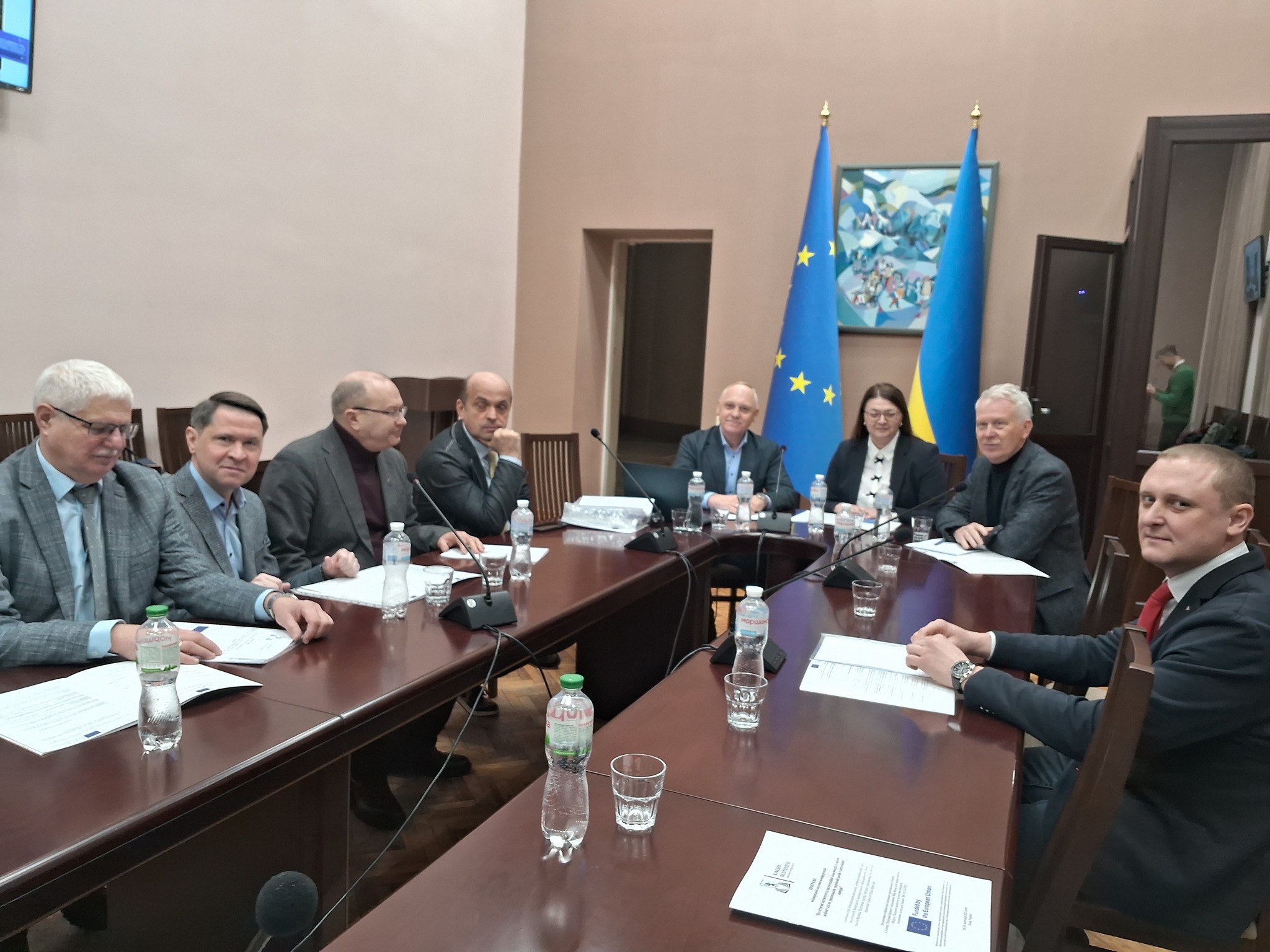
The Kuras Institute of Political and Ethnic Studies of the National Academy of Sciences of Ukraine was represented by senior researchers Nataliia Kononenko and Rostyslav Balaban, who presented studies on the state and prospects of political party development in Ukraine.
In his presentation, Rostyslav Balaban focused on the problem of the impossibility of forming classical European-type parties in Ukraine — a consequence of distorted conditions of political competition, weak party institutions, and the influence of oligarchic networks. He emphasized that the war further exacerbates the structural problems of the party system: political forces remain poorly organized, lacking internal democracy and stable ideological platforms.
Nataliia Kononenko devoted her presentation to internal imbalances in the functioning of the parliament and the government, highlighting how these imbalances affect political parties. She noted that the absence of competencies typical of parliamentary-presidential systems within parliamentary factions leads to a decline in the quality of lawmaking, reduced policy-making capacity, and the de facto weakening of parties as bearers of political responsibility. In her view, this represents one of the key structural challenges of Ukrainian politics — parties exist nominally but do not fulfill their classical functions, which complicates institutional modernization.
Over the course of two days, conference participants also discussed issues of digital democracy, institutional capacity, the legitimation of power under wartime conditions, the transformation of political processes, and the search for models capable of ensuring the stability and resilience of democratic institutions.