
THE UNIVERSITY OF WARSAW HOSTED THE CONCLUDING SEMINAR OF THE INTERNATIONAL SCIENTIFIC PROJECT “STATE STRUCTURE IN ACTION”
On June 11, 2026, the University of Warsaw hosted the twelfth and final scientific seminar within the framework of the international research project “State Structure in Action: The Impact of Political System Types on the Quality of State Institutions’ Functioning. Polish and Ukrainian Experience and Perspectives.” For a year and a half, this project brought together Ukrainian and Polish scholars around current issues concerning the development of democratic institutions and public governance in our countries.
The seminar’s work was attended by researchers from the Department of Political Institutes and Processes: Candidates of Political Science Nataliia Kononenko and Rostyslav Balaban, and Doctor of Political Science Tetiana Liashenko.
The theme of the final meeting was dedicated to local self-government and decentralization reforms in Ukraine and Poland. Rostyslav Balaban delivered a report titled “Decentralization Reform in Ukraine.” The scholar noted that the decentralization reform is one of the most successful in Ukraine, having strengthened the agency of communities and the territorial consolidation of the state. The reform, launched in 2014–2015, led to the creation of 1,469 capable territorial communities instead of more than 11 thousand, the consolidation of districts (raions), and a significant increase in local budgets due to retaining a portion of taxes locally. At the same time, the reform requires further legislative formalization, constitutional consolidation, and the development of local democracy for successful post-war reconstruction and European integration.
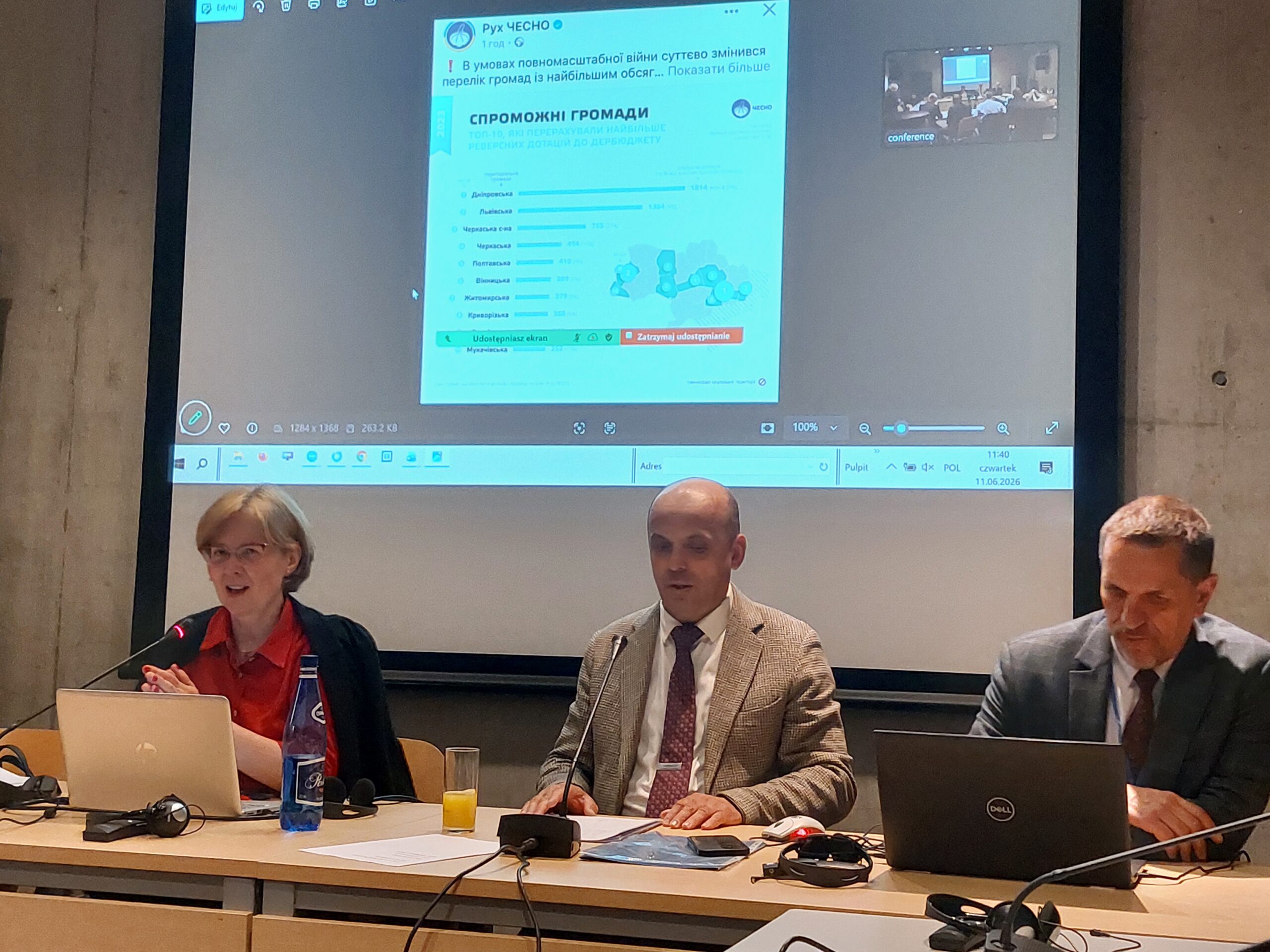
On the Polish side, Professor Jarosław Flis spoke on the topic “The Significance of Local Self-Government for Political Life in Poland: Advantages and Disadvantages.” The author noted that local self-government plays a key role in Poland’s political life due to its three-tier administrative division (gminas, powiats, voivodeships) and the significant autonomy of communities. The author emphasized the stability of the system, its historical roots, and advantages such as the flexibility of division and the importance of gminas as the foundation of self-government. Meanwhile, the author pointed out certain shortcomings, particularly tension between levels of government, clientelism in resource distribution, political favoritism, and dependence on EU funds.
The discussion was joined by Ukrainian and Polish participants of the project: Professor Agnieszka Dudzińska, Professor Antoni Kamiński, Deputy Director for Research Professor Halyna Zelenko (online), as well as staff members of the Department of Political Institutes and Processes, Candidate of Political Science Nataliia Kononenko, and Doctor of Political Science Tetiana Liashenko.
The final seminar served not only as a platform for professional discussion but also as an opportunity to summarize the fruitful cooperation within the project. Over the course of twelve scientific seminars, the participants examined a wide range of issues related to state structure, political institutions, governance mechanisms, and democratic transformations in Ukraine and Poland.
The implementation of the project contributed to strengthening the Ukrainian-Polish scientific dialogue, exchanging experience between researchers, developing international academic ties, and elaborating new approaches to the analysis of contemporary political processes. The seminar participants expressed confidence that the results achieved within the project will become the foundation for further joint research and new international initiatives.