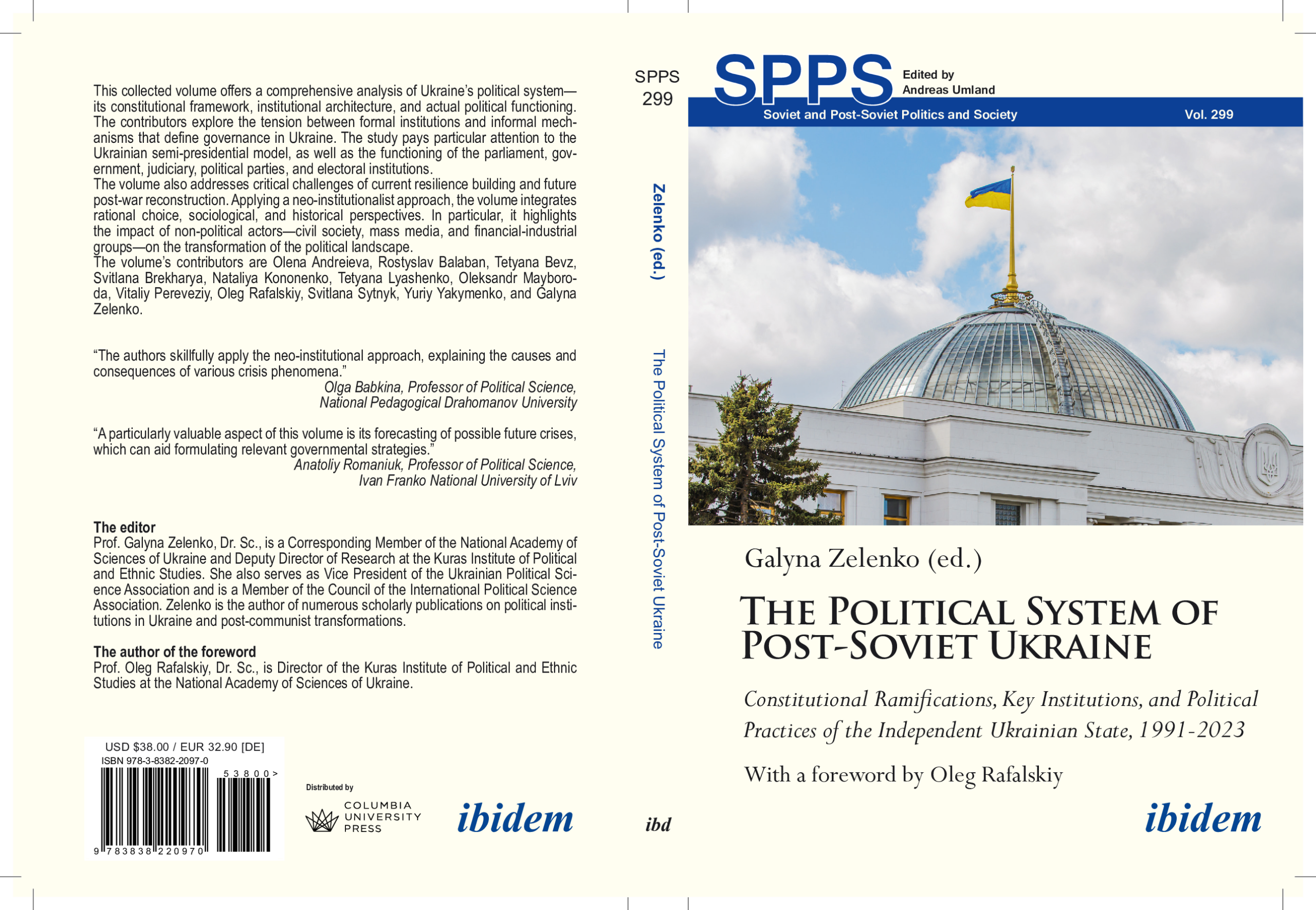
MONOGRAPH «THE POLITICAL SYSTEM OF POST-SOVIET UKRAINE: CONSTITUTIONAL RAMIFICATIONS, KEY INSTITUTIONS, AND POLITICAL PRACTICES OF THE INDEPENDENT UKRAINIAN STATE, 1991–2023»
The collective English-language monograph The Political System of Post-Soviet Ukraine: Constitutional Ramifications, Key Institutions, and Political Practices of the Independent Ukrainian State, 1991–2023 has been published in the prestigious international book series Soviet and Post-Soviet Politics and Society (Vol. 299) by the German academic publisher ibidem-Verlag.
The volume was edited by Galyna Zelenko, Corresponding Member of the National Academy of Sciences of Ukraine, Doctor of Political Sciences, Professor, and Deputy Director for Research at the I. F. Kuras Institute of Political and Ethnic Studies of the National Academy of Sciences of Ukraine.
The monograph offers a comprehensive analysis of Ukraine’s political system, its constitutional foundations, institutional architecture, and political practices during the period from 1991 to 2023. Particular attention is devoted to the interaction between formal and informal institutions, the peculiarities of Ukraine’s semi-presidential model, and the functioning of parliament, government, judiciary, political parties, and electoral institutions. A separate chapter examines the challenges of state resilience under conditions of war and discusses prospects for post-war reconstruction.
The authors of the volume are scholars of the I. F. Kuras Institute of Political and Ethnic Studies of the National Academy of Sciences of Ukraine: Rostyslav Balaban, Tetiana Bevz, Svitlana Brekharia, Nataliia Kononenko, Tetiana Liashenko, Oleksandr Maiboroda, Vitalii Perevezii, Oleh Rafalskiy, and Svitlana Sytnyk.
The foreword was written by Oleh Rafalskiy, Director of the I. F. Kuras Institute of Political and Ethnic Studies of the National Academy of Sciences of Ukraine and Academician of the National Academy of Sciences of Ukraine.
Among the topics covered in the monograph are Ukraine’s form of government, parliament and parliamentarism, the party system, the role of civil society, financial-industrial groups, the judiciary, as well as constitutionalism and the institutional capacity of the state. The volume concludes with an authorial afterword by Galyna Zelenko, devoted to institutional resilience and the political trajectories of Ukraine’s future development.
The publication of this volume will contribute to the broader international visibility of research conducted by Ukrainian scholars and will further promote Ukraine-focused political science scholarship within the global academic community.
Contents by link.