
On June 20, 2022, an international online discussion “Aid During the War” was held with the participation of Ukrainian, Polish and German historians and political scientists. Among the participants of the discussion was a leading researcher of our Institute Anatoliy Podolskiy. During the discussion, the problems that arose among scientists, teachers of institutions of higher education and secondary schools of Ukraine during the war and Russian aggression against our country were discussed, possible ways of financial and other aid to Ukrainian researchers and teachers were discussed.
The discussion was held in German and English. The discussion was also attended by Polish scientist Eliza Gaust from the Centrum Dialogu in Łódź, German historian Dr. Christine Glauning from the Leiterin des Dokumentationszentrum NS-Zwangsarbeit, Ukrainian researcher Lyubov Danylenko, who is currently an expert at NS-Zwangsarbeit / Partnerin d. Hilfsnetzwerk für Überlebende der NS-Verfolgung.
The online discussion was organized by the German institution “Nazi Crimes Victims Aid Network”. The online events of this foundation will take place from June 18 to 29, 2022 and are aimed at uniting efforts to help Ukrainian scientists. “Nazi Crimes Victims Aid Network” Hilfsnetzwerk für Überlebende der NS-Verfolgung in der Ukraine is a union of 48 memorials, museums, communities and initiatives in Germany. Since its creation, the members of the network have been the StiftungDenkmal Memorial to the Murdered Jews of Europe – FoundationMemorial.
The network provides assistance to people who survived Nazi persecution and their families. Assistance is also provided to Ukrainian colleagues (historians, political scientists, museum workers, teachers, journalists) who find themselves in a crisis situation due to Russia’s war against Ukraine.
The text of the monograph by T. A. Bevz “Regional political elite of Sumchina region: values, identities, political behavior” is posted on the website of the Institute, in the section “Our publications”.
The monograph analyzes the source and historiographical base of the research. Against the background of the analysis of all-Ukrainian elite processes, the formation and development of regional elites of Sumy region in the period from the end of 1991 to 2021 is studied. The transformation of regional political elite identities and its political values is revealed. The policy of regional identity is determined by the culture of regional elites, their conceptions about the past and future of the region, the country. Regional political elites often contribute to the increase of polar and conflicting identities. In the process of studying political behavior, it was proved that the chosen line of behavior of the regional political elite of Sumy region was not always consistent, as it was influenced by many environmental factors and individual characteristics of the elite.
On June 9, Hryhorii Skovoroda University in Pereiaslav hosted an international scientific and practical conference entitled “Transitional Society of the Post-Soviet Type: Problems of Searching for the Paradigm of Development”. One of the co-organizers of the conference was the Kuras Institute of Political and Ethnic Studies of the National Academy of Sciences of Ukraine.

Participants of the international scientific-practical conference
At the beginning of the scientific event, the Rector of the University – Doctor of Historical Sciences, Professor V. V. Kotsur awarded the Deputy Director for Research of the Kuras Institute of Political and Ethnic Studies of the National Academy of Sciences of Ukraine, Doctor of Historical Sciences, Professor, Corresponding Member of the National Academy of Sciences of Ukraine O. M. Mayboroda with the University Award “Order of Prince Volodymyr Monomakh”, noted the long and fruitful cooperation of the University with our Institute.

Oleksandr Mayboroda receives a University award
The work of the international scientific and practical conference focused on the following areas:
- current problems of modern transitology;
- power and institutions of power in the transitional society;
- socio-cultural contexts of democratic modernization of post-Soviet society;
- problems of forming the identity of a transitional society in the context of globalization;
- political and administrative structures in the conditions of democratic transit of the post-Soviet society;
- political and economic processes in the transitional post-Soviet society;
- democratic transformation of post-Soviet societies in the context of European integration processes;
- ethno-national problems of post-Soviet society.

During the scientific and practical conference
The conference participants worked in the format of two scientific briefings. On the first – “Institutional aspects of democratization of post-Soviet transformation in the context of European integration” reports were made by researchers of our Institute: Doctor of Historical Sciences, Professor, Corresponding Member of the NAS of Ukraine O. M. Mayboroda, Doctor of Political Sciences, Professor V. A. Voynalovych, Doctor of Historical Sciences, Professor Yu. O. Nikolaiets, Doctor of Political Sciences T. M. Lyashenko, Doctor of Political Sciences, Associate Professor O. Yu. Kondratenko, Candidate of Political Science, Associate Professor A. M. Degterenko, Candidate of Historical Sciences O. O. Lyashenko, Candidate of Historical Sciences V. V. Novorodovsky, Candidate of Philosophical Sciences E. V. Shcherbenko.

Yuriy Nikolaiets gives a speech
At the second briefing “Political and cultural and ethno-national contexts of modernization of post-Soviet society” spoke Doctor of Political Science, Professor O. Ya. Kalakura, Candidate of Political Science R. V. Balaban, Candidate of Historical Sciences L. I. Mazuka, Candidate of Historical Sciences L. L. Kovach and Candidate of Philosophical Sciences O. O. Chorny. In total, 115 scientists took part in the conference.

Rostyslav Balaban gives a report
Program of the international scientific and practical conference
On June 10, 2022, the XII International Scientific and Practical Conference “Social Forecasting and Designing of the Future: Changes in Global Security as a Challenge to Peacemaking and Mediation” was held at Zaporizhzhia National University.
More than 100 scientists from research institutions, higher education institutions, non governmental associations and government officials from Ukraine, Georgia, Lithuania, Poland, Slovakia, Turkey and the United States of America participated in the organization and participation in the discussions in plenary and sectionary sessions (conference program).
Doctor of Political Science, Professor, Head of the Department of Kuras Institute of Political and Ethnic Studies of the National Academy of Sciences of Ukraine, President of the Ukrainian Academy of Political Sciences Victor Oleksiyovych Kotygorenko spoke at the plenary session of the conference with the report “Ethnopolitical Security of Ukraine: Challenges and Response Options”

During the international scientific and practical conference
The work of the sessional meetings was organized in four directions:
- “Social forecasting: methodology of research and formation of the worldview of the subject of peacemaking”
- “Prospects for modernization of the political system of Ukraine and changes in the world order”
- “Philosophy of Public Administration and Local Self-Government”
- “European philosophical education and creative industries in the context of peacekeeping. The future of the social sphere in the context of human development and the implementation of peace policy “
During the section meetings, the participants of the international scientific and practical event discussed current issues. Following the results of the international scientific and practical conference, an appropriate resolution was adopted.
On June 7-8, 2022, the Taras Shevchenko National University of Kyiv hosted an international scientific and practical conference “Globalization Challenges: Government of the Future”. The conference is dedicated to the exchange of knowledge and experience, discussion of current issues in the context of globalization challenges in today’s conditions (conference program).
The conference was attended and addressed by researchers from the Kuras Institute of Political and Ethnic Studies of the National Academy of Sciences of Ukraine: Doctor of Historical Sciences, Professor, Chief Researcher of the Department of Theory and History of Political Science Tetyana Bevz, Doctor of Political Sciences, Professor, Chief Researcher of the Department of Political Institutes and Processes Mariya Karmazina and Candidate of Historical Sciences, Senior Researcher Department of Theory and History of Political Science Mykola Gorbatiuk.

During the scientific and practical conference
The topic of T. Bevz’s report was: “Tools for optimization of the government activities in conditions of wartime”. In the report, the scientist noted that in conditions of the war, the algorithms of government agencies at the central and local levels have changed. Central and local governments work as one whole and, largely due to this, the country’s governance system has been preserved. The Verkhovna Rada of Ukraine worked in a “turbo regime” and the “defense coalition” worked on the principles of consensus, which meant making important and determined decisions at a special conciliation council with minimal discussions in the session hall. Emphasis was placed on optimizing the structure and quantitative composition of public authorities by reducing inefficient functions and deconcentrating of power; to increase the autonomy of the work of ministries in the context of Ukraine’s possible acquisition of the status of a candidate for membership in the European Union; on the approval of the trend of increased intolerance to corruption; to agree on the government’s program for plans of the country recovery; optimization of public spendings in wartime; the role of civil servants in the war and postwar periods; on the problem of remote work and emigration.
Professor Mariya Karmazina made a report “Activities of political parties in the context of national security of Ukraine (period after February 24, 2022)” at the session of the section “Problems of providing national security in modern conditions.” Mykola Gorbatiuk, a Senior Researcher, delivered a report on the topic: “War and Decentralization: Realities and Prospects of Local Self-Government in Ukraine in the New Geopolitical Conditions.”
On June 2-3, 2022, the West Ukrainian National University (Ternopil) hosted the International Scientific and Practical Conference “Transformational Processes of the Social and Humanitarian Sphere of Modern Ukraine in the Conditions of War: Challenges, Problems and Prospects”. The international scientific event brought together academic scientists, educators, social and humanitarian sphere practitioners, and university students. Representatives of leading institutions of Ukraine, USA, Turkey, Austria, Poland, Slovakia, and China responded to the proposal of scientific communication. The scale of the event is evidenced by the participation of more than 50 participating universities and partners of the West Ukrainian National University. Coordinated interaction of co-organizers of the conference – Ukrainian Scientific-Methodological Center for Practical Psychology and Social Work of the National Academy of Pedagogical Sciences of Ukraine, Ivan Franko National University of Lviv, Skovoroda Kharkiv National Pedagogical University, partners from the Catholic University of Ruzomberok (Slovakia), Higher School of Management and Administration (Poland), a significant number of participants (about 300, including more than 70 doctors, professors) became an indicator of high professionalism of scientists and the difficulty of forming a single integrated social and humanitarian space of Ukraine during the war (conference program).

During the International Scientific and Practical Conference
Our Institute was one of the partners participating in this international event. The scientific committee of the conference included Doctor of Historical Sciences, Professor, Chief Research Fellow of the Department of Theory and History of Political Science of our Institute Tetyana Bevz.

Tetyana Bevz
Bevz took part in the work of the plenary part of the conference. The scientist’s report – “The idea of «unity» in the diplomatic discourse of the state during the war” – was devoted to the problems of the development of public diplomacy, the concept of «unity», which during the war became especially important for Ukrainian diplomacy and for defining its main tasks – development of the main directions of content and strategic communications for public diplomacy, the use of modern communication channels in the report of key messages, the consideration and inclusion of strategic communications in the agenda of countries and organizations where relevant measures are implemented. Diplomatic efforts during the war, the speaker stressed, are extremely important. Ukraine has set a precedent for the unprecedented unity of the democratic world around the emotion of genuine admiration for Ukrainian courage and around the understanding that freedom must be fought for and European unity must be strengthened.
Maria Karmazina, Doctor of Political Science, Professor, Chief Research Fellow of the Department of Political Institutes and Processes of our Institute, took part in the conference and presented a report “90 Days of the Full-Scale Russian Invasion of Ukraine: Diplomatic Achievements of the President of Ukraine”.
During the section “Historical and socio-cultural dimensions of Ukrainian scientific discourse in today’s conditions” with the report “Overcoming negativism in the public consciousness as a factor in the development of Ukrainian national identity” spoke PhD, researcher at the Department of Theory and History of Political Science Institute of Kuras Institute of Political and Ethnic Studies of the National Academy of Sciences of Ukraine Oleksandr Chorny.
On May 24-25, Qatar hosted the 14th Conference on Interreligious Dialogue, which brought together religious leaders – representatives of various currents of Christianity, Islam and Judaism, scholars, statesmen from 49 countries.
At the Conference, the theme of which this year was “Religions and Hate Speech. Sacred texts and practices”, the report was made by the Chief Researcher of our Institute Viktor Yelenskyi. On the example of the doctrinal evolution of the socio-theological thought of the Moscow Patriarchate, he showed how the theory and practice of dehumanizing the “other” grew out of the language of enmity. This dehumanization goes through stages of desecration of the sanctities of the “other”, then – the denial of his right to his own identity and existence as “another” to the denial of the right to physical existence as such.
The speaker stressed that the radical break between the Moscow Patriarchate and its own social concept coincided with the internalization and sacralization of the doctrine of the “Russian world”, now condemned by leading Orthodox theologians and scholars as ethnophiletic and heretical. Viktor Yelenskyi pointed out the factors that turn hate speech into the speech and practices of hatred and, ultimately, the legitimization of war to destroy the object of hatred. He called on the religious and political leaders participants of the Conference to take concrete steps to prevent any involvement of instigators of war in membership in interfaith world and regional organizations, to inevitably punish them and to establish mechanisms to respond effectively to religious justification of aggressive wars and violence.
On May 20, 2022, the International Scientific and Practical Conference “Theory and Practice of Public Administration” was held in the Academy of Public Administration of Moldova. Representatives of Moldova, Romania, Poland and Ukraine took part in the conference.
Tetiana Vasylevska, Doctor of Science in Public Administration, Professor of the Educational and Scientific Institute of Public Administration and Public Service of the Taras Shevchenko National University of Kyiv, made a welcoming speech on behalf of Ukraine.
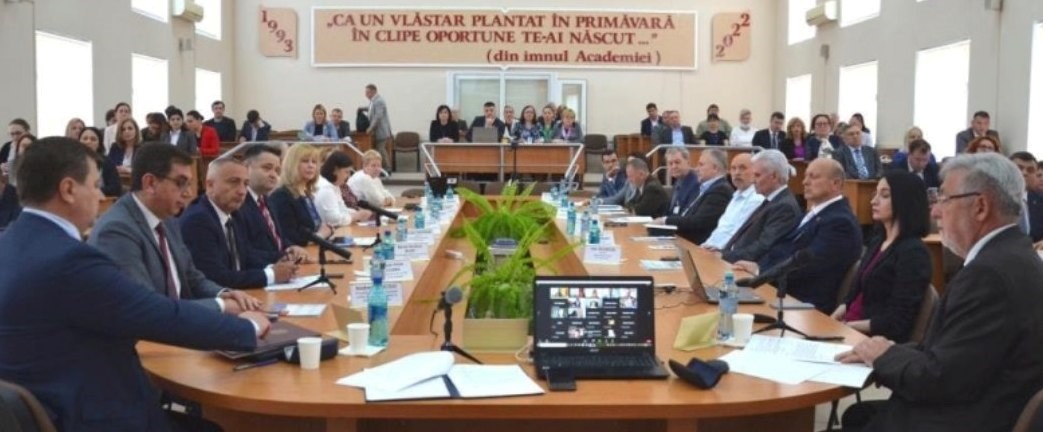
International scientific-practical conference
at the Academy of Public Administration of the Republic of Moldova
Tetyana Bevz, Doctor of History, Professor, Chief Research Fellow of the Department of Theory and History of Political Science of our Institute, took part in the conference and made a report within the work of the section “Actual Problems of Political Science and Integration Processes”. The topic of the scientist’s report is “National identity in the context of globalization”.
In her speech Tetyana Bevz noted that in the 21st century national identity differs from the national identity of other historical periods so that “in the global era, national identity is both stronger through effective nation-building strategies and much more open to foreign influences that cannot be controlled and not allowed into the national space”.

During the conference
The speaker stressed out that the full-scale invasion of the Russian Federation into Ukraine created a new reality, strengthening the feeling of political unity and state identity of Ukrainians. Ukrainians have proved to themselves and to others that they exist as a nation that has a civic and national identity and is able to defend its independence, territorial integrity and unity.
May 12, 2022, a leading researcher at the Kuras Institute of Political and Ethnic Studies of the National Academy of Sciences of Ukraine Anatoliy Podolskiy gave a lecture on the Ukrainian resistance during the war in Ukraine and the Russian aggression, which has been going on for more than three months.
It was an online conference held at the French Cultural Center in Tokyo. The event was attended by about 200 students, high school students and their teachers. The audience was represented by seven countries in the Pacific region: Japan, Australia, Cambodia, China, South Korea, Indonesia and Vietnam.
Among the listeners were future historians, geographers, political scientists, and geopolitics specialists. The participants of the conference expressed their support for Ukraine in the difficult times of the military confrontation with Russia, and wished them a fastest victory over the Russian invaders and occupiers.
The problems highlighted by A. Podolskiy during his lecture focused on the need to rethink the events of World War II under the influence of modern Russian aggression and Ukraine’s struggle for its own identity, freedom and Ukrainian statehood. Emphasis is placed on comparing the war crimes of Hitler’s Germany and modern rushism.
The English-language video conference was a notable educational event for the Asia-Pacific region of AEFE educational institutions. Several international French universities and high schools from Tokyo, Hana, Phnom Penh, Jakarta, Shanghai, Sydney, Seoul and Kyoto joined the scientific and educational event.
On May 23, Dr. Mykola Riabchuk, the Senior Research Fellow oy, took a part in the conference on “Russia’s war in Ukraine and the End of the Post-Cold War Era: European and Historical Contexts” at Stockholm University. He delivered a keynote speech at conference opening under the title “In Spite of the Obvious: Ukraine and the Crisis of Realpolitik” – with a sharp critique of the so-called “realist” approach to international relations, in particular to the ongoing Russo-Ukrainian war. There is nothing wrong with the “realism”, he argued, as long as it stands for a sober assessment of political situation and capacities of the political actors. But, rather often than not, the presumed “realism” is employed as a mere disguise for a cynical sacrifice of the professed liberal democratic (a.k.a. “Western”) values for the sake of particular interests and corporate benefits.

During the discussion
At the end of the conference, Dr. Riabchuk also took part in the last, third discussion panel where he addressed the conference concluding topic “Ukraine and/in the world: Scenarios of the future”.
On May 18-20, 2022, the IV International Scientific Conference “Euro-Atlantic Security and Policy of the Russian Federation” was held online, organized by the Institute of Security Sciences of the Jan Kochanowski University (Poland), the NATO-DEEP Center for Defense Enhancement (Belgium) and the Center for European Policy Analysis in Washington (USA).

The conference was attended by the Head of the Department of Political Institutes and Processes of our Institute, Doctor of Political Sciences, Professor, Corresponding Member of the National Academy of Sciences of Ukraine Galyna Zelenko.

Galyna Zelenko
In her report, G. Zelenko substantiated the groundlessness of Russia’s accusations of Nazism against Ukraine and that the “junta” rules in Kyiv. She stressed that for the first time in the history of Ukraine, the President of Ukraine, who in 2019 became V. Zelensky, was elected by 74% of citizens with a turnout of almost 70%. The legitimacy of the election was recognized by all observers, both from the governments of the world and from reputable international organizations.
As for the accusations of Nazism, G. Zelenko drew the participants’ attention to the fact that in the conditions of military aggression the surge of nationalism is a completely natural reaction of the society. At the same time, ideological nationalist forces in Ukraine have always had illusory parliamentary prospects. Nationalist parties (primarily the well-known “Right Sector”) received less than 2% of the vote in the 2014 parliamentary elections. According to the results of the 2019 parliamentary elections, the nationalist parties Svoboda, the Right Sector, the National Corps, and the Democratic Ax together received only about 3% of the votes. Therefore, nationalism should not be entangled with patriotism, which is really a characteristic feature of modern Ukrainian society, patriotism, without which Ukraine would not be able to resist Russian military aggression.
The text of the monograph “Civilizational Identity of Ukraine: History and Modernity” is posted on the Institute’s website in the “Our Publications” section.
The monograph was prepared by a team of scientists consisting of: O. Rafalskiy (head of the team of authors), O. Kalakura (scientific editor), M. Yurii.
The monograph examines the phenomenon of Ukrainian civilizational identity, its origins, becoming and current condition in the context of humanitarian interdisciplinarity, combination of historical, philosophical, politological, sociological and cultural methods of cognition, from the standpoint of civilizational, anthropological and sociocultural approaches.
Theoretical and methodological principles of the essence of civilizational identity, its structure: ethnic, national, cultural, religious, political, civic, european and other components, the relationship of civilizational identity with mentality and globality in the dynamics of historical progress and transformations since the era of Middle Ages, Kyivan Rus state, Renaissance, modern and ending with postmodern are being clarified. The historical mission of the Ukrainian Cossacks as the bearer of new features of national identity is shown, the civilizational self-determination of Ukrainian identity at the turn of the XIX-XX centuries, the role of conscious, social psychology and national idea in the transformation of identity are being tracked, the causes of the crisis and the split of identity in the conditions of totalitarianism, its devastating consequences for the identificational process of Ukrainianness in general are shown.
Central place is given to the research of the specifics of civilizational identity of independent Ukraine, the role of its components – ethnic, religious, national, civic and European identity, the impact of international relations, democratization of the society, digitalization and globalization of the modern world, Russia’s aggressive politics on identification processes is clarified. The ways of preserving Ukrainian identity in a foreign environment, the role of foreign Ukrainianness in the formation of civilizational identity are highlighted. A number of proposals for further research of the problem, the roles of the state and civil society in activation of the identification process in modern Ukraine and its prospects are expressed.
Made for scientists, lecturers of history, philosophy, cultural studies, sociology, social psychology, political science, ethnology, teachers, graduate students and undergraduate students, all those who are interested in Ukrainian history, methodology of its civilizational, anthropological and sociocultural knowledge.
The edition is dedicated to the bright memory of professors Ivan Kuras, Yuriy Levenets, Mykola Mykhalchenko, Larysa Nagorna, May Panchuk and other Ukrainian ethno-political scientists who passed away.
The text of the monograph (PDF)
On May 17, the All-Ukrainian Scientific and Practical Conference “Ukraine in the Context of Socio-Humanitarian Challenges of the Present: Historical Experience and Prospects” took place online at the Hryhorii Skovoroda University in Pereiaslav.
One of the co-organizers of the scientific event was Kuras Institute of Political and Ethnic Studies of the National Academy of Sciences of Ukraine.
The participants of the conference focused on the discussion of socio-humanitarian challenges, actual political, socio-cultural, religious and nation-building issues of national history in the context of the “hot phase” of the Russian-Ukrainian war, noted on the importance of the intellectual component of resisting the Russian aggression.
Doctor of Political Science, Professor, Head of the Department of Political Culture and Ideology of the Kuras Institute of Political and Ethnic Studies of the National Academy of Sciences of Ukraine Victor Voynalovych made a report on “The Religious Front of the Russian-Ukrainian War: Global and National Potential Consequences” at the plenary session.

During the online conference
During the sectional meetings and in the theses of speeches prepared by the participants were highlighted through the prism of socio-humanitarian problems current issues of socio-political and socio-economic development of Ukraine XX – early XXI century; nation-building, religious and socio-cultural processes in Ukraine; problems of local lore and regional studies of national history.
The discussion was held in the following areas:
- Socio-political and socio-economical slice of the history of Ukraine in the context of socio-humanitarian problems of the XX – XXI centuries.
- History of everyday life and Civil defense in Ukraine.
- Russian-Ukrainian war: civilizational and socio-humanitarian challenges of the Present.
- Nation-building, religious and socio-cultural problems of Ukrainian history.
- Scientific and educational area of Ukraine: traditions and prospects.
- Actual issues of national and patriotic education in Ukraine.
- Socio-humanitarian studies in historiographical heritage.
- Local lore, tourism and regional aspects of socio-humanitarian research.
The sectional meetings of the conference were attended by researchers and graduate students of our Institute: Doctor of Historical Sciences, Professor Bevz T. A., Doctor of Political Sciences, Professor Kalakura O. Ya., Doctor of Political Sciences, Professor Karmazina M. S., Doctor of Political Sciences, Associate Professor Kondratenko O. Yu., Doctor of Political Sciences, Associate Professor Yaremchuk V. D., Candidate of Political Sciences, Senior Researcher Scientist Zorych O. O., Candidate of Historical Sciences Kovach L. L., Candidate of Historical Sciences Lyashenko O. O., Candidate of Pedagogical Sciences Machuskiy V. V., Candidate of Historical Sciences Novorodovsky V. V., Candidate of Philosophical Sciences Shcherbenko E. V., Graduate Student of the Institute Baranivska M. M.
In total, more than 100 participants took part in the conference.
Program of the scientific and practical conference
Dear colleagues!
Today is our professional holiday!
For 26 years in a row, according to the Decree of the President of Ukraine, every year – on the third Saturday of May – the professional holiday of Ukrainian scientists – Science Day is celebrated!
Science Day is a holiday of creative work people, whose activities are aimed at scientific progress and social consolidation, and which is a symbol of spiritual freedom and personal development.
We are going through hard times today. But, despite the difficult conditions of martial law, domestic scientists continue to work selflessly on implementation of scientific research programs, are engaged in volunteer activities, and help the Armed Forces of Ukraine, approaching our victory over the aggressor!

Victory, peace and prosperity to our native Ukraine!
To our scientists – inexhaustible energy, inspiration and new creative achievements!
May the desire for new knowledge never die out,
and inspiration always accompanies scientific activity.
Glory to Ukraine!
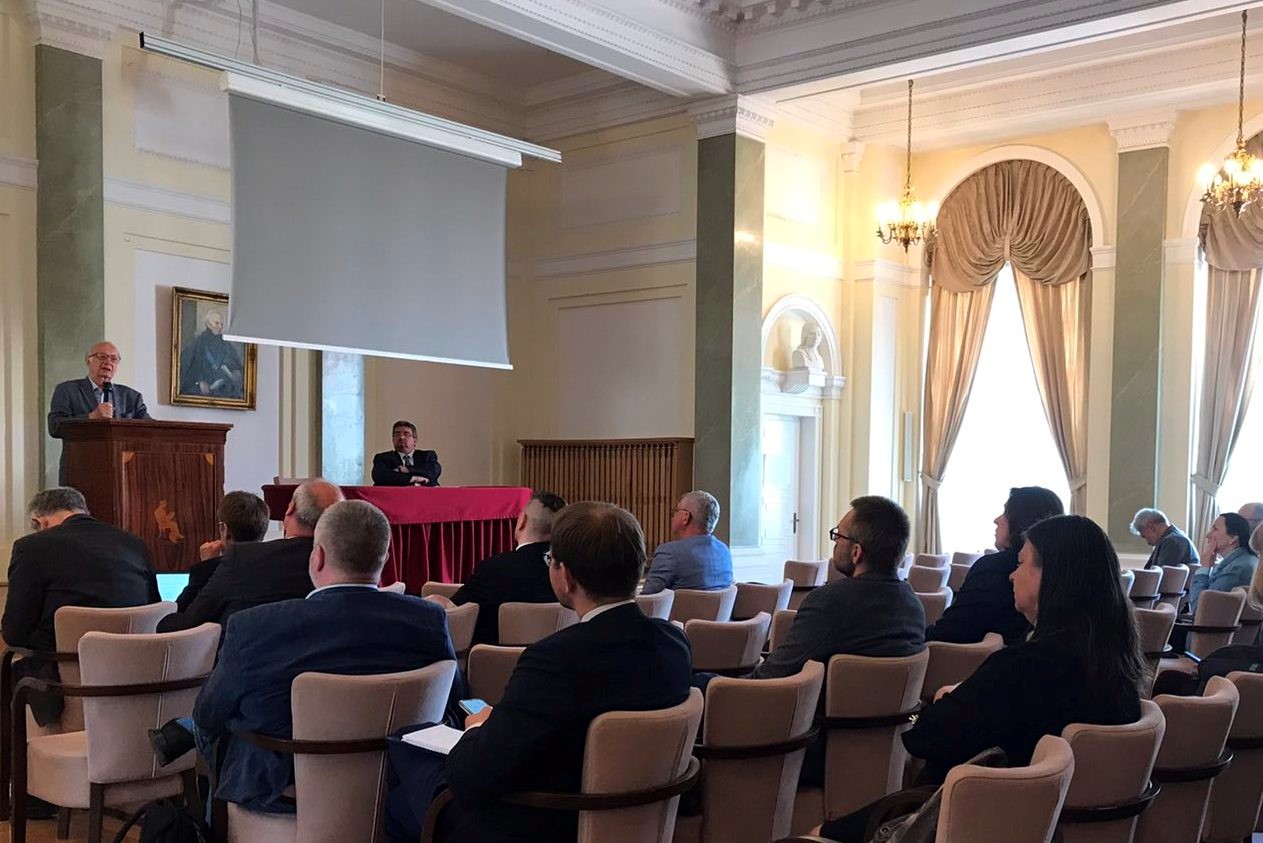
International seminar “Analogies and longevity. Russian crimes in Ukraine in terms of historical and genocide researches”
One of the participants of the seminar was the chief researcher of our Institute, Doctor of Historical Sciences, Professor Yuriy Shapoval. He made a report “How and whether historical analogies help us in understanding and assessing Russia’s current war against Ukraine.”

During the seminar
The seminar was organized by the Institute of Political Studies of the Polish Academy of Sciences, with which our Institute has a partnership.
On the website of the Institute, in accordance with the Resolution of the Presidium of the NAS of Ukraine dated on 06.04.2022 № 98, in the section «Our Publications» the text of the national report of the NAS of Ukraine «National resilience of Ukraine: hybrid threats challenge response and prevention strategy» was publicated.
The national report, prepared by the experts of the Section of Social Sciences and Humanities of the National Academy of Sciences of Ukraine, is an attempt to justify the concept of national stability (resilience) as the stability of the civilizational subject of the country in modern geopolitical conditions. To define its strategy to ensure the balance of development and successful counteraction to external and internal threats, including hybrid ones. The question of interaction of national resilience and national security of the state is investigated, the problem of institutional maintenance of strategy of national resilience is put.
Text of the National Report of the National Academy of Sciences of Ukraine (PDF)
The text of the monograph «Hierarchy of Values of the Population of the East and South of Ukraine: Ethnopolitical Aspect in the Context of Russian Aggression» prepared by the team of authors under the guidance of V. Voynalovych is posted on the Institute’s website in the section «Our Publications».
The monograph analyzes the essential content, condition and dynamics of value orientations of the population of the East and South of Ukraine, its social behavior and social practices in the conditions of Russian aggression. Based on the usage of a broad empirical base and the results of researches made by sociological services, the main ideologies of the «Russian world», the main channels of their spread over Ukraine and ways of adaptation to specific Ukrainian realities, prevalence and dynamics of national and civic values have been analyzed. The demographic distribution and evolution of linguistic identities and practices of the population of Eastern and Southern Ukraine, the dynamics of religious and confessional preferences of the population, features and nature of ethnocultural policy in the region, behavior and mobility of major actors in the ethnocultural sphere have been researched. Recommendations for the development and implementation of a social consolidation strategy have been formulated. The book is intended for scientists, politicians, activists of non-governmental organizations, all those who are interested in the problems of national development.
Leading researcher at the Kuras Institute of Political and Ethnic Studies of the National Academy of Sciences of Ukraine Anatoliy Podolskiy gave an open online lecture on the topic: “Ukraine at war. Historical parallels with the past. The pathway to victory over the enemy. Among the listeners were more than 150 teachers, PhD students and undergraduate students of the National University of Life and Environmental Sciences (NULES) of Ukraine.
Dean of the Faculty of Humanities and Pedagogy of the University Inna Savitska addressed the audience with an introductory speech. She stressed the urgency of the topic of the lecture, stressed that it is right now – in terms of martial law – appealing to our historical past will help us to understand the present, to a large extent – will determine the future.

Inna Savytska
During his lecture, Anatoliy Podolskiy drew parallels between history and the present: the extermination of Jews by Hitler’s Nazis and the Russian Federation’s genocide against the Ukrainian nation in Ukraine.

Anatoliy Podolskiy. During the online lecture
If people do not assimilate the lessons of history, A. Podolskiy stressed out, they are doomed for a repeat of them. The refrain of the speech was the statement: we will no longer be able to study the past, history, without drawing parallels with modern war. From now on, the experience of Ukrainians in occupation, captivity, and the experience of participants in hostilities will prevail over the historical military experience of mankind. “Enemies despise our past, they want to steal our memory. We are talking about our culture, our history, art, spiritual life “- said Anatoliy Podolskiy.
To discover more about the event
The text of Valerii Novorodovskyi’s monograph “National minorities of Ukraine in the political processes of (1945-1991): scientific discourse” is posted on the Institute’s website in the “Our Publications” section.
In the monograph it is examined the scientific discourse of the problem of participation of national minorities in the socio-political life of the Ukrainian SSR in 1945–1991, systematized the existing scientific knowledge on this issue and summarized the main problems of Soviet national policy. The comprehensive research of Soviet, modern Ukrainian and foreign scientific literature is carried out, the main directions of scientists research are singled out and development trends are revealed. A number of problems of historical and ethno-political science raised by scholars are covered.
At its meeting on April 14, 2022, the The National Agency for Higher Education Quality Assurance (NAQA) decided to accredit an educational and scientific program for training doctors of philosophy in the field of knowledge “05 Social and Behavioral Sciences” in “052 Political Science” of the Kuras Institute of Political and Ethnic Studies of the National Academy of Sciences of Ukraine.
The NAQA expert group highly appreciated the level of training of scientific personnel at the Institute and based on the results of professional expertise came to the conclusion that the educational program meets the evaluation criteria.
The decision to accredit the educational and scientific program is published on the official website of the National Agency.
Scientific journal «POLITICAL STUDIES»
Новини
Оголошення

