
Collective monograph “The political field of Ukraine in a situation of social crisis: authority, opposition, political parties, non-governmental organisations” was published. (more…)
On April 29, 2021, the Institute of Political Studies of the Polish Academy of Sciences and the editorial board of the journal Studia Polityczne held an online discussion on the topic: “The Way to Europe: Polish and Ukrainian Experience”. About 30 scientists from Poland and Ukraine took part in the scientific event.

This event was attended by the employees of Kuras Institute of Political and Ethnic Studies of the National Academy of Sciences of Ukraine – Doctor of Historical Sciences, Professor, Corresponding Member of the National Academy of Sciences of Ukraine Oleksandr Maiboroda, Doctor of Political Sciences, Professor Yuriy Shaihorodskyi and Doctor of Political Sciences, Professor Oleh Kalakura.
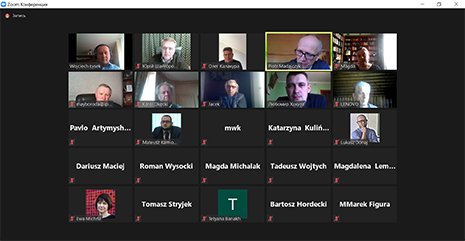
During an online discussion
The key issues of discussion were the problems of compliance of the state ethno-national policy of Ukraine with European criteria. During the discussion, problematic issues that arise in ensuring the state unity of Ukraine, the consolidation of its citizens into a common nation, the filling of national historical consciousness were raised.
The participants of the meeting stressed that the idea of federalization in Ukraine has no preconditions and is mostly part of Russia’s policy, its efforts to prevent Ukraine’s movement towards the European and Euro-Atlantic integration, to keep Ukraine within its imperial influence.
The participants of the discussion made proposals for deepening cooperation between Ukrainian and Polish scientists.
On April 26, 2021, the Head of the Department of theoretical and applied problems of political science of Kuras Institute of Political and Ethnic Studies of the NAS of Ukraine, Doctor of Political Sciences, Professor Halyna Zelenko gave an interview to the YouTube channel Ukr.life on the peculiarities of the political regime in Ukraine, which described the nature and causes of the clan-oligarchic regime in Ukraine, revealed the specifics of functioning formal and informal political institutions, showed the mechanisms of incorporation of the political class, assessed the process of de-oligarchization, which has become a top topic of Ukrainian political discourse in recent years.
The full version of the interview can be viewed here.
Chief Research Scientist of Kuras Institute of Political and Ethnic Studies of the NAS of Ukraine, Doctor of Historical Sciences, Professor Tatiana Bevz took part in the III International Research Online Conference “Historical and Cultural Heritage: Preservation, Access, Use”. The conference took place on April 21-22, 2021. The scientific event was organized by the National Aviation University with the participation of the Central State Electronic Archive of Ukraine, the Lithuanian State New Archive and the Kaunas Regional State Archive (Republic of Lithuania). The conference was attended by 86 scientists from Ukraine, Lithuania and the Czech Republic. The main attention of the participants was paid to the activities of archival, museum and library institutions in the preservation, use and access to historical and cultural heritage.

During the conference
In her report “The problem of actualization of historical memory in the context of the political influence of regional elites” Tatiana Bevz stressed that historical memory not only shapes the picture of the past, but also constructs the meanings of the present. In Ukraine, the speaker stressed, the politics of memory is a symbolic resource not only of national but also regional elites, which, on the one hand, “can create a favorable ground for the growth of multiple and complementary identities”, and on the other – “can stimulate the growth of polar and conflicting identities”.

Tetiana Bevz
In conclusion, the speaker stressed that, given that the historical past is becoming an ideological present, the Ukrainian society needs a balanced state policy of national memory at both the national and regional levels.
On April 21, 2021, a round table was held on the topic: “Maidan as a postmodern revolution: problems of terminology” with the participation of historians, philosophers, political scientists, lawyers, culturologists and direct participants in the protests of modern times in Ukraine.
The round table was organized by the National Museum of the Revolution of Dignity.
The main issues for discussion were:
- The phenomenon of “revolution” and the definition of the term “revolution of a new type”. Transformation of meanings: driving forces and essential characteristics of new types of revolutions.
- “Maidan” as a generic concept for modern protest movements in Ukraine. Euromaidan as a revolution of the precariat: pro & contra. Euromaidan as a trigger of the Revolution of Dignity.
- “Protest movement”, “resistance movement”, “mass protest”: qualification of the phenomenon of civil protest.
The round table was attended by staff of Kuras Institute of Political and Ethnic Studies of the NAS of Ukraine – Doctor of Political Sciences, Professor, Head of the Department of Socio-Political History Maria Karmazina and Doctor of Historical Sciences, Professor, Chief Researcher of the Department Tatiana Bevz.
The full version of the round table can be viewed here.
Researchers from Kuras Institute of Political and Ethnic Studies of the National Academy of Sciences of Ukraine – Chief Research Scientist, Doctor of Historical Sciences, Professor Yuriy Shapoval and Leading Research Scientist, Candidate of Historical Sciences Anatoliy Podolsky took part in the research conference “The Ukrainian Liberation Movement during World War II: Memory vs. Propaganda”.
The conference was held on April 15-16, 2021 on the basis of the Faculty of History of Ternopil Volodymyr Hnatiuk National Pedagogical University with the support of Taras Shevchenko National University of Kyiv, the Ukrainian Institute of National Memory and the Embassy of Ukraine in the State of Israel. A peculiar impetus for holding a research conference on this topic was the discussion that unfolded in Ukrainian society around the naming of the stadium in Ternopil after Roman Shukhevych. The participants of the conference once again proved the need for a balanced scientific approach to a thorough and comprehensive analysis of the history of the Ukrainian liberation movement during the Second World War. The issues of instrumentalization of memory, the role of the individual in history, as well as the use of various political forces of problems related to the history of the Ukrainian liberation movement in the past and present were discussed.
During the two days of the conference, five panel discussions were held.
Researchers of our Institute took part in an online discussion on the topic: “Ukrainian dimension of the Second World War: remember everything”. The moderator of this scientific discussion was A. Podolsky.
In their speeches, Yu. Shapoval and A. Podolsky stressed the importance of building a realistic model of memory of the events of World War II, in particular – the activities of representatives of the Ukrainian national liberation movement during the Nazi occupation. In the Ukrainian historiography of the Soviet period, this topic was subjected to a total ban. Today, along with the history of the Holocaust, the Roma genocide, the fate of prisoners of war and forced laborers – has become one of the leading studies of domestic historians.
Professor J. Hrytsak, Professor O. Styazhkina, Associate Professor O. Yatyschuk, historian V. Nakhmanovych also took part in the discussion.
On April 15, 2021, Vasyl Stefanyk Precarpathian National University hosted the All-Ukrainian online scientific conference “Alexander Karpenko – a prominent Ukrainian historian, teacher, public figure” dedicated to the 100th anniversary of the birth of a prominent Ukrainian historian, teacher and public figure. He entered historiography as a researcher of the Ukrainian national movement of the first half of the twentieth century, made a significant contribution to the study of the history of the Western Ukrainian People’s Republic.
One of the co-organizers of the conference was our Institute, because O. Karpenko’s scientific activity was closely connected with our scientific institution – he long headed the Research Center for the Ukrainian National Liberation Movement (a joint unit of the V. Stefanyk Precarpathian National University and Kuras Institute of Political and Ethnic Studies of the National Academy of Sciences of Ukraine).
Opening the conference, the rector of Vasyl Stefanyk Precarpathian National University, Ihor Tsependa, recalling Oleksandr Karpenko, said: “When we remember our teachers, we have a future.”
The conference was attended by staff of Kuras Institute of Political and Ethnic Studies of the NAS of Ukraine – Chief Research Scientist, Doctor of Historical Sciences, Professor Tatiana Bevz and Leading Research Scientist, Doctor of Political Sciences Vyacheslav Yaremchuk.

Tatiana Bevz
In a report on “The Political Elite in the Conditions of Revolutions: A View from the Present,” Tatiana Bevz noted that the creation and functioning of the state always depended on the quality of the political elite or, as it was called at various times: aristocracy. For centuries, the “Achilles’ heel” of the Ukrainian statehood has been and remains the quality of the national political elite. This problem was urgent during the Ukrainian liberation struggle of 1917–1921, and remains unresolved even in our turbulent times.
The research conference in Ivano-Frankivsk, in fact, continues the cycle of scientific events with the participation of the Institute, during which on the eve of the 30th anniversary of Ukraine’s independence, scientists analyze and discuss the fundamental problems of Ukrainian statehood.
On April 13, 2021, Doctor of Historical Sciences, Professor, Corresponding Member of the National Academy of Sciences of Ukraine, Honored Worker of Science and Technology of Ukraine, Chief Research Scientist of our Institute Valery Soldatenko celebrates his 75th birthday.
On the eve of the anniversary, V. Soldatenko’s monograph ” Ukraine: the revolutionary era and the following decades: historical and historiographical essays.” was published.
The staff of the Institute sincerely congratulates the jubilee on his 75th birthday and wishes him good health, creative inspiration and new scientific achievements! (more…)
March 31, 2021 at the invitation of Rivne State University of the Humanities and NGO “Mnemonics” in the framework of the project “Paths of Memory” the leading research scientist of Kuras Institute of Political and Ethnic Studies of the NAS of Ukraine, Candidate of Historical Sciences Anatoliy Podolsky gave a lecture in online format “Ideology and practice of National Socialism. On the issue of the brutal crime of a totalitarian state against human communities in the twentieth century. “

Anatoliy Podolsky
The lecture was dedicated to the history of one of the most terrible totalitarian ideologies of the last century, the implementation of which led to millions of human victims who were absolutely not guilty of anything. The historian analyzed the path of the ideology of National Socialism: from the ideology of the political current, movement, ideology of one political party to the ideology of the Nazi state, considered the foundations of criminal state policy and practice of the Third Reich. The researcher also revealed the attitude towards the victims of Nazi ideology and regime and emphasized the structural similarity between Nazism and Communism.
How to classify totalitarian regimes, what are their fundamental features? What is totalitarianism? What is “Nazism” in terms of historical science? How did the grassroots political movement progress to the ideological core of the totalitarian state of the Third Reich – National Socialism? How and from what did people who found themselves outside the bounds of ideological acceptance suffer? After all, was the Nazi state the only one of its kind in the twentieth century? A. Podolsky’s lecture was devoted to these issues.

During the lecture in online format
Anatoliy Podolsky’s presentation opened a lecture hall dedicated to the events of the Second World War in Volyn. The lectures are held as part of the “Paths of Memory” project. The project aims are to foster a critical approach to the events of World War II in Volyn by introducing an inclusive model of collective memory among local residents, the community of educators, civic activists and public opinion leaders living in Rivne and Volyn regions.
The project “Paths of Memory” is implemented by the NGO “Mnemonics” in partnership with the NGO “Other Education” and “Centropa” with the friendly financial support of the EVZ Foundation.
The employees of Kuras Institute of Political and Ethnic Studies of the NAS of Ukraine, Doctor of Political Sciences, Professor, Head of the Department of Socio-Political History Maria Karmazina and Doctor of Historical Sciences, Professor, Chief Research Scientist of the Department Tetyana Bevz took part in the All-Ukrainian research and practical online conference “Philosophical, historiosophical and pedagogical aspects of the unity in the Ukrainian society in the framework of the XII International Exhibition “Modern Educational Institutions” and the Exhibition of Education Abroad “World Edu 2021”. The conference took place from March 31 to April 1, 2021. Its organizers were: The National Academy of Pedagogical Sciences of Ukraine, the Institute of Gifted Children of the National Academy of Pedagogical Sciences of Ukraine and the all-Ukrainian educational and information publication – the newspaper “Education and Society”. Philosophers, political scientists, historians, theologians, economists, social psychologists, educators, philologists, as well as educational practitioners – methodologists, managers, teachers discussed current scientific and practical problems, outlined possible ways to solve them. Among the issues discussed by the conference participants: citizenship and subjectivity of the individual; philosophical imperatives of the development of Ukrainian society; historical narrative as a trend of national security; citizenship and gifted personality as a potential for success of the state, etc.
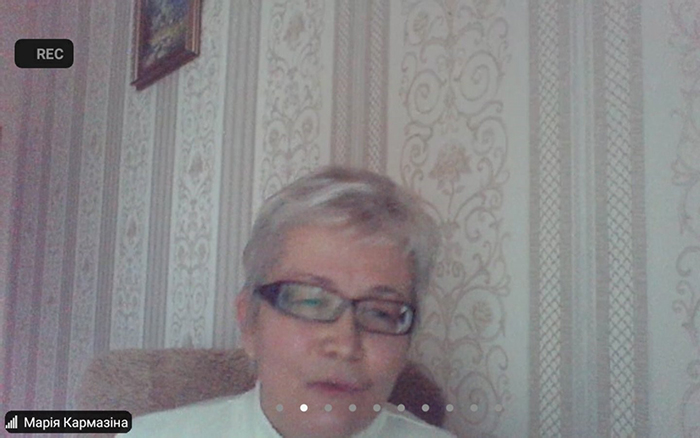
Maria Karmazina
MS Karmazina made a report “Political elites in Ukraine – a threat to the state and a challenge to society: an analysis of discourses.” She stressed that the elite are individuals who directly or indirectly influence political decision-making. The speaker focused on the latest research by foreign scholars and reflections of the Ukrainian authors; pointed out the undeveloped conceptual and categorical apparatus for elites in Ukraine and thematic gaps in their study. It was also about the closed and divided elites; their destructive power, lack of competence and professionalism; unpredictability of decisions; lack of self-esteem in the elite environment, focus on their own political future. Professor Maria Karmazina also actively participated in the discussion that took place during the conference.

Tatiana Bevz
Bevz’s report “Misinformation as a problem of national security: the challenges of today” stated that misinformation has become a phenomenon that becomes a global problem, significantly affects socio-political processes, is a tool that destabilizes the world and becomes a threat to national security of Ukraine. The speaker emphasized the negative impact of misinformation on the processes related to overcoming the spread of the COVID-19 pandemic, drew attention to the harmful effects of external influences and misinformation on security issues, as well as the ability of government and society to mobilize and respond effectively another challenge of modernity.
The delivered reports aroused interest and productive discussion by the participants of the all-Ukrainian research and practical event.
On the occasion of the 30th anniversary of the state independence of Ukraine, Kuras Institute of Political and Ethnic of the National Academy of Sciences of Ukraine in cooperation with the Taras Shevchenko National University of Kyiv, Institute of History of Ukraine of the National Academy of Sciences of Ukraine, M.S. Hrushevsky Institute of Ukrainian Archeography and Source Studies of the National Academy of Sciences of Ukraine, I. Krypakevych Institute of Ukrainian Studies of the National Academy of Sciences of Ukraine, the National Union of Local Historians of Ukraine initiated the organization of a series of scientific events in the form of a web discourse with the general title “Ukrainian state formation of the new age: controversial issues.” The organizers hope to start a professional discussion among scholars about the key stages of modern Ukrainian state formation, the causes, circumstances, nature of their course, the consequences of these complex processes for both today and the future of the Ukrainian people.
See more information (in Ukrainian) here
On March 22, an international online presentation of the Canadian researcher Alik Gomelsky’s book “Jewish-Ukrainian relations. Twentieth Century”, which was published thanks to the Kyiv publishing house “Ukrainian Priority” took place.
The specialists from Toronto, Jerusalem and Kyiv were among the participants. The meeting was attended by Chief Research Scientist of Kuras Institute of Political and Ethnic Studies of the NAS of Ukraine, Doctor of Historical Sciences, Professor Yuriy Shapoval, who also made a report.
The author of the book, the participants of the meeting noted, in his work touches on many issues, seeks to separate the truth from the propaganda stereotypes. In particular, it concerns assessments of Simon Petliura’s activities and shameful attempts to portray him as a Judaophobe, approaches to the activities of the OUN and its leaders, the KGB’s struggle against Jewish and Ukrainian nationalists, and so on. The speeches noted that constant attempts to sow confrontation in Jewish-Ukrainian relations were made by tsarist, communist Russia, and now by the Putin regime.
In his speech, Yu. Shapoval analyzed the content of the book, expressed critical remarks and wishes to the author, as well as he invited him to creative collaboration – participation in a large-scale publishing project – a series of books “Political Portraits”, initiated by the Center for Historical Political Science in Kuras Institute of Political and Ethnic Studies of the National Academy of Sciences of Ukraine in the Parliamentary Publishing House.
Kuras Institute for Political and Ethnic Studies of the National Academy of Sciences of Ukraine was recognized as the winner of the tender procedure for the procurement of consulting services in the field of scientific research (Development of a draft program of scientific research important for effective state policy of reintegration of temporarily occupied territories of Donetsk and Luhansk regions). The tender was ordered by the Ministry of Reintegration of the Temporarily Occupied Territories of Ukraine. On March 16, 2021, an agreement was signed between the Ministry and the Institute to perform the relevant works.
On March 8, 2021, the Razumkov Center hosted a round table on “Ukraine 2020-2021: unjustified expectations, unexpected challenges.”
During the round table there was a presentation and a discussion of the results of a study on this topic, conducted by the Razumkov Center. The employees of Kuras Institute of Political and Ethnic Studies of the National Academy of Sciences of Ukraine: Deputy Director for Scientific Work Oleksandr Maiboroda and Head of the Department of Theoretical and Applied Problems of Political Science Halyna Zelenko took an active part in the round table.
As a result of the discussion, the participants agreed on a general assessment of the current socio-economic and political situation. In particular, it was noted that despite the negative impact of the coronary crisis, the results of socio-political development of Ukraine in 2020 were less negative than expected. At the same time, the participants noted the lack of progress in resolving the conflict in Donbass, the lack of significant progress in the process of reforming the state, the deepening of socio-economic crisis.
Among the biggest challenges facing Ukraine in 2021, experts identified the fight against the spread of acute respiratory disease COVID-19, the Russian-Ukrainian armed conflict in Donbass, deteriorating socio-economic situation, radicalization of the political scene and the problem of de-oligarchizing, which was stressed by the President of Ukraine. V. Zelensky.
Paying attention to the current situation both in Ukraine and about Ukraine, the participants agreed with the predictive conclusions on the escalation of the conflict in Donbass and the further deterioration of the socio-economic situation, and expressed skepticism about the success of the government in the process of de-oligarchizing, as G. Zelenko noted, despite the de jure presence of a one-party majority, it is de facto absent. Therefore, neither the inventory of legislation nor the relevant decisions at the level of changing the rules of the game for big business, which could eliminate the gaps in the legislation that allow the formation of a clan-oligarchic regime in Ukraine, will be adopted extremely difficult or impossible.

March 11, 2021 Chief Research Scientist of Kuras Institute of Political and Ethnic Studies of the NAS of Ukraine, Professor, Doctor of Historical Sciences Yuriy Shapoval took part in an online meeting of the German-Ukrainian Commission of Historians. It was dedicated to a new joint German-Ukrainian scientific project to study school history textbooks. In addition, they discussed the preparation of a scientific conference on the study of the Holodomor of 1932-1933 in Ukraine, which is to take place in September 2021 in Berlin. The issues of co-opting new members of the Commission were also considered. The particular attention was paid to the relations of the Commission, co-chaired by Martin Schulze-Wessel (Germany) and Yaroslav Hrytsak (Ukraine) with the Ministries of Foreign Affairs of Germany and Ukraine.
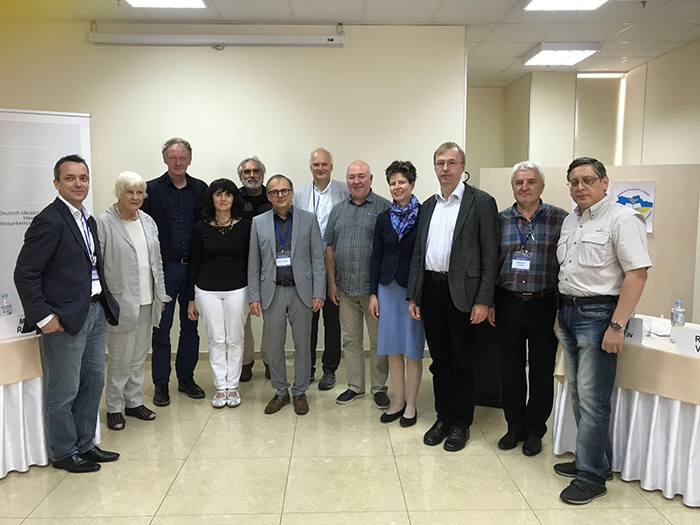
German-Ukrainian Commission of Historians (early 2020)
On March 4, 2021, an international research conference “Lviv Cathedral” in 1946: historical circumstances and modern assessments” was organized by the Institute of Church History of the Ukrainian Catholic University to celebrate the sad 75th anniversary of the so-called “Lviv Cathedral” (March 8-10, 1946), where the “reunification” of the Greek Catholic Galician metropolitanate with the Russian Orthodox Church was officially proclaimed
At the plenary sessions of the conference, which were attended by leading scholars from Ukraine, Poland, Romania, Slovakia, the United States, government officials and church structures, the forms and methods of repressive policies of the Soviet government and its intelligence services aimed at “eliminating” Ukrainian Greek-Catholic Church, stages and content of underground activities of the UGCC, lessons and tasks of modern and future cooperation of the Church, the state and civil society to overcome the traumas of the past and harmonize modern interfaith relations were discussed.
The report of the UGCC as an object of the post-war party-state policy of the USSR was made by Doctor of Political Sciences, Head of the Department of Ethno-Political Studies of Kuras Institute of Political and Ethnic Studies of the NAS of Ukraine Victor Voynalovych. The expert discussion was attended by Doctor of Philosophy, Chief Research Scientist of the Department of Ethno-Political Studies of Kuras Institute of Political and Ethnic Studies of the National Academy of Sciences of Ukraine Victor Yelenskiy.
Victor Yelensky, Chief Research Scientist of the Department of Ethno-Political Science of our Institute, received a 9-month internship grant from the Fulbright Academic Exchange Program in Ukraine for an internship in the United States of America.
Congratulations colleague!
On January 4, 2021, Kuras Institute of Political and Ethnic Studies of the National Academy of Sciences of Ukraine announced a competition for the post of a vacant post:
- Chief Research Scientist (Doctor of Sciences) of the Department of Theoretical and Applied Problems of Political Science
- Junior Research Scientist (Candidate of Sciences) of the Department of Theoretical and Applied Problems of Political Science
The duration of the competition is one month from the date of the announcement.
The Institute does not provide residential space.
The documents are sent to:
01011 Kyiv – 11, 8 General Almazova St.
Kuras Institute of Political and Ethnic Studies of the National Academy of Sciences of Ukraine
Human Resources Department
Help by phone 285-70-49
On the 5th of December, a new book on the postcommunist transformations in Eastern Europe since 1989 was launched online during the international conference “90 years of Polish Eastern Studies” at the University of Warsaw. The Senior Research Fellow of the Ethnopolitics department Mykola Riabchuk presented the book “Eastern Europe since 1989” that summarized the cycle of his guest lectures delivered at the UW in the past decade. The book examines political processes in Eastern Europe after the fall of the communist system and collapse of the Soviet empire in 1989-1991. Its primary goal, according to the author, was to explore the structural factors that determined their different development as well as the role of domestic and international actors that influenced the direction and speed and scope of postcommunit transformations. While the author keeps all the East Europe in mind, the main focus is on the post-Soviet part of the Eastern Europe, specifically on Ukraine as the most complicated, ambivalent, and graphical case of both the decommunization and decolonization processes. The process tracing is combined in the study with political analysis of historical developments in the postcommunist Eastern Europe drawn primarily on the theories of hybrid regimes, illiberal democracies, path-dependence and revolutionary breakthroughs. The UW professor Dr. Aleksandra Hnatiuk moderated the Q & A session with the author during the book launch. The video-record of the presentation can be accessed (in Polish, between 1:18 – 1:57) at https://www.youtube.com/watch?v=YThRboAbjZc.

On November 24-25, 2020, the Ukrainian-Polish research conference “Poland-Ukraine, Poles-Ukrainians: Balance of Relations”, organized by the Polish Academy of Arts and Sciences (Krakow) and the the Institute of State and Law. V.M. Koretsky National Academy of Sciences of Ukraine was held. The conference was attended by the Head of Department of Theoretical and Applied Problems of Political Science of the Institute Halyna Zelenko. In her report, “the Polish-Ukrainian Strategic Partnership VS Polish-Ukrainian Nationalist Ping-Pong: Who’s Who?” the speaker analyzed the state of current Ukrainian-Polish relations against the background of conflicts that arise between Poland and Ukraine over different interpretations of the common history – the glorification of the OUN-UPA, Volyn tragedy, and so on. The author conducted a retrospective analysis of the development of Polish-Ukrainian relations after the collapse of the socialist camp and described the level of institutional support for bilateral cooperation, the basis of Ukrainian and Polish nationalism and the reasons for the radicalization of the political scene in the two countries. G. Zelenko warns against the deepening of the conflict over different interpretations of history, which in political conflictology is interpreted as a conflict of identities and is practically unresolved. According to the researcher, the escalation of these contradictions can have extremely devastating consequences not only for Ukraine and Poland, but also for the entire region of Central and Eastern Europe.

Scientific journal «POLITICAL STUDIES»
Новини
Оголошення

