
Today, May 18, 2024, Science Day is celebrated in Ukraine!
According to the Decree of the President of Ukraine, the Day of Scientific Workers is celebrated every year on the third Saturday of May.
Science Day is a symbol of personality development, a celebration of people’s creative work aimed at scientific progress and social consolidation.
Domestic scientists, despite the difficult conditions of wartime, selflessly work on the implementation of scientific research programs, bringing our Victory closer with their hard work.
HAPPY HOLIDAY, DEAR COLLEAGUES!

INEXHAUSTABLE ENERGY, DRIVE AND CREATIVE ACHIEVEMENTS!
May the desire for new knowledge never die out, and inspiration always accompanies scientific activity!
On May 17, 2024, the XXVIII International Scientific and Practical Conference “Theory and Practice of Public Administration” was held at the State University of Moldova (Kishinev). Scientists from Moldova, Ukraine, and Romania took part in the conference.
The report “Public control, public participation and solidarity in the support of democratic values in the conditions of war in Ukraine” was presented by Ukrainian scientists – Doctor of Public Administration, Professor, Professor of the Public Policy Department of the Educational and Scientific Institute of Public Administration and Civil Service of Taras Shevchenko Kyiv National University Tetyana Vasylevska and Doctor of Historical Sciences, Professor, chief researcher of the Department of Theory and History of Political Science of our Institute Tetyana Bevz.

During the conference
Tetyana Vasylevska noted that the activity of civil society, the effective functioning of procedures that ensure public participation and citizen control over the processes of adoption and implementation of public-management decisions are absolutely necessary in peacetime conditions and it is very important not to lose these influences during war, in periods of uncertainty and social instability. In the speaker’s opinion, the role of public control over the activities of power institutions in wartime remains outside of due research attention. The state of war in the country complicates the implementation of democratic values and principles of social life and carries the risk of curtailing the activity of civil society. Thus, the experience of Ukraine shows that in a situation of full-scale war, some constitutional rights of citizens may be limited, and it becomes difficult to ensure the openness and transparency of government activities. Weakening the possibilities of public influence and control over the activities of the authorities is one of the challenges of martial law. At the same time, as practice proves, even in such difficult conditions, civil society is able to remain an actor of influence on management processes in the state.

Tetyana Vasylevska
Tetyana Bevz emphasized the problem of solidarity, stressing that public participation contributes to social solidarity, creates conditions for interaction and cooperation between citizens. Collective discussion of problems, joint decision-making and mutual support contribute to the formation of a sense of unity, the development of solidarity structures and initiatives, for example, such as public funds, joint projects and volunteer activities. Public control is an important tool of interaction between the public and the authorities, raising the level of political culture and social consolidation.
Ukrainians, the speaker emphasized, have proven that they are capable of overcoming the challenges of wartime, defending their independence, territorial integrity and unity.

Tetyana Bevz
The speaker expressed her gratitude to Moldova for its support and assistance to Ukraine and Ukrainians, as well as for the decisions made by the Moldovan government, in particular, the continuation of temporary protection for displaced persons from Ukraine, which “is a demonstration of solidarity with Ukraine and the Ukrainian people.”
Tetyana Bevz thanked Moldovan scientists for their solidarity with Ukrainian scientists.
On May 16, 2024, an expert discussion was held at the National Institute of Strategic Studies based on the results of a survey that was conducted by the Center for Internal Political Studies of the National Institute of Social Sciences in February 2024 and was attended by employees of the Department of Political Institutes and Processes of the Kuras Institute of Political and Ethnic Studies of the NAS of Ukraine. The survey was conducted as part of the analytical study “Analysis of threats to national security in the field of domestic policy”. The purpose of the study was to identify threats to internal policy that the Russian Federation uses to destabilize Ukraine, and to assess the level of threats to national security.
Representatives of scientific institutions, teachers of higher education institutions, representatives of the media sphere, etc. took part in the discussion of the research results. The participants of the event analyzed the dynamics of changes in expert assessments of threats in the field of domestic policy in comparison with the assessments and forecasts expressed by experts during a similar survey in 2023, and also emphasized the importance of deepening cooperation between scientists, research and analytical institutions and authorities.
At the event, a Doctor of Political Sciences, Professor, corresponding member of the National Academy of Sciences of Ukraine, Head of the Department of Political Institutes and Processes of the Kuras Institute of Political and Ethnic Studies of the NAS of Ukraine Galyna Zelenko gave a speech.

Galyna Zelenko reports
Employees of the department also took part in the discussion: chief researcher Vasyl Kozma, leading researcher Tetyana Lyashenko, leading researcher Rostyslav Balaban, leading researcher Nataliya Kononenko, senior researcher Svitlana Sytnyk.

During the meeting


Expert discussion
Results of the study “Analysis of threats to national security in the field of domestic policy”
On May 14, 2024, the National Union of Cinematographers of Ukraine organized the presentation of two book editions of the scientist of our Institute, chief researcher of the Department of Theory and History of Political Science, Doctor of Historical Sciences, Professor Yuriy Shapoval. These editions are dedicated to researching the art and life path of the writer and film director Oleksandr Dovzhenko.
The first book is “Unforgiven”. Oleksandr Dovzhenko and the communist special services”. This unique publication was published in 2022 in Warsaw under the auspices of the Institute of Political Studies of the Polish Academy of Sciences. Our Institute has fruitfully cooperated with this scientific institution headed by the well-known Polish researcher Professor Grzegorz Motyka for many years.
The second, two-volume edition, entitled “Olexandr Dovzhenko”, was published by the Kharkiv Folio publishing house.
The scientist processed unique, previously unavailable documents and materials of the Soviet special services, which from 1928 until the end of Oleksandr Dovzhenko’s life in 1956 were constantly monitoring the artist, recording his every step, his moods, plans, his activities, and in his closest circle was many informants. Yu. Shapoval’s research allows you to hear and understand a completely different Oleksandr Dovzhenko. Forced to create a communist film canon, he was at the same time a non-conformist, giving realistic and ruthless assessments of the ruling order.

During the presentation (photo by Yu. Shapoval)
At the beginning of the presentation, the participants watched the documentary feature film “Dovzhenko on Fire”, created in 2014 by director Iryna Shatokhina in collaboration with Yuriy Shapoval (he was a co-author of the script and host). And then the famous film connoisseur, screenwriter, researcher Serhiy Trimbach held a dialogue with Yuriy Shapoval about both mentioned editions. The conversation aroused the great interest of those present, lively reaction, questions.
The presentation was held as part of events for the 130th anniversary of the birth of Oleksandr Dovzhenko, which will be celebrated in September this year.

From left to right: Head of the National Union of Cinematographers of Ukraine Serhiy Bordenyuk, Professor Yuriy Shapoval, film expert and screenwriter Serhiy Trimbach
On May 8, 2024, on the Day of Remembrance and Victory over Nazism in the Second World War 1939–1945, a scientific round table with international participation “Documentation, use and dissemination of information during wars: historical retrospective and contemporary challenges” was held at the Department of History and Document Studies of the Faculty of Linguistics and Social Communications of the National Aviation University.
Doctor of Historical Sciences, Professor, Chief researcher of the Department of Theory and History of Political Science of our Institute Tetiana Bevz presented the report “The Postage Stamp as a Historical Source of Documenting Information in the Conditions of War”.
The speaker noted that postage stamps are considered symbols of the state and history; a kind of socio-cultural code; mass media category; an effective mass communication tool; propaganda and a tool for waging information warfare; as a creative weapon.

Tetyana Bevz during the report
Studying postage stamps from the standpoint of political history – the speaker noted – we can state, firstly, that they often have political significance and can reflect the ideologies, cultural values and historical events of the country that issued them; secondly, by analyzing the themes and images on postage stamps, you can get information about the cultural and identity aspects of the nation; third, postage stamps can be used to support diplomatic efforts, reflect cultural exchange, etc.
Postage stamps acquired special characteristics in the conditions of the full-scale war of the Russian Federation against Ukraine. First, Ukrposhta stamps became a symbol of statehood and a factor of diplomacy; secondly, with the help of stamps, Ukrainians mark the important events of the war with the occupiers and collect funds to support the military and civilians; thirdly, the plots of artistic brands unite – this is the strength and heroism of the Ukrainian people; fourthly, stamps have become valuable, such a product helps to raise funds for resistance to the Russian occupiers even without separate auctions; fifth, stamps became symbols of our indomitability; sixth, the brand is a great way to convey to children our way to victory.

During the round table
Tetiana Bevz’ report aroused great interest. The participants of the round table asked the speaker a number of questions.
May 2, 2024 at the Kuras Institute of Political and Ethnic Studies, the VI panel discussion “The modern Russian-Ukrainian war as a conflict of values and ideologies” took place.
The organizers of the event were the Kuras Institute of Political and Ethnic Studies of the National Academy of Sciences of Ukraine, the National Academy of the Security Service of Ukraine, the Institute of History of Ukraine of the National Academy of Sciences of Ukraine, the Skovoroda Institute of Philosophy of the National Academy of Sciences of Ukraine.
Before the start of the panel discussion, the heads of the organizing institutions addressed the participants of the scientific event with a welcome speech.
Director of the Kuras Institute of Political and Ethnic Studies of the National Academy of Sciences of Ukraine, Academician Oleg Rafalskiy expressed his gratitude to the scientific institutions that participated in the event and announced further projects together with the National Academy of the Security Service of Ukraine.
Director of the Institute of History of the National Academy of Sciences, Academician Valeriy Smoliy reminded that the idea of this event is primarily to be a platform for discussions and exchange of opinions between representatives of various fields of knowledge.
The rector of the National Academy of the Security Service of Ukraine Andriy Chernyak, as a representative of the educational community on the one hand, and the state security system on the other, noted in particular: “The issue of values is no less important than the issue of weapons or military training. We at the SSU Academy try to educate not only military or security forces, but first of all citizens and patriots.”

Valeriy Smoliy, Oleg Rafalskiy and Andriy Chernyak
The discussion took place on two panels, each of which had its own moderator and a separate topic. The first panel “The Russian-Ukrainian war in the context of value orientations of the modern world” was moderated by a Candidate of Political Sciences, a leading researcher of the Department of Political Institutions and Processes of the Kuras Institute of Political and Ethnic Studies of the NAS of Ukraine Rostyslav Balaban.
Doctor of Philosophy, head of the Department of Philosophy of Culture, Ethics and Aesthetics of the Skovoroda Institute of Philosophy of the National Academy of Sciences of Ukraine, Serhiy Proleev with his report on the topic “Are there any value orientations left in the modern world?” War as a devaluation of values”.

Serhiy Proleev and Anna Goncharenko
Anna Goncharenko, Doctor of Legal Sciences, Associate Professor, Deputy Director of the State Security Institute of the National Academy of the Security Service of Ukraine offered to look at the issue through the prism of identity. In her report “Ukrainian identity in the context of universal values as basic elements of national security strategies and concepts”, the scientist raised the question of how Ukrainian legislation defines the concept of identity and what conflicts arise in this regard.

Oleksandr Lysenko
The moderator of the second panel on the topic “Value priorities of the warring parties” was Candidate of Historical Sciences, senior researcher of the Department of Special Branches of Historical Science and Electronic Information Resources of the Institute of History of Ukraine of the National Academy of Sciences of Ukraine Volodymyr Golovko. Oleksandr Lysenko, Corresponding Member of the National Academy of Sciences of Ukraine, Doctor of Historical Sciences, Head of the Military Historical Research Department of the Institute of History of Ukraine of the National Academy of Sciences of Ukraine, devoted his report to the differences between Ukraine and Russia, even at the level of observing the traditions of warfare. Using specific examples of the legislation that regulates and establishes the rules of warfare, the scientist demonstrated not just the occupiers’ disregard for humanitarian legislation, but also their deliberate and deliberate violation of it. According to the participants of the discussion, Oleksandr Lysenko collected material that will be used to compile an anthology of documents on the rules of warfare.

Yuriy Nikolaiets
The logical continuation of the theme of the polarity of the values of the Russian Federation and Ukraine was the report of the Doctor of Historical Sciences, Professor, Head of the Department of Political Culture and Ideology of the Kuras Institute of Political and Ethnic Studies of the National Academy of Sciences of Ukraine Yuriy Nikolaiets “Political values: conflict in the context of the Russian-Ukrainian war”.

During the discussion. Viktor Kotigorenko
The panel discussion was completed by the third block, in which, in addition to the discussants, those present in the hall and participants in the online format joined the discussion.
Media resource “Mirror of the Week” published an article by Nataliya Kononenko – Candidate of Political Sciences, leading researcher of the Department of Political Institutes and Processes of our Institute.
The article is devoted to the analysis of modern socio-political processes in Ukraine and the prospects of state formation. “In order to avoid a “swamp state” after the war, the scientist noted, it is extremely important to start the search for a new constitutional design today, which will not violate the basic principle of “separation of power” for democracies, the informal development of institutions and the mechanism of its post-war implementation. The renewal of the legal norms of the political system of Ukraine should become the leading vector of the modern national discussion.”
Head of the Department of Political Institutes and Processes of our Institute, Doctor of Political Sciences, Professor, Corresponding Member of the National Academy of Sciences of Ukraine, Galyna Zelenko, gave an interview to the program “About Science. Competently” (presenter – Academician Volodymyr Semynozhenko).
In particular, G. Zelenko noted: “Any constitution is the result of a compromise. In 1996, the influence of leftist and paternalistic sentiments was strong, hence the large number of preconditions for populism in the constitution.” Because – the scientist noted – the young state could not fulfill all the established social guarantees. After the voucher model of privatization, monopolies in the economy and FPG, which have already begun to adapt the norms of the constitution through the relevant procedural legislation, were added to these problems. In the end, this led to the fact that the scissors between formal and real constitutionalism became almost catastrophic. All this was especially acutely manifested during the war, when no one is particularly responsible for anything.
What form of government is better and why the constitution does not work, what should the new social contract be and why it is better to reform institutions as a “package”, about the effects of electoral systems and why for Ukraine dispersion (diffusion) of power is more organic than its concentration?
Halyna Zelenko tried to answer these and other questions in an interview on the YouTube channel of the National Academy of Sciences of Ukraine.
On April 26, Zaporizhia National University hosted the 14th International Scientific and Practical Conference “Social Forecasting and Projecting the Future: Recovery in the Conditions of Global Risks and Uncertainties.” One of the organizers of the conference was the Kuras Institute of Political and Ethnic Studies of the NAS of Ukraine. More than 120 scientists, educators and public activists took part in the conference.
Doctor of Political Sciences, Professor, Head of the Department of Ethnopolitics Viktor Kotygorenko and Doctor of Political Sciences, Professor, Chief Researcher of the Department of Ethnopolitics Oleg Kalakura delivered reports at the plenary session of the conference.
Oleg Kondratenko, Doctor of Political Sciences, leading researcher of the Department of Global Political Development Problems, took part in the work of the sections; Oleksiy Lyashenko, Candidate of Historical Sciences, researcher of the Department of Ethnopolitics, Valeriy Novorodovsky, Candidate of Historical Sciences, junior researcher of the Department of Ethnopolitics. The participants of the event emphasized the importance of deepening cooperation and exchange of experience between scientists of higher education institutions and research and analytical institutions, between authorities, civil society institutes and international organizations, and emphasized the need to create a foundation for the restoration of the work of state authorities and local self-government in the de-occupied territories.

During the plenary session of the conference
On April 26, 2024, the Ukrainian Research Institute of Harvard University hosted an international webinar on the topic “The Last Soviet Famine of 1946/47: Mass Mortality in Ukraine, Moldova, and Russia in the Postwar Period.” Among the participants of the event are well-known scientists – professors Hryhoriy Grabovych, Olya Gnatyuk, Roman Shporlyuk and others.
The meeting was moderated by the Director of the Ukrainian Institute, Professor Serhiy Plokhiy. About 100 interested people pre-registered to participate in the webinar online.

Ukrainian Research Institute of Harvard University
(Photo by Yu. Shapoval)
The webinar presented and discussed the results of the three-year work of a group of scientists on the study of the “forgotten” tragic episode of Soviet history before Gorbachev’s “perestroika”. Among the participants of this group is the chief researcher of the Department of Theory and History of Political Science of our Institute, Doctor of Historical Sciences, Professor Yuriy Shapoval. He made a report on little-known political aspects of the history of the famine of 1946-1947. Professors Philip Slaveski (Australia) and Hiroaki Kuromiya (USA) gave two more presentations at the meeting of this webinar group.

Yuriy Shapoval, Serhiy Plokhiy, Philip Slaveski

During the meeting
(From left to right: Hiroaki Kuromiya, Serhiy Plokhiy, Philip Slaveski, Yurii Shapoval)
On April 24, 2024, the annual International Scientific and Practical Conference “Globalization Challenges: Governance of the Future” was held at the Educational and Scientific Institute of Public Administration and Civil Service of Taras Shevchenko Kyiv National University.
During the work of the section “Anti-crisis public administration in Ukraine under the conditions of globalization challenges”, which was moderated by the Professor of the Department of Public Policy, Educational and Scientific Institute of Public Administration and Public Service of Taras Shevchenko National University of Kyiv, Doctor of Sciences in Public Administration, Professor Tetyana Vasylevska, the main speaker researcher of the Department of Theory and History of Political Science of our Institute, Doctor of Historical Sciences, Professor Tetyana Bevz with the topic “Solidarity as a factor of public administration in wartime”.
Tetyana Bevz
The speaker emphasized that solidarity is a function of societies, as societies, firstly, strive to maintain solidarity, and secondly, maintaining solidarity contributes to the stability of societies. Political solidarity plays a key functional role in the stability of the state system in conditions of war. Solidarity is necessary for the functioning of political institutions.
Public administration in the conditions of war turns out to be a particularly important and difficult task. The war created a number of specific challenges for public administration, including the urgent need to make quick and effective decisions, coordinate the actions of various government structures and public organizations, ensure security and humanitarian aid to the population, and maintain the normal functioning of political, socio-economic, and cultural systems.
In a military environment, solidarity can have an important influence on the perception of power and decision-making by the power. In this context, several key aspects were considered and analyzed: 1) strengthening trust in the authorities; 2) increasing the legitimacy of government institutions; 3) ensuring joint responsibility of government and society; 4) support of government measures; 5) a sense of solidarity with the soldiers.
Summing up, the speaker emphasized that solidarity and public administration are interrelated, since effective administration can contribute to the creation of conditions for the development of solidarity in society, and solidarity can serve as a basis for the formulation and implementation of effective government policies and programs.
On April 25, 2024, at the session of the General Assembly of the National Academy of Sciences of Ukraine, the Director of our Institute, Oleg Rafalskiy, was elected a valid member (academician) of the National Academy of Sciences of Ukraine, majoring in “Ethnopolitics”.
We sincerely congratulate Oleg Rafalskiy on this important not only for him, but also for the entire team of the Kuras Institute of Political and Ethnic Studies of the National Academy of Sciences of Ukraine with an event.
Creative inspiration, endurance, perseverance and new achievements in the name of the development of Ukrainian science!
Scientists of the National Academy of Sciences of Ukraine joined the project “Investigation of the impact of the war against Ukraine on the socio-political transformation of the Russian Federation”, which was carried out by the NGO “Institute of Transformation of Northern Eurasia” with the financial support of the International Renaissance Foundation. Based on the results of the research, the popular science book “Feigned Russia: Imitation of Greatness and Power” was published.
On April 3, 2024, the Ukrainian Crisis Media Center hosted a presentation of the results of the project “Investigation of the impact of the war against Ukraine on the socio-political transformation of the Russian Federation”, the results of which were recently published in the edition “Feigned Russia: Imitation of Greatness and Power”. It was prepared, among other things, by scientists of the Academy, namely, the Kuras Institute of Political and Ethnic Studies of the National Academy of Sciences of Ukraine and the Hrushevsky Institute of Ukrainian Archeography and Source Studies of the National Academy of Sciences of Ukraine.

During the presentation
The event was moderated by the project manager and scientific editor of the publication, Head of the Department of Political Institutes and Processes of the Kuras Institute of Political and Ethnic Studies of the NAS of Ukraine, Corresponding member of NAS of Ukraine Galyna Zelenko. In her introductory speech, she said that the presented research lasted about a year.

Corresponding member of the National Academy of Sciences of Ukraine, Galyna Zelenko
“How did the idea of this book come about – to analyze the real state of affairs in Russia? In 2022, Ukrainians were euphoric: we thought we were about to win, and Russia would collapse. Although it was clear to many that Russians had been preparing for war against us since at least 2010, when, in particular, they began to reform their army. So, it turned out that Ukraine has a very large deficit for the study of Russia. “We don’t really understand Russian identity and we don’t know what kind of political regime there is and what socio-political processes are taking place,” the scientist explained. – We started the preface to the book “Feigned Russia: Imitation of Greatness and Power” with the quote “Russia cannot be understood with the mind alone, No ordinary yardstick can span her greatness: Her soul is of a special kind – In Russia, one can only believe”, because these lines by Fyodor Tyutchev are actually such an ideal of Russia, which Russia itself exports and promotes in the world. This is the idea of Russia as something completely incomprehensible and at the same time powerful, something that everyone should be afraid of.
Our team of authors came out as a collective team, each member of which analyzed certain issues depending on their specialization. The biggest problem while working on this topic was related to the empirical material. Of course, we did not use propagandistic Russian sources – we selected only scientific, scientific-analytical, scientific-journalistic texts. Probably hundreds of materials were processed in order to understand as much as possible from the words of the Russians themselves what is happening in them.
Our book is written in the popular science genre. First of all, because we do not pretend to have exhaustive knowledge about Russia. I will repeat that empirical data was insufficient for the full scientificity of our research. But here is the main thing: we tried to study the image of the real Russia. If you remember, Russia always called Ukraine a “failed state”. Based on the existing theoretical base and supplementing it, we propose to characterize Russia as a “failing state”. Why did Russia start a war against Ukraine? What she calls the “Ukrainian crisis” is actually a Russian crisis. The reason for this crisis is that Russia, as one of the biggest geopolitical players, has not found its place in the world after the collapse of the socialist camp. So in the process of building up Russia’s muscles, one could expect armed aggression from it. We tried to analyze what she wanted to get as a result of this conflict and what she got. We believe that she has brought herself to the state of “failing state”. Another thing is that Russia can degrade for a very, very long time, and an attentive reader will rightly say that it is not easier for Ukraine. I agree! But understanding what is happening in Russia is important for understanding how to be with us.”

Candidate of Political Sciences Oles Lisnychuk
Next, the moderator gave the floor to Candidate of Political Sciences Oles Lisnychuk, who, while working at the Kuras Institute of Political and Ethnic Studies of the National Academy of Sciences of Ukraine in 2000–2019, researched financial and industrial groups and political regimes. For the book “Feigned Russia: Imitation of Greatness and Power” he analyzed the current political regime in Russia, its features and essential characteristics: “First, I aimed to assess what changes took place in the ruling regime of the country that started the largest war in Europe after the Second World War, how radicalized he was – precisely in the context of a full-scale invasion. However, during the work it became clear that without a wider and deeper context – historical, structural, ontological – it will be quite difficult to explain these nuances. Therefore, the section was supplemented with new plots and partly even changed the starting idea. Everything in it is focused on the search for the most adequate, correct, accurate name for this regime, finding the name of evil that is no longer hidden.
In my opinion, the time of various constructions, which in one way or another are connected with certain transitional forms, for example, hybridity (“hybrid regime”, “hybrid war”), and to a large extent self-soothing – intellectually, politically, methodologically, theoretically – has passed. Now this evil has shown its true nature and face, so it needs a completely different identification. This is not just a terminological game: how we will see, define and explain the Russian political regime, its features and prospects, significantly depends on how we will perceive the main enemy force opposing Ukraine, the Western world, democracy in general, what our expectations will be regarding its transformation, evolution, strengthening, change, and ultimately replacement.
My conclusion: we, Ukrainians, faced a phenomenon that is now finally crystallizing – totalitarianism of a new period, a new time, a new type, neo-totalitarianism. Given the peculiarities of the modern era, I also call it postmodern totalitarianism. Obviously, this is a metaphor, an oxymoron, because the meaning of the postmodern era allegedly contradicts the idea of totality, totalitarianism. However, this is the specificity of the Russian political regime: it was able to find opportunities to maximize control and violence, as well as to destroy competitive political and geopolitical forms. Perhaps his main feature is that he seeks and finds his strength in the application of tools of the postmodern era.
Of course, Russian totalitarianism differs from the totalitarian precedents of the 20th century. Let’s say, today in Russia it is not about ideological indoctrination, ideocracy. On the contrary, very different ideologues, different doctrines are borrowed there. These borrowings perform mainly an instrumental function – they serve to strengthen the regime itself and promote its pragmatic goals. Such a feature of previous totalitarian forms as the cult of personality also looks different. I took the liberty of asserting that the cult of Putin as a leader, the head of the country, is based in Russia on the so-called synthetic charisma, which does not correspond to the classical types or combinations known for regimes of this type. Actually, its basis is the use of technologies to influence mass consciousness and the political process. Propaganda and informational and psychological influence in Russia are aimed not only at their basic goals, but also at the construction of a new political and social reality. And this is also one of the methods of violence used by this regime. But the violence is not direct, not physical, but cultural, informational. Violence, for which there are simply no other alternatives, but a single vision is established. And in this way, for Vladimir Putin – a rather average character, a representative of one of the powerful corporations, which, admittedly, received sufficient power in the country – they created the image of an extremely wise ruler, a visionary, a combiner, a master of the political game both inside the country and on international level. One of the greatest achievements: those who were influenced accepted this cult, believed in it, made it a reality. In my opinion, this is both a characteristic feature and the Achilles heel of a new type of totalitarian regime. She personalizes it and makes it dependent on the physical existence of a person with the created charisma. Although Russian propaganda, as we can see, tries to multiply this essence, defeats the motive of the possibility of replacing Putin with some pseudo-Putin, etc. And this is also part of the political technology of postmodern Russian totalitarianism.
Another note: unlike the previous totalitarian forms that gained power and immediately radicalized, using the apparatus of violence, indoctrination, destroying enemies, Russian totalitarianism grew slowly, it strengthened and appeared in fact before our eyes, finally crystallized and radicalized already after a full-scale invasion of Ukraine. And this is also his vulnerable place. Why? We in Ukraine talk about the need to mobilize against the enemy militarily, economically, and socially. In Russia, in my opinion, the regime was mobilized first of all, and this mobilization works as long as it sets new tasks, as long as the ascending line of aggression is maintained. De-escalation can be a serious challenge for such a political regime. However, for now, we are still observing the birth of a new type of totalitarianism, without having complete and reliable information about it, so we can only speculate and make cautious predictions. It should also be taken into account that such a movement, such an evolution towards totalitarianism of a new type is possible not only in Russia. Obviously, this trend will significantly determine the great confrontation, which is sometimes called the Third (or the next) World War.”
Candidate of Historical Sciences, Iryna Pavlenko, Head of the Political System Department of the Center for Domestic Political Studies of the National Institute of Strategic Studies, commented on the process of formation and ideological design of the totalitarian regime, which many call racism: “I was a member of the Working Group on the preparation of the Resolution of the Verkhovna Rada of Ukraine on the condemnation of racism work analyzed how researchers evaluated fascism and Nazism. As a result, she identified 10 signs of a totalitarian regime, and all of them are present in modern Russia. Only Gulag is missing.”

Candidate of Historical Sciences Iryna Pavlenko
Another scientist of the Kuras Institute of Political and Ethnic Studies of the National Academy of Sciences of Ukraine – leading researcher of the Department of Political Culture and Ideology, Candidate of Political Sciences Mykola Ryabchuk – prepared the section “Putin and Ukraine: the history of a painful obsession”. In this chapter, the author analyzed the genealogy of Russia’s “claims” to Ukraine and how Russia, which in 1991 was one of the first to recognize the state sovereignty of Ukraine, gradually moved from flexible forms of influence to a complete denial of Ukraine’s statehood and to armed aggression.
The leading researcher of the National Institute for Strategic Studies, Candidate of Political Sciences, Volodymyr Nagirniy, spoke about the largest domestic political changes in the Russian Federation: “Russia is positioning itself as a giant power that is regaining control over what it considers to be a natural space. It is absolutely sincerely anti-Ukrainian and close to setting the task of destroying Ukraine and Ukrainians as a vitally necessary goal for itself. This is a country that is waging a war and perceives it as, in particular, an existential one. Behind the facade created by the Russians, talking about “greatness, invincibility, power”, etc., processes are taking place that are quite difficult to analyze – due to the lack of empirical material, censorship and the completely understandable desire of Ukraine to distance itself from the Russian information space as a factor of destabilization. Nevertheless, many of these processes, especially at a more strategic level, are visible.”

Candidate of Political Sciences Volodymyr Nagirniy
According to the researcher, among the most significant of such processes, which have been activated in Russia over the past two years, was the change and then the leveling of the so-called “Putin’s social agreement”: “It is a basic unspoken social agreement for the Putin regime, the essence of which is in a simple formula: the government provides the population with a gradual, slow, but increase in the standard of living – in return, the population refuses any civic activity and interference in the affairs of the government, fully delegates to the government the resolution of issues of the national agenda. It was this agreement that was the basis of the internal policy of the Russian Federation and defined the consensus, in particular anti-Ukrainian, and later anti-Western. The process of changing this agreement began on the eve of the war and unilaterally – by the government, which gradually began to offer less to the population of Russia and demand more from it. And the population does not have the tools to oppose it, because there is no civil society, political movements and, in general, the skills of vertical competition. The vertical conflict between the bottom and the top is becoming more and more acute. Sooner or later, this will lead to crisis phenomena, in particular, related to the internal agenda, not external aggression.”
As Volodymyr Nagirniy emphasized, previous hopes for the liberalization and democratization of Russia have not come true and there is no social base for future structural changes in this direction either, but there is a demand (albeit not total) for competition and change of political elites. “Today, the main problem of Russia, from the point of view of internal processes, is the lack of a clear image of the future. Putin’s broadcast intimidation and claims to “greatness”, the status of the “fourth economy in the world” and one of the largest geopolitical centers, rather allow the regime to stay on the domestic plane, but they do not offer a model for the future. Because of this, sooner or later the regime will either have to be significantly transformed (which it is not capable of), or it will give way to something else (not least better and more convenient for us). But it definitely does not have a historical perspective beyond the physical lives of its key figures,” the scientist concluded.

Candidate of Historical Sciences Andriy Starodub
How a full-fledged federation is Russia – said the senior researcher of the Department of Foreign Sources on the History of Ukraine of the M.S. Hrushevsky Institute of Ukrainian Archeography and Source Studies of the National Academy of Sciences of Ukraine Andriy Starodub, Candidate of Historical Sciences, who analyzed ethno-national processes in Russia: “I was attracted to this topic for several reasons. On the one hand, because, in view of my specialization, I studied the period of the first collapse of the Russian Empire (after World War I), due to my age, I remember the process of the disintegration of the Soviet Union well, and now I would like to – although, rather, not as a researcher – to check whether the humorous maxim “What happened once may not happen again, but what happened twice, will definitely happen a third time” will work.
Indeed, the current historical stage is characterized by certain signs of the previous two collapses of the Russian Empire. So, looking at the still rather hazy horizons and fragmentary data that we can extract from open sources, we have reason to assume that the third disintegration is not a matter of a long-term perspective, because one way or another it will already start as a result of the current war unleashed by Russia.
Is it possible to more or less accurately and in detail predict whether Russia will disintegrate into a certain number of states, or whether it will remain as some fragile federation/confederation? It is as difficult as, say, in 1913 it would be difficult to predict the new borders of Europe, which will be formed by the end of 1918. At the beginning of the 1980s and even in 1985, anyone who would have predicted the approach of earth-shattering changes and the emergence of new “unexpected” independent states would have been declared a floodlighter and a dreamer. Therefore, I would now also prefer to avoid too categorical conclusions and predictions. After all, Russia is really very multifaceted. Despite the unfamiliarity of the “matryoshka” for Russia (like many other inventions that this country once brazenly “borrowed” and appropriated), the image of the matryoshka is really what this state entity is. Now we can see only one of its shells, others can be seen only through the “cracks” in it. But they are there, and there are more of these internal “matryoshka dolls” than it seems at first glance.
Briefly about the main theses. First, everything that Russia tells about itself cannot really be trusted. Any statistical or other data from there by default should be questioned. For me, it was a paradoxical discovery that many Western researchers uncritically perceive official Russian information about the processes taking place in this country, in particular about the ethno-national composition, language skills, economic indicators, etc. However, manipulations in Russia already occur at the level of population censuses, and even more at the level of interpretation of the received data. This especially applies to regions that the Kremlin considers to be critically important for itself and that can really claim to self-reliance. A vivid example is the Republic of Tatarstan, the majority of whose population (52–53%) is the titular nation – Tatars. At the same time, the interpreters of the censuses try to divide this group as much as possible – for example, according to religion: into religious and non-religious Tatars, into Muslim Tatars and “Kryashen” Tatars (that is, converts to Orthodoxy, Christian Tatars), and so on. By the way, Russian propaganda works here side by side with the Russian opposition. At one time, a survey was conducted in Tatarstan by Navalny’s team and based on one indicator – the number of “practicing” Muslims there (those who regularly visit mosques), which turned out to be approximately 38% – made a surprising conclusion that there is no protest potential and demand for self-determination of the nation… So, I repeat, any data from Russia should be treated extremely critically.
Secondly, it is worth paying closer attention to the regions that are in the information “shadow”. Russia outwardly broadcasts that it is monolithic, and the friendship of peoples flourishes in it, but in reality the Russian authorities are afraid of disintegration and are actively preparing for it. This became especially noticeable after 2017-2018, when they began to cancel the study of national languages and replace management personnel in the national republics. But no one has analyzed how successful this process is. Of course, it is still too early to draw conclusions – only 5-6 years have passed. But during this time, the All-Russian population census was held, and more than one sociological survey was conducted. It became clear that far from everywhere, the process moves as the central government intended. In this regard, Russia is quite colorful. For example, Russification is divided into monoethnic entities such as the Chechen Republic, the Republic of Tyva, and even polyethnic Dagestan. The mechanism of displacing national personnel also does not work. It is not about the fact that there are some managers from among representatives of indigenous peoples who are not loyal to Moscow – they are loyal everywhere. Some are grotesquely loyal. But Moscow is trying to replace even them as much as possible, so that in each of these republics there are at least ethnic Russians in the second and third positions. This was demonstrated, for example, by the replacement of prime ministers in Bashkortostan and Tatarstan.
Thirdly, for the foreign audience, Russia uses a modified concept of the “united Soviet people”, telling that there are no reasons for contradictions between the peoples who inhabit the Russian Federation. Nevertheless, there are “swept under the carpet” conflicts with Tatarstan and Chechnya regarding history textbooks. Moreover, recently, Chechnya demonstratively forced to rewrite the paragraphs related to the deportation of peoples during the Second World War. Although this is apparently a region loyal to the metropolis, where secondary officials are sometimes released to the public to assure that the Chechens have always dreamed of being the younger brothers of the Russians. But how can these statements be taken seriously? And in what way is it possible to reconcile the history of Chechnya with the history of Russia? Under any serious disturbances, all this pretend, grotesque loyalty will be quickly discarded and completely different processes will begin.
Finally, the last thing: data distortions give a wrong idea not only about national minorities in the Russian Federation, but also about Russians. For example, according to the latest population census, 80% of those who indicated their nationality consider themselves Russian. At the same time, the total number of ethnic Russians is steadily decreasing. The difference between the indicators of their number in the Russian Federation according to two censuses is almost 6 million people. That is, Russians are a dying people. The authorities are trying their best to add residents of the temporarily occupied Ukrainian territories to the total number of ethnic Russians. In addition, in some places in Russia, the inertia of assimilation processes is still great. This can be seen most clearly in the example of the Chuvash people, a numerically rather large people (more than a million people). But their number is noticeably decreasing from year to year due to the fact that many choose Russian identity. But this is no longer available almost anywhere. That is, Russia has already exhausted the resources for “depreciation” of demographic losses among ethnic Russians. Modern labor migrants to the Russian Federation from the republics of Central Asia no longer wish to assimilate (as was the case in the times of the USSR) and identify themselves as Russians.
My general conclusion is as follows: our task now is to carefully look at everything that is happening in Russia. Rationally and critically evaluate all, even the smallest, “signals” about troubles inside the “matryoshka”. Do not nurture unnecessary illusions, do not pass off wishful thinking, but also do not fold your hands pessimistically because, as it seems to us, there are no strong national movements and national leaders in Russia. Still to come: All empires eventually fall.

Galyna Zelenko also spoke about the section she was preparing: “I called it “World Order Z”. Why such a journalistic name? In 2022, the magazine “Russia in Global Politics” published an article of the same name “World Order Z”, which talked about “peace, friendship, traditional values” and so on. She prompted me to analyze what Russia actually achieved by starting a war against Ukraine. After all, in order to understand how to act, one must also understand what Russia wants. It is clear that the war against Ukraine is not exactly a story about Ukraine. “Demilitarization”, “denazification” are just figures of speech. Russia uses them for internal use and to justify itself in front of the so-called “global South”. In fact, it is an attempt to change the rules of the game. Russia is trying to be one of the most important geopolitical players, but it does not have modern resources either for waging war or for decent competition, it cannot offer an attractive socio-political model, the latest technologies, etc. At the beginning of 2022, already during the full-scale Russian invasion of Ukraine, Forbes magazine published a ranking of the world’s 500 largest companies, among which there was not a single Russian company. At the same time, experts in political science considered Russia to be one of the five most sovereign states in the world, that is, states that have the highest level of political and national sovereignty (of course, all this is relative, because in the conditions of globalization it is impossible to remain completely sovereign).
What happened when Russia launched a major war against Ukraine in order to regain the geopolitical weight, control over certain territories and resources of influence that it possessed in 2014? Russian analysts themselves (in particular, within the Valdai discussion club) openly wrote and said that Ukraine is a tool of Russia to put pressure on the West, to intimidate the West. Shortly before a full-scale invasion, in late 2021, Russia effectively issued NATO an ultimatum, demanding a return to the status quo of 1997, before the Alliance expanded eastward. Probably, it was planned that with the beginning of full-scale military aggression, the West would cede Ukraine, Moldova and Georgia. At least Russia believed that it had all the tools of influence, so that the West, not that it did not want to, but was unable to apply the amount of sanctions that it, in the end, applied, because Europe was significantly dependent on Russian energy carriers. Obviously, there were miscalculations on both sides. According to formal indicators (say, the level of GDP), the Russian Federation allegedly overcame the sanctions, and its economic decline was not as rapid as predicted (2%, not 10%, as predicted by the International Monetary Fund). But in fact, Russia is currently experiencing a colossal simplification of the economy. From the point of view of quality, regression is very big. Due to Western, as well as its own, mirror sanctions, Russia, limited in the purchase of the latest equipment, which is sold complete with maintenance, must gradually abandon the development of high-tech industries, as well as ambitions to develop the Arctic and space. And without these attributes, the status of a superpower, a major geopolitical player, is lost. Russians now talk a lot about reorientation to the markets of the global South, in particular to Asia (they say, “all the money in the world is now being made in Asia”), however, according to the calculations of the newspaper “The Wall Street Journal”, by the middle of 2023, the Russian share in Chinese imports will be only 3.9%, while Chinese in Russian is about 50%. That is, Russia drove itself into a dead end and became dependent on other states. In fact, it handed over its political sovereignty to China with its own hands and continues to drag this mess on itself. That is why we decided to apply the phrase “failing state” to it, which already existed in political science.” However, it is methodologically correct to compare not Russia and Ukraine, but Russia and countries that have similar claims to the role of world leader. And here, according to all indicators, the Russian Federation loses significantly and, against their background, it really looks like a country that is degrading. In fact, the Russian Federation is now fighting for those tools of influence in the world that it had as of 2014, but already under the pressure of sanctions and with irreversible reputational losses.

The presentation was followed by a session of questions, answers and comments from the guests of the event
Answering a question, Andriy Starodub compared the current Russian-Ukrainian war with the First World War: “I would draw two parallels. First of all, both then and now, all parties involved in the conflict inadequately assessed their own forces and the forces of their opponents. In 1914, no one predicted that the war would last so long. It was about the standards, relatively speaking, of the usual wars of that time, such as the Balkan wars. They hoped that in a year, at most in two years, everyone would come to an agreement and the war would end. But it turned out the way it did. Now, too, there are signs that all the explicit and implicit sides of the conflict were not ready for it – in the sense that they had no idea how many resources would be needed, nor what the other side could do.
There is also a second parallel (we’ll see if it comes true): possible surprises to who will win and lose in the current war. After all, Russia entered the First World War with the bloc that ultimately won, but as a result of the war, it not only did not gain anything, but also lost it.”

Galyna Zelenko expressed her opinion on whether the disintegration of Russia is possible in the foreseeable future. “Russia has done everything to remove itself from the cohort of the largest geopolitical players. Can she build muscle and make a comeback? So far, I have my doubts, says the scientist. – As for its possible disintegration, the prerequisites for this are not sufficient at the moment. Firstly, due to the large territory and at the same time almost the lowest population density (8 people per 1 square kilometer). This is not enough for the development of socio-political processes in the regions. Secondly, the subjects of the federation have no experience of independent and democratic existence. Thirdly, Russia has no neighboring countries that would have a common identity with it and would clearly claim its territory. The territorial claims of Japan and other countries are not critical. Fourthly, all large Russian business is subordinate to the Kremlin, and therefore even if one of its owners wanted to support national liberation movements, they have no means to do so. Yes, the war against Ukraine is very unprofitable for Russia, from the point of view of the future and geopolitical processes in general. Of course, this does not make it easier for us, there are no fewer missiles flying at us, the Russians are not killing fewer of our people… Russia’s current war against Ukraine and the confrontation with the West is a complex and non-linear conflict, the aggravation of which significantly depends on the processes in the global South, where, in my opinion, Russia is losing ground. And yet there is not enough data to predict the development of events. This is an equation with many unknowns and high multivariate solutions. But, taking into account the previous history, the most likely change in the political situation in Russia (in particular, the political regime) can take place through abdication, that is, a momentary break (for example, a palace coup).”

“As a historian, in my chapter of the book, I singled out a set of factors by which you can try to “measure” the readiness of certain regions of the Russian Federation for secession. But there are at least two problems here, – notes Andriy Starodub. – First, the list of these factors cannot be exhaustive. In order for any of the subjects of the federation to wish to become independent, neither cultural distance nor the short duration of the conquest is enough. Theoretically, the Republic of Tiwa can restore its statehood, which was violently abolished in 1944, with one decision of the parliament. But this does not mean that this will happen. Tiwa is mono-ethnic, terribly far from Russia both culturally and in terms of historical memory, but at the same time it is isolated, poor and an object of Chinese interest. In fact, statehood is ready in Chechnya, no matter how you treat it. However, I emphasize that the possession of a national language or the presence of a national elite may not be decisive factors. Secondly, and this is often forgotten, we are predicting what will naturally happen to Russian regions if a parade of sovereignties suddenly begins in Russia. How will large regions act? Will there not be projects like the Ural Republic? All this is very difficult to calculate.”
Commenting on the presentation, the leading researcher of the Department of Political Institutes and Processes of the Kuras Institute of Political and Ethnic Studies of the NAS of Ukraine, Candidate of Political Sciences Rostyslav Balaban noted the importance of the new work: “The title of the book – “Feigned Russia…” – seems to me very successful, because the real Russia really does not correspond to the ideas about it. Ukrainian society and politicians, as well as Europeans, should understand this. In my opinion, terms that more adequately describe the Russian political system, which is characterized by political banditry, the customs of the criminal world, and the expansion of the territory on the model of Horde conquest, should be introduced into political science circulation. It doesn’t matter if this formation collapses or not, but researchers have an extremely responsible mission – to change the perception of Russia by showing its realities.”
According to the press service of the National Academy of Sciences of Ukraine
and the Ukrainian Crisis Media Center
Photo: Ukrainian Crisis Media Center
Notice of the presentation on the website of the Ukrainian Crisis Media Center
The electronic version of the book “Feigned Russia: Imitation of Greatness and Power”
VIDEO RECORDING OF THE PRESENTATION
The Kyiv publishing house “Lira-K” published the monograph “Ukraine in the Revolutions of 1917-1920: Historiographical study trends”.
The monograph attempts to briefly define the key historiographical trends in the study of one of the most difficult periods of Ukrainian state formation.
The author focused on the analysis of the latest trends in interpretations and assessments of the most important social events and processes in Ukraine during the revolutionary era of 1917–1920.
Reviewers of the publication:
- I. Kudryachenko – Doctor of Historical Sciences, Professor, Corresponding Member of the National Academy of Sciences of Ukraine
- G. Slyusarenko – Doctor of Historical Sciences, Professor, academician of the National Academy of Sciences of Ukraine
- V. Strelets – Doctor of Historical Sciences, Professor
CONTENT
Introduction
I. A short excursion into the recent historiographical past
II. Independent Ukraine: changing social vectors and research paradigms
III. In search of modern interpretations and correlation of assessments of real experience
IV. Modern discourse of specific historical and local aspects of the processes of the revolutionary era
Epilogue
You can read the text of the monograph in the Institute’s library
On the website of the Institute, in the “Our Publications” section, there is an electronic version of Oleksiy Lyashenko’s monograph “State Structure of Ukraine: Interaction Space of National-Civil and Ethnic”.
The monograph analyzes the dynamic of national-civic and ethnic in state-building process in Ukraine is analyzed in the monograph starting from its sovereignization by the late 1980s and state independence declaration in December 1991 up to February 2022 when full-scale Russian military aggression against Ukraine started.
The impact of ethnic factor on the process of state-building is analyzed. The preconditions, driving forces, process, results and consequences of attempts to autonomize some Ukrainian regions or to federalize state structure are considered. The book could be useful for researchers, lecturers and students, politicians and all those who are interested in the process of state-building and ethno-politics in nowadays Ukraine.
In order to increase the level of fundamental and applied scientific research, effective use of professional and expert potential in the creation of research, information-analytical and expert materials between the Kuras Institute of Political and Ethnic Studies of the National Academy of Sciences of Ukraine and the Ukrainian Center for Economic and Political Studies named after O. Razumkov, a Cooperation Agreement was concluded.
The agreement is aimed at deepening joint activities on the implementation of scientific and research projects. It defined directions and outlined forms of cooperation.
On behalf of the Institute, the Agreement was signed by director Oleg Rafalskiy, on behalf of the Center by its president Yuriy Yakymenko.

Oleg Rafalskiy and Yuriy Yakymenko during the signing of the Agreement
Anatoliy Podolskiy, a Leading Researcher of the Department of Ethnopolitics of our Institute, Candidate of Historical Sciences, gave an interview to the channel “10 Questions to a Historian”. This channel is a well-known educational resource on Ukrainian YouTube, created by the team of the “History without Myths” channel and dedicated to history. The best domestic and foreign specialists are involved in its work.
Podolsky’s interview was devoted to the history of the Auschwitz death camp, which became a symbol of Nazi crimes in World War II.
In his interview, the scientist particularly noted that the history of the Auschwitz death camp is a tragic story of how some people (educated and seemingly mentally healthy) killed other people on a previously unknown scale and system. The “banality of evil” was that the virtue of loyalty turned bureaucrats into committed perpetrators of genocide. A vivid example of such a functionary was the commandant of Auschwitz, Rudolf Goess. His image appears in many works of art. For example, the film “Zone of Interest”, which won two Oscars (in particular, as the best feature film).

Anatoliy Podolskiy during an interview
Auschwitz, emphasized A. Podolskiy, is also part of the history of Ukraine. During the Second World War, the prisoners and victims of this Nazi death camp were Ukrainian prisoners of war, activists of the Ukrainian resistance movement, Ukrainian Jews deported by the occupiers in the summer of 1944 to the camp from Transcarpathia.
The current Russian occupying power on the temporarily occupied Ukrainian lands also commits terrible crimes against Ukrainian citizens, against civilians, and also creates camps and prisons – in Donetsk, Mariupol, and other cities. The crimes of the racists must be punished in the same way as the crimes of the German National Socialists during the Second World War.
Video recording of the interview
The electronic version of the collective monograph “Political security of Ukraine: problems of political and state governance. Predictive assessment, mechanisms of provision” is posted on the website of the Institute, in the “Our Publications” section.
The monograph contains an analysis of the current situation and forecasts of possible dangers that could threaten political stability in Ukraine in the context of war, as well as proposals for their neutralization. The authors’ analysis of the wartime situation focuses on the problems that are most likely to arise in the exercise of state power, especially in the “center- region” line, in relations between the country’s political actors. The authors examine the symptoms of problems observed in the efforts to mobilize the country to resist the aggressor, in the interchurch confrontation in the Orthodox environment, in interethnic relations, and in the geostrategic efforts of the state.
All-Ukrainian (with international participation) conference “XIII Dragomanov Readings: Ukraine in European and World History: Modern Scientific and Educational Discourse” was held at Dragomanov Ukrainian State University. On this day, the teaching staff and students of the faculty gathered for a common goal – the implementation of scientific activity, which is so important, especially during the war.
Scientists from the Kuras Institute of Political and Ethnic Studies of the National Academy of Sciences of Ukraine – Chief Researcher of the Department of Theory and History of Political Science, Doctor of Historical Sciences, Professor Yuriy Shapoval and Leading Researcher of the Department of Ethnopolitics, Candidate of Historical Sciences Anatoliy Podolskiy took part in the work of the conference.

Anatoliy Podolskiy is speaking
Anatoliy Podolskiy spoke at the plenary session of the conference with the report “Memory of the victims of the Second World War as a weapon against Russian aggression (using the example of studying the history of the Holocaust in Ukraine)”. In his report, the scientist emphasized that during the years of state sovereignty of Ukraine, civil society, together with state institutions, slowly but gradually created a culture of memory of Ukrainian Jews, victims of the Holocaust. These are also memorial places, commemoration of the victims of mass murders committed by the Nazis on our land, museum expositions, educational and scientific work. In general, researchers have identified about 2,000 mass burial sites of Ukrainian Jews who were killed by the Nazi occupation authorities in 1941–1944 on the territory of modern Ukraine. Not less than 1,300 of these places were decorated, memorial signs, memorials, etc. were installed during the period of Ukraine’s sovereignty. All that was impossible to imagine during the communist dictatorship on our territory. And the dictatorial, totalitarian regime of modern Russia is a logical and terrible continuation of the Stalinist communist regime, which, like its criminal predecessors, is inherently anti-Ukrainian and anti-Semitic, and, in general, simply xenophobic. At the beginning of the full-scale war, this was clearly demonstrated by the Russian aggressors themselves, when during March 2022 Russian missiles destroyed memorials to the victims of the Holocaust. Thus, the Russian invaders and occupiers are destroying the Ukrainian culture of commemorating the victims of the Holocaust, which was respectfully and carefully created precisely in the years of independence, after the fall of the communist regime. Thus, today’s Russian criminal government and the equally criminal Russian society demonstrate their frank Ukrainophobia and anti-Semitism, continuing the worst traditions of Stalinism.

During the conference
Scientific reports of Dariusz Rogut (Poland), Oleksandr Lysenko, Dmitry Frolov (Finland), Karen Nikiforov, Mykhailo Zhurba, Andrii Bulvinskyi were also announced at the plenary session. The reports of other speakers will be published in the online collection of conference materials.
Video recording of conference reports
April 9, 2024 at the Kuras Institute of Political and Ethnic Studies a round table presentation of the results of the scientific study “Political system of Ukraine: constitutional model and political practices” was held. The research was conducted under the leadership of the corresponding member of the National Academy of Sciences of Ukraine, Doctor of Political Sciences, Professor, Head of the Department of Political Institutes and Processes of our Institute, Galyna Zelenko.
In his introductory speech, the Director of the Institute, Vice-President of the National Academy of Sciences of Ukraine, Doctor of Historical Sciences, Professor, Corresponding Member of the National Academy of Sciences of Ukraine Oleg Rafalskiy emphasized the relevance of the main results of the study, which is aimed at studying the peculiarities of the formation of the political system of Ukraine in the conditions of the Russian-Ukrainian war.

Oleg Rafalskiy and Galyna Zelenko
Head of the Department of Political Institutes and Processes of the Kuras Institute of Political and Ethnic Studies of the National Academy of Sciences of Ukraine, Doctor of Political Sciences, Professor, Corresponding Member of the National Academy of Sciences of Ukraine, Galyna Zelenko, presenting the work of her colleagues, noted that the monograph is devoted to the study of the institutional, normative-legal, and informative-communicative subsystems of the political system of Ukraine from the point of view of combining formal and real constitutionalism. Non-political institutions are studied – civil society organizations, financial and industrial groups, media, which directly influence the nature of the political system and political practices. The team of authors tried to understand in detail and structure all the subsystems of the political system and analyze its applied manifestations in Ukraine, giving answers to a number of urgent questions, among which, in particular, the following: omissions that practically made the effectiveness of certain elements of the established constitutional model impossible and, as a result, generated them weak institutional capacity; the correctness and expediency of the political choice made during the implementation of institutional construction, etc. However, the main thing is the search for tools to eliminate the existing problems, which currently prevent the further full-fledged democratic development of Ukraine.

During the presentation of the research results
During the round table, the project executors gave short presentations of their sections:
- “Form of state government: semi-presidentialism in the Ukrainian version” (executor – Oleksandr Mayboroda, Deputy Director of the Institute, Doctor of Historical Sciences, Professor, corresponding member of the National Academy of Sciences of Ukraine);
- “Functional capacity of the Ukrainian parliament” (executor – Vitaliy Pereveziy, Scientific Secretary, Candidate of Historical Sciences, Associate Professor);
- “The problem of structural coherence in the political system of Ukraine” (executor – Tetyana Bevz, Chief Researcher, Doctor of Historical Sciences, Professor);
- “The ruling class as a producer of changes in the political system” (performer – Tetyana Lyashenko, Leading Researcher, Doctor of Political Sciences);
- “The influence of financial and industrial groups on the functioning of the political system of Ukraine” (executor – Svitlana Brekharya, Senior Researcher, Candidate of Political Sciences);
- “Political aspects of the functioning of the judicial branch of government in Ukraine” (executor – Yuriy Nikolaiets, Head of the Department of Political Culture and Ideology, Doctor of Historical Sciences, Professor);
- “Mass media in Ukraine: structure, functions and political influence” (executor – Maxym Kyjak, Senior Researcher, Candidate of Philosophical Sciences);
- “Socio-political tasks of the post-war reconstruction of Ukraine” (executor – Nataliya Kononenko, Leading Researcher, Candidate of Political Sciences).

During the work of the round table
Scientists of the Institute took part in the round table: Deputy Director of the Institute, Doctor of Political Sciences, Professor Yurii Shaihorodskyi, Chief Researcher, Doctor of Political Sciences, Professor Vasyl Kozma, Leading Researcher, Candidate of Political Sciences Rostyslav Balaban, Leading Researcher, Senior Researcher, Candidate of Political Sciences Iryna Ovchar, graduate student Ihor Tsygvintsev and others. 50 guests also joined the discussion of the research topic online. Among them are representatives of scientific institutions, teachers and students of higher education institutions, representatives of the media sphere, etc.
The public discussion of the institutional, normative-legal and informational-communicative subsystems of the political system of Ukraine became a kind of event for the concentration of intellectual resources of scientists and public experts, and proved the importance of a professional discussion on solving institutional problems of Ukraine’s development.
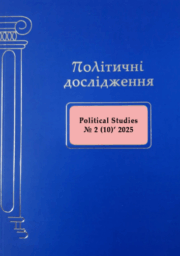
Scientific journal «POLITICAL STUDIES»

Новини
Оголошення

