
On July 11, 1943, a bloody Polish-Ukrainian confrontation began in Volyn. In Poland and Ukraine, discussions about the causes, consequences and assessment of the mentioned confrontation, starting from 2003, have gained extraordinary political and historical sharpness. They went beyond the scientific study of this issue. In 2016, deputies of the Sejm and Senate of the Republic of Poland, as well as the Verkhovna Rada of Ukraine, joined this process.
It should be recognized that a consensus has not yet been found in Ukraine and a position regarding the Polish-Ukrainian conflict that began in Volyn has not been clearly articulated. In Polish society, there has been an evolution in the perception of those events – from the popularization of this topic in society and attempts to establish a dialogue with Ukraine to the unilateral recognition in 2016 of July 11 as the official Day of Remembrance of the Victims of the Genocide of Poles in Volyn.
On July 7, 8 and 9, 2023, Poland and Ukraine will host church celebrations on the occasion of the 80th anniversary of the Volyn crime. They will be accompanied by the announcement of the joint message “Forgiveness and Reconciliation” of the Catholic Church in Poland, the Ukrainian Greek-Catholic Church and the Roman Catholic Church in Ukraine.
On this occasion, the Catholic Information Agency (KIA) organized a special session for journalists in Warsaw on June 19, 2023. At the session, the clergy talked about the modern process of Polish-Ukrainian dialogue and reconciliation. A detailed program of this year’s church events was also presented.
KIA also invited two researchers to participate in the session – director of the Institute of Political Studies of the Polish Academy of Sciences, doctor of history, professor Grzegorz Motyka and chief researcher of the Department of Theory and History of Political Science of our Institute, doctor of historical sciences, professor Yuriy Shapoval.

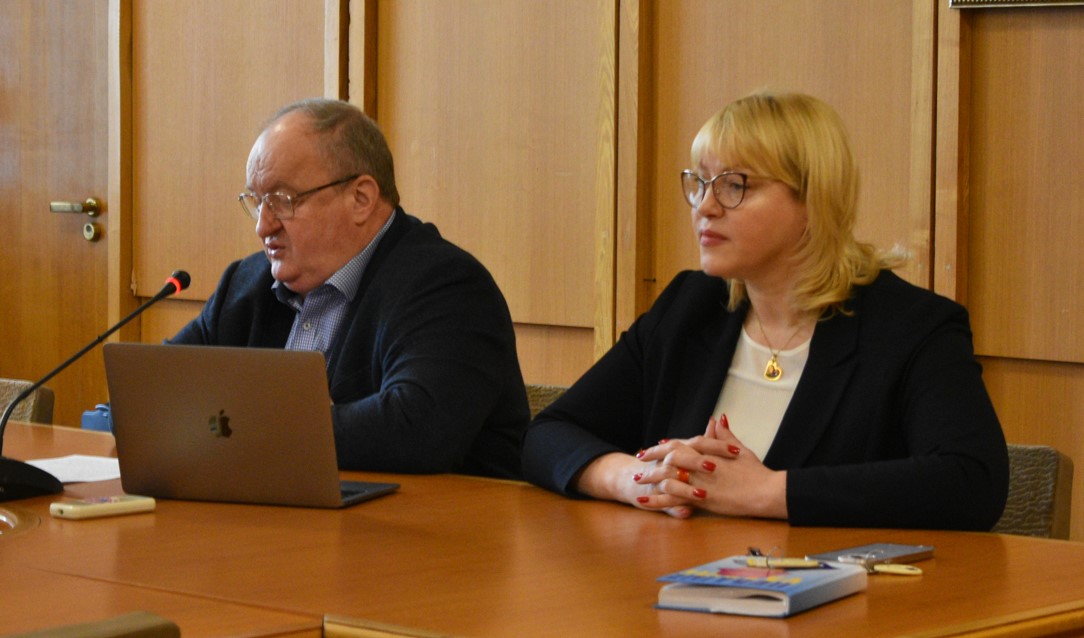
During the session
In the photo (from left to right): Head of the Catholic Information Agency Marcyn Przecyszewski, Professor Grzegorz Motyka, Professor Yuriy Shapoval and other participants of the session
The scientists familiarized those present with the approaches of Polish and Ukrainian scientists to the interpretation of the Volyn tragedy in the context of the Second World War and the current state of Polish-Ukrainian relations. G. Motyka delivered a report “Volyn crime in the light of historical research”, and Yu. Shapoval – “Volyn 1943: how to do research and how to remember?”.
The participants of the session answered numerous questions of journalists and attendees.
On the website of the Institute, in the section “Our Publications”, the text of the collection of scientific works “The Unity of Ukraine: History and Modernity” is posted.
The collection contains the materials of the All-Ukrainian scientific conference “The Unity of Ukraine: History and Modernity”, which took place in Kyiv on January 19, 2023 and was dedicated to the Day of the Unity of Ukraine.
The scientific event was organized and conducted by the Kuras Institute of Political and Ethnic Studies of the National Academy of Sciences of Ukraine together with V. I. Vernadsky Taurida National University.
The text of the collection of scientific works (PDF)
On June 4-6, 2023, the annual international conference of the Association of Jewish Museums of Europe was held in the Jewish Museum of Berlin.
Scientists and specialists in museum affairs from Ukraine took part in the work of the conference and spoke for the participants of the scientific meeting (online): leading researcher of our Institute, Candidate of Historical Sciences Anatoliy Podolskyi (Kyiv), Director of the Museum of History and Culture of the Jews of Bukovyna, Candidate of Historical Sciences Mykhailo Kushnir (Chernivtsi), head of the Ukrainian Association of Judaics, Doctor of Art Studies Yevhen Kotlyar (Kharkiv)
Ukrainian scientists spoke at the opening and the first plenary session “Ukraine: Jewish museums and Jewish cultural heritage in conditions of war – a report on the state of affairs and changing narratives”, which was dedicated to the preservation of Jewish cultural heritage and research on Judaica in our country during the Russian war against of Ukraine.
The questions of the European audience that arose during the discussion mostly went beyond the framework of cultural and museum discourse and related primarily to the war in Ukraine, the crimes of the Russian military on the territory of our country.

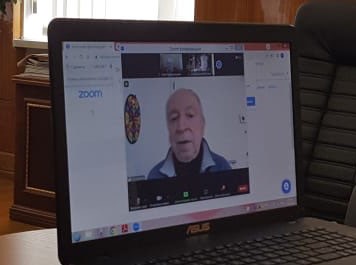
During the discussion
In his speech, A. Podolskyi emphasized that as a result of Russian bombings and rocket attacks over the last fifteen months of Russian aggression, hundreds of cities and villages, thousands of civilians were affected. Among the crimes of Russian aggression are the destroyed Jewish community centers, synagogues, Jewish cemeteries, and memorials to the victims of the Holocaust. In particular, there are memorials in Drobitskyi Yar in Kharkiv and Babiny Yar in Kyiv, the 19th-century Jewish cemetery in Glukhiv in Sumy Oblast, choral synagogues in Kharkiv and Mariupol. The Russian aggressor is destroying everything that was preserved and created in sovereign Ukraine in the realm of the Jewish cultural heritage of Ukraine. He must be punished according to international law. In particular, for these crimes.
Video recording of the plenary session
The text of O. Maiboroda’s monograph “Ethnic Traps of Decolonization: African Experience” is posted on the Institute’s website in the “Our Publications” section.
The book examines the influence of the ethnic factor on such aspects of the post-colonial development of African countries as the lack of noticeable socio-economic progress, the decorative nature of the democratization of their political systems, the establishment of a neo-patrimonial style of government and a prebendable economy, the ethnicization of the political space, the generation of conflict situations in domestic political life and in international relations, the nation-building process has slowed down. For scientists, teachers, students, everyone who is interested in issues of political life in foreign countries.
“The European research hub for the study of anti-Semitism and the development of Jewish life can be opened in Ukraine” (Interview with O. Kozerod to European Interest).
On May 8, 2023, Oleg Kozerod, a senior researcher at the Department of Ethnopolitics of our Institute, Doctor of Historical Sciences, gave an interview to the publication European Interest. In it, he praised the efforts of researchers from the British Center for the Jewish Policy Research and the European Jewish Research Archive in London, who in April jointly issued a report commissioned by the European Commission, “The Field of Research on Contemporary Anti-Semitism and Jewish Life: Working to Create a European Research Center.”
During the interview, Oleg Kozerod supported the idea of starting the implementation of the tasks of the EU Strategy on Combating Anti-Semitism and Promoting Jewish Life (2021-2030) precisely by creating a scientific hub and involving Jewish Studies specialists in this process. He emphasized that before allocating multimillion-dollar funding within the framework of this Strategy, it is necessary to define priorities and a strategy with the help of European scientists, which should include the interests of the largest Jewish communities both among EU member states and candidate countries for EU accession.

Oleg Kozerod supported the European Commission’s decision to attract research centers from Great Britain, because the British Institute for Jewish Policy Research and the European Jewish Research Archive in London are well known in the EU for their analysis of the life and development of Jewish communities. But at the same time, the scientist emphasized, the European research hub of anti-Semitism and the development of Jewish life should be located and work in continental Europe, so he suggested opening it in Ukraine, which is a candidate for EU membership. O. Kozerod reminded that Jewish studies in Ukraine are developing mainly on the basis of the Kuras Institute of Political and Ethnic Studies of the NAS of Ukraine. The opening of a research hub under the auspices of the European Commission in Ukraine would be logical given the plans to open the College of Europe and other scientific European institutions in Kyiv. The researcher also offered his own vision of a plan for the development of Jewish life. According to the scientist, this plan may contain five consecutive steps. Namely: 1) activation of the restitution of Jewish property; 2) restoration of citizenship to descendants of Jews illegally expelled from European countries; 3) creating legislation that will protect the rights of believers in the workplace; 4) protection of the right to preserve the kosher method of slaughtering livestock in Jewish communities; 5) measures to support the birth rate in modern Jewish communities and social support of Jewish families.
The text of the interview by O. Kozerod
On May 23-24, 2023, the annual Brussels Forum (Brussels, Belgium), organized by The German Marshall Fund of the United States was held. This year, the event was held in the SQUARE conference center and was dedicated to the formation of the post-war international system, the key pillar of which, according to the forum organizers, should be the restoration of Ukraine in accordance with the modern Marshall Plan.
World opinion leaders, representatives of business and civil society gathered at the forum. The main issues discussed at the forum were:
- the role of civil society in the recovery process and its leadership in certain aspects;
- a system of collaboration between key stakeholders to fill gaps in the recovery process and avoid duplication of efforts;
- improving cooperation between donors and civil society in order to strengthen joint efforts.
At the workshop of the Forum, dedicated to the problems of Ukrainian restoration and development of civil society, a report on the topic “Energetic civil society as a transformer of change” was presented by Doctor of Philosophy in Political Sciences Olena Dmytrenko, a junior researcher of the Department of Political Institutions and Processes of our Institute.

Olena Dmytrenko at the Brussels Forum
The speaker emphasized that modern Ukrainian civil society has become more active, and the number of public organizations has increased significantly, while, as the results of the study have shown, 80% of public organizations are ready to participate in the restoration of the country.
On May 14, 2023, Anatoliy Podolskiy, a leading researcher of the Department of Ethnopolitics of our Institute, candidate of historical sciences, gave an interview to Suspilne Television (Public. Culture) as part of the program “Cultural Instinct”. The interview was devoted to the problem of falsification, the use of the historical past for anti-Ukrainian political purposes by our enemy Russia during the modern war. The list of interview questions was quite broad and touched on the problem of the origins of anti-Semitism, why the Stalinist regime was partly responsible for the Holocaust, and how today Russian propaganda instrumentalizes anti-Semitism…

During the interview, Anatoliy Podolskiy drew attention to the fact that the fates of Ukrainians and Jews during the communist dictatorship in the last century were similar, both peoples were stateless and suffered both during Stalinism and during the Second World War. Speaking about today’s radical Ukrainophobia of the criminal Russian Putin regime, the scientist drew historical parallels with the policy of state anti-Semitism in the times of Nazi Germany. In general, the interview emphasized that xenophobia and discrimination were inherent in all totalitarian regimes of the last century. A. Podolsky noted: “the current Putin regime in Russia absorbs the worst anti-human features of both Stalinism and Hitlerism.”
Video recording of the interview
On May 25-26, 2023, the international conference “Poland-Ukraine. On the way to a good neighborhood.” was held in Ossolineum National Institute. Ossolineum is one of the most important and oldest Polish cultural centers with a rich library collection. The University of Wroclaw, the Association of Ukrainians in Poland, the Lviv Polytechnic National University, the Center for Europe of the University of Warsaw and the Center of the Ukrainian Catholic University in Poland joined the scientific organization.
The Rector of Wroclaw University Robert Olkiewicz, Consul General of Ukraine in Wroclaw Yuri Tokar, President of the City of Wroclaw Jacek Sutryk spoke at the opening of the conference.

Ossolineum House (Photo by Y. Shapoval)
Conference participants discussed a wide range of problems related to Polish-Ukrainian relations in the 19th and 20th centuries. It was, in particular, about Ukraine’s struggle for independence in 1917–1923, attempts at Polish-Ukrainian understanding in the Second Polish-Lithuanian Commonwealth, and the development of Volyn in the interwar period. The issues of schooling, scientific Polish-Ukrainian dialogue and problems of dialogue between Polish and Ukrainian emigration were discussed. A special section of the conference was dedicated to modern Russian aggression against Ukraine.

During the conference (Photo by Y. Shapoval)
At the conference, the chief researcher of the Department of Theory and History of Political Science of our Institute, Doctor of Historical Sciences, professor Yuriy Shapoval, gave a speech on the topic “Bohdan Osadchuk and the Polish-Ukrainian dialogue in the European context”.

One of the organizers of the conference, professor of Wroclaw University Grzegorz Hrytsyuk (Poland) and Yuriy Shapoval (Ukraine)
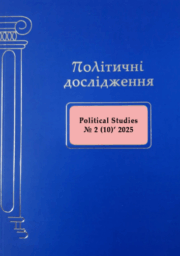
On the website of the Institute, in the “Our Publications” section, there is an electronic version of the scientific publication – the journal “Political Studies”, the founder and publisher of which is the Kuras Institute of Political and Ethnic Studies of the NAS of Ukraine.
In the next issue of the journal, articles on the problems of the theory and history of political science, the study of political institutions and processes, political sociology, political culture and ideology, scientific intelligence on the problems of world political development, ethno-political science and ethno-state science are published.
Until October 1, 2023, the editorial board of the journal accepts manuscripts of articles for publication in the next issue – No. 2 (6)’ 2023 – issue of the magazine.
Today is a professional holiday for scientists!
According to the Decree of the President of Ukraine, every year – on the third Saturday of May – Ukraine celebrates a professional holiday – the Day of Science Workers.
Science Day is a symbol of spiritual freedom and personal development, a holiday of creative work aimed at scientific progress and social consolidation.
Despite the difficult conditions of martial law, domestic scientists selflessly work on the implementation of scientific research programs and, bringing our Victory closer, they help the Armed Forces of Ukraine and join the volunteer movement.
Happy holiday, dear colleagues!

Victory, peace and prosperity to Ukraine!
To the scientists – inexhaustible energy, inspiration and new creative achievements!
May the desire for new knowledge never die out, and inspiration
always accompanies scientific activity!
Kuras Institute of Political and Ethnic Studies of the National Academy of Sciences of Ukraine became a co-organizer of the All-Ukrainian interdisciplinary scientific and practical online conference “Ukraine on the road of reconstruction: tasks of science and education in the Europeanization of the state”, which took place on May 17-18, 2023. A wide range of conference participants included scientists of the National Academy of Sciences of Ukraine and scientific branch academies; teachers of higher education institutions; representatives of departments and administrations of education, institutes of postgraduate education, etc.
The event took place within the framework of the International Exhibition “Modern Educational Institutions” and was designed to update the theoretical and practical problems of innovative development of Ukrainian society, in particular education and science; the post-war recovery of Ukraine based on the European values of democracy, human rights, freedom, equality, respect for human dignity and the rule of law; development of gifted children and youth in the conditions of the struggle for the independence of the Ukrainian state.
The scientific topics of the conference were outlined in four main areas:
- Innovation VS tradition: philosophical, historiosophical, historical discourse
- Alter ego of Ukraine after the war: social and psychological determinants of development
- Education in the transformations of Ukraine: priority tasks
- Gifted children and giftedness: present and future
Director of the Institute, Vice-President of the National Academy of Sciences of Ukraine Oleg Rafalskyi, together with the President of the National Academy of Pedagogical Sciences of Ukraine Vasyl Kremen and the President of the National Center “Small Academy of Sciences of Ukraine” Stanislav Dovgiy opened the conference with motivational speeches.

Oleg Rafalsky’s motivational speech
In his speech, Oleg Rafalskyi outlined the problems and tasks that Ukrainian science faced in wartime, emphasizing the extraordinary importance of scientific innovations not only in peaceful life, but also in the development of defense technologies. Under such circumstances, the state faced the urgent task of preserving and developing the scientific potential, which lies to the greatest extent in human capital. Summarizing his speech, the vice-president of the National Academy of Sciences of Ukraine noted that the main goal of science and education in the Europeanization of the state is to ensure the breakthrough development of Ukraine in the field of fundamental and applied sciences based on the model of combining education, science and innovation, training highly qualified scientific personnel for scientific institutions, higher education institutions of Ukraine, innovative and knowledge-intensive enterprises and promotion of integration into the European and global educational and scientific space.

Vasyl Kremen’s welcome speech
Stanislav Dovgiy is speaking
The main research associate of the Institute Maria Karmazina took part in the plenary session of the conference, and gave a speech on the topic: “The hypostases of Europe (to which we aspire): analysis of the reflections of the President of Ukraine during the 445 days of Russian aggression against Ukraine (February 24, 2022 – 14 May 2023)”.
On May 17, 2023, the All-Ukrainian scientific and practical conference “Socio-cultural transformations in Ukraine in the 20th-21st centuries and overcoming the Soviet heritage in education, culture, mentality” was held on the basis of Hryhorii Skovoroda University in Pereiaslav. Head of the Department of Political Culture and Ideology, Doctor of Historical Sciences, Professor Yuriy Nikolaiets took part in the work of the conference and gave a speech “Communication of coercion in the conditions of a full-scale Russian invasion in Ukraine”. In his report, the scientist defined “coercive communication” as one of the forms of imposing certain ideas and forming value orientations of the population with the large-scale use of modern information and communication technologies. Among the methods of ensuring communicative control over the mind, the researcher identified the dissemination of the most interesting messages, the publication of messages by influential narrators; dissemination of messages using modern delivery channels.

Yuriy Nikolaiets during the report
Yuriy Nikolaiets noted that although modern Ukrainian society has demonstrated sufficient resilience against the influence of Russian propaganda, comprehensive measures are needed to counter the implementation of enemy special information operations related to the influence on historical memory. It is important not only to have in the legislator’s arsenal the ability to stop anti-Ukrainian activity in the information space, but also effective mechanisms to counter such activity with effective punishment of guilty persons. Valuing democratic freedoms (in particular, freedom of speech), it is worth inviting Ukrainian scientists and political figures who express certain views beneficial to Russian propaganda outside the country, to a public discussion in academic institutions of Ukraine. This will contribute to providing an opportunity for them to defend their position in the circle of professionals who are well versed in historical and historiographical analysis. Such an approach will allow countering the use of certain concepts by some Ukrainian researchers in the interests of the Russian Federation. In the same way, it is also worth organizing meetings with rating “experts” who often impose their opinion on the general public, but avoid participating in professional scientific discussions, as well as with influencers, whose influence on the formation of citizens’ opinion has significantly increased in the conditions of the information society. Ukraine, whose citizens stopped the “second army of the world”, should not emphasize the victimization of its own history in the future, but should focus its efforts on the formation of modern historical memory, focused on the perpetuation of achievements in the way of state building and protection of the unity and territorial integrity of the state.
On May 5, 2023, with the support of the Ministry of Culture and Information Policy of Ukraine, the National Museum of the History of Ukraine in the Second World War hosted the International Scientific and Practical Conference “War for Ukraine: 20th-21st Centuries.”
Head of the Department of Political Culture and Ideology, Doctor of Historical Sciences, Professor Yuriy Nikolaiets participated in the work of the conference and gave a speech “Concept of hybrid war: myths and reality”. In his report, the scientist singled out signs and ideas about the ways of waging hybrid war, and also analyzed the main approaches to its definition. Based on the fact that hybrid war can be considered a type of conflict escalation that combines the use of state and non-state, traditional and non-traditional strategies, resources, means, methods of subversive activity, mechanisms of cyber warfare with the aim of achieving certain political goals, the speaker questioned the statement that hybrid war of the Russian Federation against Ukraine began in 2014.
It was emphasized that confrontations in the information space, economic, trade and other wars are one of the means of waging a hybrid war, he expressed his belief that Russia has started a hybrid war against Ukraine since at least 2004. The speaker emphasized that the hybrid war of the Russian Federation against Ukraine can be completed only after the collapse of the Russian Federation, since even a peace agreement, which will provide for the restoration of the territorial integrity of Ukraine, will not mean that Russia will abandon the continuation of the hybrid war using means of economic, diplomatic pressure and war in the information space. According to Y. Nikolaiets, Russia will not give up supporting separatist movements and terrorist activities on the territory of Ukraine.

Yuriy Nikolaiets is speaking
Determining the specifics of the confrontation in the information space, the speaker singled out the following features: asymmetric dissemination of information and flexible response to the results of public opinion polls; information confrontation does not serve physical confrontation; disinformation streams of the aggressor country are aimed not only at the enemy audience, but also at consumers inside the country; social media have gained the opportunity to shape and change the discourse related to the deployment of hostilities; centralized models of communication in conditions of accelerated development of the information society give way to social networks focused on the individualization of content; internet communication and streaming services have eliminated certain restrictions in the provision of information, inherent in classical mass media, which received a license from the state; increasing the influence of influencers.
Among the possible means of counteracting the implementation of hostile information and psychological operations (IPsO), Yu. O. Nikolaiets singled out the following: verification of information and expert assessments; coordination of efforts of civil society and the state in the matter of identifying enemy IPsO; intensification of efforts aimed at counteracting hostile agents of influence; formation of balanced historical policy; the use of software capable of detecting signs of hostile IPsO and providing analysis of information dissemination algorithms; involvement of specialists in information policy in the staff of state administration bodies and local self-governments.
On April 26–27, 2023, the annual International Scientific and Practical Conference “Globalization Challenges: Future Governance” was held at the Educational and Scientific Institute of Public Administration and Civil Service of Taras Shevchenko Kyiv National University.
During the work of the section “Public administration and the public sector: interaction for the consolidation of Ukrainian society”, which was moderated by the Professor of the Department of Public Policy, the Educational and Scientific Institute of Public Administration and Civil Service of Taras Shevchenko Kyiv National University, Doctor of Sciences in Public Administration, Professor Tetyana Vasylevska, the main researcher of the Department of Theory and History of Political Science of our institute, Doctor of Historical Sciences, Professor Tetyana Bevz spoke on the topic “Assertion of national identity and consolidation of Ukrainian society in the conditions of war”.

Tetyana Bevz gives a speech
The speaker emphasized that during the war, the issue of the affirmation of civil and national identity was enshrined in the Law of Ukraine dated December 13, 2022 “On the Basic Principles of State Policy in the Field of Affirmation of Ukrainian National and Civil Identity.” For the first time in the history of independent Ukraine, the law defined the purpose, tasks, principles, directions, features of the formation and implementation of state policy in the sphere of establishing Ukrainian national and civil identity as a component of ensuring Ukraine’s national security. The scientist gave examples of the implementation of the provisions of the Law of Ukraine in the conditions of war.

During the work of the section “Public administration and the public sector: interaction for the consolidation of Ukrainian society”
Considerable attention in the speech was paid to such important markers of identity as language and history. It was emphasized that the history of Ukraine should become a national priority in the educational and humanitarian sphere in the conditions of war. State authorities must keep in mind the experience of national unity during a full-scale war. The task of civil society and the state remains unity in freedom and diversity, the basis of which is the national identity and value of one’s own state.
The chief researcher of the Department of Political Institutes and Processes, Doctor of Political Sciences, Professor Maria Karmazina took an active part in the discussion.
Program of the International Scientific and Practical Conference (pdf)
On April 19, Oleg Kozerod, a Doctor of Historical Sciences, chief researcher at the Department of Ethnopolitics of our Institute, gave an interview to the Belgian publication EU Morning Post. In it, he positively assessed the European Strategy for Combating Anti-Semitism and Development of Jewish Life for 2021-2030. The scientist emphasized that currently 27 EU countries are successfully adapting the Strategy to their national characteristics and its implementation will begin in the United Europe in the near future. According to the scientist, this will make it possible to radically improve the situation with anti-Semitism and revive the development of Jewish culture and religious life thanks to state support.
During the interview, Oleg Kozerod drew attention to the fact that the situation with anti-Semitism in the EU is directly related to the information about Jewish history and culture that society receives. Therefore, according to the researcher, the state of affairs with anti-Semitism in Europe is directly related to the development of Jewish Studies.

Oleg Kozerod
The scientist emphasized that Ukraine, in the formation of national policy, moves along the same path as EU countries, and Jewish studies in the country continue to develop dynamically, despite the war. O. Kozerod noted the significant contribution to this development of the Kuras Institute of Political and Ethnic Studies of the National Academy of Sciences of Ukraine.
The scientist noted that today certain steps are being taken to combat anti-Semitism within the framework of the Erasmus+ program, but they foresee an increase in the activity of youth organizations and schoolchildren in the field of preserving the memory of the Holocaust, while part of the funding of the Strategy could be directed to the development of Jewish Studies. The scientist noted the high level of work of European legislators who developed the Strategy for Combating Anti-Semitism and Development of Jewish Life, which is comparable to other countries, in particular, the USA, where the government is working on a similar document.
The text of the interview by O. Kozerod
April 18, 2023 at the Kuras Institute of Political and Ethnic Studies of the National Academy of Sciences of Ukraine held a round table “Crises of political development in Ukraine and the Russian-Ukrainian war” and a presentation of the results of the scientific study “Crises of political development in Ukraine: causes, content and methods of leveling”. The research was conducted during 2020-2022 under the guidance of a corresponding member of the National Academy of Sciences of Ukraine, Doctor of Political Sciences, Professor, Head of the Department of Political Institutes and Processes of our Institute, Galyna Zelenko.
In his introductory speech, Oleg Rafalskiy, Director of the Institute, Vice-president of the National Academy of Sciences of Ukraine, Doctor of Historical Sciences, Professor, Corresponding Member of the National Academy of Sciences of Ukraine, Oleg Rafalskiy, emphasized the relevance of the main results of the study, which is aimed at studying the causes and features of political development crises in Ukraine, as well as finding ways to overcome them.
Oleg Rafalskiy, Galyna Zelenko
The scientific research was based on the analysis of crises of political development, including systemic, deep, long-term ones that arise due to institutional incoherence, legal vacuum, socio-cultural features of social development and existing political practices. Crises of political development, unlike political crises, have a systemic and long-term nature, are interconnected and often reinforce each other. In Ukraine, this creates a situation where the country seems to “go around in circles”, or it develops in leaps and bounds, unevenly, when a situation of “scissors” is formed between formal and real constitutionalism, etc.

Leonid Kiyanitsa, Oleh Kondratenko
The theoretical and methodological justification of the research was outlined in his presentation by the researcher of the Institute, Candidate of Political Sciences, Leonid Kiyanitsa. Galyna Zelenko characterized the crisis of identity as a crisis of political culture and political consciousness and its course in Ukraine. The reasons and features of the crisis of political legitimacy, as well as the challenges caused by the war and the tasks of post-war reconstruction, were presented in her report by a leading researcher, Candidate of Political Sciences Nataliya Kononenko.
Tetyana Lyashenko, a leading researcher, Doctor of Political Sciences, devoted her speech to the crisis of distribution as the state’s inability to effectively perform the function of distributing material goods and to build an appropriate institutional structure that would eliminate it.

Tetyana Lyashenko
The reasons for the penetration crisis, which is manifested in the insufficiency of reforms and the reasons for the low effectiveness of reforms, were outlined in her speech by chief researcher, Candidate of Political Sciences Svitlana Brekharya. The crisis of participation as a systemic problem based on, on the one hand, the paternalistic society, and on the other hand, the low efficiency of the existing channels of political participation, was highlighted in his speech by the leading researcher, Candidate of Political Sciences, Rostyslav Balaban. In the end, leading researcher, Doctor of Political Sciences Oleg Kondratenko characterized how the crises of political development affected the foreign policy of Ukraine and what decisions were converted into and why this has the effect of the current Russian military aggression.

Rostyslav Balaban, Galyna Zelenko
In the course of the research, the project executors discovered the causes and features of crisis phenomena, and also developed recommendations for overcoming these problems. These results, the participants of the round table emphasized, are important for understanding the situation in Ukraine, particularly in view of the full-scale Russian military invasion. Project participants drew attention to the importance of analyzing political crises in the context of democratic transition, denationalization of the economy, primary accumulation of capital and the nature of the political regime, and what is especially important – in the course of post-war recovery of Ukraine. Emphasis is placed on the need to consider crises of political development taking into account their systemic, deep and long-term nature.

Nataliya Kononenko
The director of the Institute of Sociology of the National Academy of Sciences of Ukraine, Doctor of Philosophy, Professor, Corresponding Member of the National Academy of Sciences of Ukraine Yevhen Golovakha, President of the Razumkov Center, Candidate of Political Sciences Yuriy Yakymenko, Head of the department of the National Institute of Strategic Studies Iryna Pavlenko, Head of the Department of Political Science of the Kyiv-Mohyla Academy, Doctor of Political Sciences Margarita Chabanna and others took part in the discussion of the research results.
In general, the results of the scientific project and, especially, the recommendations developed during its implementation, provide an understanding of the cause-and-effect relationships, advantages and disadvantages of the existing institutional system, institutional capacity (inability) of state authorities, which were especially evident during the full-scale Russian armed aggression, problems that Ukraine will face in the post-war period.
Download video files of the scientific event
On April 24, 2023, Anatoliy Podolskiy, a leading researcher of the Department of Ethnopolitics of our Institute, Candidate of Historical Sciences, gave an interview to the Hromadske Radio as part of the “Meetings” project.
The interview was devoted to the problem of the post-war life of those who suffered during the Second World War, from the anti-human, criminal ideology and practice of National Socialism, and how does it apply to modern Ukraine? What awaits us after the Victory in relations between people who received different experiences during the Russian aggression. It was in the context of comparisons with modernity. The fate of people in the occupation, the fate of refugees, events at the front.

Anatoliy Podolskiy in the studio of Hromadske Radio
During the interview, Anatoliy Podolskiy drew attention to the fact that “we are doomed to compare the current war against Ukraine by Russia with the Second World War. Ukrainian and Western intellectuals compare the regime, dictatorship, ideologies, practices of National Socialism, Communism, and modern Russia. And in that regard, the Holocaust is also a subject of discussion.”
We are talking, the scientist noted, about the fate of Jews during the Second World War and Ukrainians today. Larisa Yakubova, a well-known Ukrainian researcher, wrote last year in March that the Ukrainian political nation, citizens of Ukraine of various ethnic origins during the full-scale invasion of the Russian Federation, are as ethnic Jews in World War II. It is about the fact that today such crimes against the civilian population, the enemy’s hatred of Ukrainian statehood and citizenship, are compared to the hatred based on the racial policy against the Jews in the times of National Socialism. It is important to responsibly compare the entire spectrum, talk about typology, and features.
Historians, political scientists, philosophers discuss comparing the crimes of Hitler’s Germany and Putin’s Russia. It is important that such a comparison is based on academic, professional, scientific approaches – stressed Anatolii Podolskyi.
Text and audio recording of the interview
On April 12-13, 2023, the International Scientific and Practical Conference “European Integration Processes in Ukraine: Historical, Cultural, Political-Legal and Psychological Aspects” was held at V.I. Vernadsky Taurida National University (Kyiv).
The conference was co-organized by the Kuras Institute of Political and Ethnic Studies of the National Academy of Sciences of Ukraine and Pomorska Szkoła wyższa, Republic of Poland.
The reports of the participants of the conference were devoted to the analysis of the process of European integration of Ukraine, achievements and miscalculations in this area, and prospects for Ukraine’s acquisition of full membership in the European Union and NATO. The special attention of the conference participants was focused on the Russian-Ukrainian war, which poses the greatest threat to Ukraine and its European future.

Participants of the plenary session of the conference
Employees of the Kuras Institute of Political and Ethnic Studies of the National Academy of Sciences of Ukraine – Leading Researcher of the Department of Theory and History of Political Science, Doctor of Political Sciences Vyacheslav Yaremchuk (“Ukraine and European integration: the fourth attempt”), Leading Researcher of the Department of Ethno-Political Science, Candidate of Historical Sciences Anatoliy Podolskiy (“Jewish community of Ukraine during the war and Russian aggression: political and cultural challenges”), Senior Researcher of the Department of Theory and History of Political Science, Candidate of Historical Sciences Mykola Gorbatiuk (“Cooperation of Ukrainian communities and regions with foreign partners during the war: current state, challenges and perspectives”).

Vyacheslav Yaremchuk, Anatoliy Podolskiy, Mykola Gorbatiuk
during speeches at a scientific and practical conference
During the conference, there were three sections (“Historical-cultural platform”, “Political-legal platform”, “Social-psychological platform”) where a number of important issues were raised. In particular: “Ukraine among the European frontiers: contacts, exchanges, integration, cooperation”; “Ukraine’s contribution to the European intellectual and artistic treasury”; “Ukraine and Europe: cooperation in education, culture, sports, business”; “The European historical experience of Ukraine”; “Transformation of the political system of Ukraine in the process of European integration”; “New security challenges for the EU in the context of the modern Russian-Ukrainian war”; “Peculiarities of the provision of social and psychological services in the conditions of European integration” and others.
Scientific and pedagogical workers of higher education institutions of Ukraine (Kyiv, Uzhhorod, Lviv, Odesa, Kamianets-Podilskyi) and the Republic of Poland (Gdansk), scientists of academic institutions, representatives of public organizations, graduate students and students took part in the conference.
Program of the international scientific and practical conference
Oksana Zorych, a Senior Researcher at the Department of Theory and History of Political Science at our Institute, Candidate of Political Sciences, became a laureate of the PAUSE program in the field of individual research “Propaganda of violence. The Russian invasion of Ukraine: strategies and tactics of information warfare”, which will be carried out on the basis of the Center for Theory and Analysis of Law at the École normale supérieure – one of the most authoritative educational and research centers in France.
The PAUSE program supports scientists and artists who have been forced to leave their countries and temporarily continue their activities on the basis of higher education institutions and research centers in France.
The program also provides for the implementation of advocacy activities for the protection of academic freedoms and the observance of human rights.
On March 30, 2023, the National Council of Television and Radio Broadcasting of Ukraine held the first of a series of meetings planned to discuss and define criteria for information that can be classified as intolerant and discriminatory based on national or religious affiliation. This meeting was dedicated to countering anti-Semitism in Ukrainian society. Scientists, journalists, and representatives of the country’s Jewish community were invited to the meeting.
Among the participants of the meeting were the head of the National Council Olga Herasimyuk, the responsible secretary of the National Council Olena Nitsko, the member of the National Council Maksym Onoprienko, the representative of the Secretariat of the Commissioner of the Verkhovna Rada of Ukraine for Human Rights Elvina Kurtalieva, the expert of the Association of Jewish Public Organizations Vyacheslav Likhachev, experts of the media regulator and representatives of Jewish public organizations and institutions, experts on anti-Semitism, and others.

During the discussion
Anatoliy Podolskiy, a leading researcher of the Department of Ethnopolitics of our Institute, Candidate of Historical Sciences, took part in the discussion on the problem of confronting anti-Semitism in Ukraine during the Russian military aggression.
During his speech, the scientist drew attention to the fact that “there is anti-Semitism in the country, and it’s nothing to worry about. It is about the fact that it is marginal and is not mainstream in Ukrainian society.”

Anatoliy Podolskiy
He reminded that Jews stood alongside Ukrainians in the protest movement during the Revolution of Dignity, and they are among the victims-heroes of the Maidan. Nowadays, many Jews are defending Ukraine at the front: “During the full-scale invasion and as early as 2014, there was a letter from the Jewish community, it is known, it is in open sources, where it is said that we share the fate of our own country, we are Ukrainian Jews… and there is no need to protect us”. Anatoly Podolskiy noted: “We consider Ukrainian Jews as a part of Ukrainian culture. The Jewish culture of Ukraine is Ukrainian culture.” This is exactly what the media should emphasize, such messages unite us.
Based on the results of the discussion on issues of anti-Semitism in the Ukrainian media, recommendations will be developed to which all participants will be able to provide their clarifications or suggestions.
More details about the meeting
Scientific journal «POLITICAL STUDIES»

Новини
Оголошення

