
Mykola Ryabchuk, a leading researcher of the Department of Political Culture and Ideology, received in Lublin the medal of the Union of Lublin from the city president and the award named after Jerzy Giedroyc from the Maria Sklodowska-Curie University for scientific and journalistic activity aimed in particular at strengthening Polish-Ukrainian relations.
The Jerzy Giedroyc Award was established in 2001. Among her laureates are Daniel Beauvois, Yaroslav Hrytsak, Jerzy Pomyanovskyi.
At the award ceremony in Lublin’s Old Theater, Mykola Ryabchuk gave a speech (in Polish) “What is left of the “two Ukraines”? Ukrainian identity after two revolutions and ten years of war”.

The vice president of the city of Lublin Beata Stepaniuk-Kusmierczak hands Mykola Ryabchuk the medal of the Union of Lublin
On March 21, 2024, the Ukrainian Institute of the Future hosted an international expert discussion: “Presidentialism VS Parliamentarism for Ukraine.” The initiator of the series of public discussions on the topic of the social contract was the Head of the Center for Constitutional Modeling Gennadiy Druzenko, judge of the Constitutional Court of Ukraine Serhiy Holovaty, representatives of the UIM Maksym Andrushchenko and Maria Chumak, Professor of Law and Professor of Political Sciences at Duke University (USA) Donald Horowitz and Professor of Constitutional Law at Indiana University (USA) David Williams.
At the event with the report “Constitution as a social contract: what should it be like in post-war Ukraine?” Doctor of Political Sciences, Professor, Corresponding Member of the National Academy of Sciences of Ukraine, head Department of Political Institutes and Processes of the Institute Galyna Zelenko gave a speech.

Galyna Zelenko is speaking
In her report, G. Zelenko characterized the prerequisites and circumstances of the constitutional process in Ukraine, the reasons for the establishment of teleological constitutionalism and its flaws. In particular, the reasons for the formation of a kind of “scissors” between formal and real constitutionalism. She also analyzed the qualitative changes that took place in the government itself and society under the influence of the war. In view of this, she warned against the temptation of presidential institutions to strengthen the centralization of power and personalized influence to the detriment of parliamentarism and local self-government. After all, as research shows, it is wrong to think that wars are won by centralized and authoritarian countries. In addition, the centralization of power creates prerequisites for political tension in society and is not organic for Ukrainian society, which once again demonstrated the ability to self-organize. Instead, society needs order, but order that would have institutionalized forms – the dictatorship of the law, the rule of law, social justice, a clear information policy, etc.
Employees of the Institute also took part in the discussion: leading researcher Nataliya Kononenko, senior researchers Svitlana Sytnyk and Iryna Ovchar.
On March 21, a meeting of the Director of the Kuras Institute of Political and Ethnic Studies of the National Academy of Sciences of Ukraine Oleg Rafalskiy with the Director of the Representative Office of the Polish Academy of Sciences (PAN) in Kyiv Mateusz Byalas. The representative office of the National Academy of Sciences in Kyiv is a unique institution that has tremendous opportunities for establishing scientific communication between Ukrainian and Polish scientists. Given the realities in which Ukrainian science found itself during the war, this cooperation is one of the main bridges connecting Ukrainian and world science. During the meeting, urgent problems and ways to solve them, possibilities of cooperation in the scientific field were discussed.

Oleg Rafalskiy and Mateusz Byalas
On March 14-15, 2024, the Jagiellonian University (Krakow, Poland) hosted the international scientific conference “New Approaches in Political Science”, which was organized by the Polish Association of Political Sciences and the International Political Science Association (IPSA).
In the center of attention of the conference participants: problems of using data in political science research; new research approaches and methods due to the development of artificial intelligence and means of communication; interdisciplinary research, which is gaining more and more popularity; mediatization of politics, use of digital technologies in political research.
Doctor of Political Sciences, Professor, Corresponding Member of the National Academy of Sciences of Ukraine, Head of the Department of Political Institutes and Processes of the Kuras Institute of Political and Ethnic Studies of the National Academy of Sciences of Ukraine, the first vice-president of the Association of Political Sciences of Ukraine, Galyna Zelenko. During the conference, G. Zelenko gave an introductory lecture on the topic: “Russian military aggression against Ukraine as a catalyst for political changes: regional and Ukrainian dimensions.” The lecture was prepared based on the results of research conducted by the Director of the Kuras Institute of Political and Ethnic Studies of the National Academy of Sciences of Ukraine, Doctor of Historical Sciences, Professor, Corresponding Member of the National Academy of Sciences of Ukraine Oleg Rafalskiy “War and civilizational choice of Ukraine” and published in the monograph “Adaptive changes of the political field of Ukraine in the conditions of war”, as well as the study “Pretend Russia: imitation of greatness and power”, prepared by a group of researchers headed by G. Zelenko with the support of the International Foundation “Renaissance”.

Galyna Zelenko is speaking
G. Zelenko characterized the relevance of the empirical base, which makes it possible to adequately assess the state of affairs in the Russian Federation, outlined how the political regime in the Russian Federation was transformed under the influence of military aggression against Ukraine, analyzed the prospects of the so-called “world order Z” and the reasons for the disintegration of the Russian Federation, which are clearly not obvious, which determines the need for an adequate assessment of the probable scenarios of the development of the Russian-Ukrainian war and an equally adequate policy for confrontation in this war.
The electronic version of the collective monograph “Adaptive Changes in the Political Field of Ukraine in the Conditions of War” is posted on the Institute’s website in the “Our Publications” section.
The monograph contains an analysis of the changes that took place in the political field of Ukraine under the influence of the war unleashed by Russia. The author’s team focused attention on the key aspects of political changes in Ukraine caused by the conditions of martial law – on functional changes in the country’s political system, on new formats of relations between the government and society, on innovations in the implementation of the Euro-Atlantic course of the Ukrainian state. The subject area of the analysis of political changes in the country is the functioning of political and power institutions, the nature of political governance in accordance with the activation of social processes in the spiritual, cultural, ethnopolitical spheres, and the search for ways to integrate Ukraine into the global democratic space.
For scientists, teachers, students of higher education, analysts, for everyone who is interested in the development of political processes in the country.
On March 13, 2024, the Cooperation Agreement was signed between the Kuras Institute of Political and Ethnic Studies of the National Academy of Sciences of Ukraine and the State University of Trade and Economics.
The cooperation agreement provides for the establishment of joint work in separate areas of activity of the institutions. In particular, cooperation in the creation of research, information-analytical and expert materials, organization of scientific events, implementation of joint projects based on grants, competitions, organization and conduct of practices, internships, consultations.

When signing the Agreement
The contract was signed by: the Director of the Kuras Institute of Political and Ethnic Studies of the NAS of Ukraine, Doctor of Historical Sciences, Professor, corresponding member of the National Academy of Sciences of Ukraine, academician of the National Academy of Pedagogical Sciences of Ukraine, vice-president of the NAS of Ukraine Oleg Rafalskiy and Rector of the State University of Trade and Economics, Doctor of Economic Sciences, Professor, academician of the National Academy of Pedagogical Sciences of Ukraine Anatoly Mazaraki.

Oleg Rafalskiy and Anatoly Mazaraki
On the website of the Institute, in the “Our Publications” section, an electronic version of the collection of scientific works “Ukrainian Society: Political and Psychological Dimensions of the Change of Generations” is posted.
The collection contains the materials of the All-Ukrainian scientific and practical conference “Ukrainian society: the political and psychological dimension of the change of generations”, which took place in Kyiv on December 15, 2023.
The scientific event was organized and conducted by the Kuras Institute of Political and Ethnic Studies of the National Academy of Sciences of Ukraine within the framework of the research work “The concept of the unity of Ukraine: origins, evolution, political relevance” (state registration number: 0122U000572) jointly with the Institute of Social and Political Psychology of the National Academy of Sciences of Ukraine, the Association of Political Sciences of Ukraine and the Association of Political Psychologists of Ukraine.
On February 24-25, Dr. Mykola Riabchuk, a Senior Research Fellow of the Department of Political Culture and Ideology, took part in a two-day conference „Challenges of Ukrainian Culture: Beyond the Times of Upheaval”, organized at the Keio University in Yokohama. On the second day of the event he presented a paper titled “Ukraine: Unmuted. The Toxic Spell of “Imperial Knowledge” and Challenges of Decolonization”.
His primary focus was on the ongoing processes of disassembling of Russian imperial legacy in both Ukraine and abroad – in mental and linguistic clichés, academic curricula, and various mechanisms of knowledge production and distribution. While any colonial power strives to deprive subjugated nations of their political agency, cultural viability and psychological self-confidence, the main goal of national liberation is to get unmuted, to acquire distinct visibility and to assume political agency beyond anybody’s „sphere of influence”.
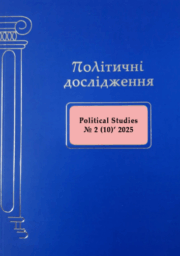
The journal “Political Studies”, the founder and publisher of which is our Institute, is indexed in the DOAJ (Directory of Open Access Journals) – an international multidisciplinary catalog of open access journals.
The mission of DOAJ is to disseminate reliable information about scientific peer-reviewed open access journals on the Internet, to provide an opportunity for scientists, libraries, universities and other interested parties to obtain quality and reliable information about the results of scientific research, to promote the integration of journals into the international scientific space. Through this work, DOAJ contributes to the development of science and education.

Journals that meet a number of requirements are included in the DOAJ catalog. These requirements apply in particular to:
- members of the editorial board;
- organization of editorial work;
- review process;
- copyright compliance;
- compliance with the periodical publication of the magazine;
- detection process for prevention of academic dishonesty;
- compliance with the long-term archiving policy;
- use of digital article identifiers (DOIs);
- accessibility and content of the magazine’s website, etc.
DOAJ editors constantly monitor the quality of publications entered into the database.
The introduction of the journal “Political Studies” to DOAJ will contribute to the popularization of the publication, the expansion of the readership and the familiarization of the scientific community with the publications of domestic scientists.
At the end of January, on the occasion of the International Holocaust Remembrance Day, the 17th annual scientific round table “Ukrainian society and memory of the Holocaust: the experience of the modern war against Ukraine” was held in Kyiv. The organizer of the event was the Ukrainian Center for the Study of the History of the Holocaust with the support of Goethe-Institut Ukraine and House of Europe, the Jewish community of Düsseldorf, as well as the Ukrainian Association of Judaics and the Master’s Program in Judaics of NaUKMA.
At the opening of the annual round table, a Leading Researcher of the Department of Ethnopolitics of the Kuras Institute of Political and Ethnic Studies of the National Academy of Sciences of Ukraine, Candidate of Historical Sciences, Anatoliy Podolskiy.

Anatoliy Podolskiy is speaking
In his report, the scientist drew attention to the importance of academic studies and teaching the history of the Holocaust, as a component of the history of Ukraine during the Second World War, during the Russian aggression against our country. During the two years of the Russian aggressor’s full-scale war against Ukraine, the enemy’s propaganda is constantly engaged in the instrumentalization of the historical past, in particular, the falsification of the events of the Second World War, the history of the Holocaust on Ukrainian soil. Therefore, the historical fate of the Jews of Ukraine, the commemoration of the victims of the Holocaust today is also a battlefield with the Moscow invaders and occupiers. Formed during the years of sovereignty, the culture and policy of memory for the victims of the Second World War in Ukraine is today our weapon in the fight against Russian falsifications of the past, which are aimed, among other things, at smearing the history of Ukrainian Jewry and inciting anti-Semitism in Ukraine, which in fact together with Ukrainophobia and xenophobia in general is a characteristic of the modern criminal Russian political regime.
The work of this year’s scientific round table was devoted to two relevant and important aspects of studying the history of the Holocaust at the modern stage, which are reflected in the names of the two sessions of the table:
“High school and challenges in teaching the history of the Holocaust during the war”
“Memory and experience of ongoing war”

Participants of the round table
Well-known and young Ukrainian historians and political scientists studying this issue spoke at the round table: Pavlo Hudish from Uzhgorod National University, Serhii Girik from the National University “Kyiv-Mohyla Academy”, Yevgen Zakharchenko from Kharkiv National University, Roman Shlyakhtych from the State University of Economics and Technology (Kryvyi Rih), Vitaly Nakhmanovych from the Museum of the History of the City of Kyiv and others.
Video recording of the round table reports
On the website of the Institute, in the section “Our publications”, there is an electronic version of the analytical note “Political security of Ukraine: problems of political and state governance. Predictive assessment, mechanisms of provision”.
The analytical note contains an analysis of the current situation and predictive assessments of probable dangers that may threaten political stability in Ukraine in war conditions, as well as individual proposals for overcoming them. Research attention is focused on problems that may arise during the exercise of state power, especially along the “center-region” line, in relations between subjects of the country’s political field. The problems associated with the implementation of the tasks of mobilizing the country to resist military aggression are highlighted and analyzed, as well as existing contradictions in inter-ethnic relations, in inter-church confrontation in the Orthodox environment, and in the state’s geostrategic efforts. The analytical note was prepared based on the results of the research work “Forecasting the security environment of Ukraine in the political sphere” (state registration number 0123U102067).
On February 15-16, 2024, the capital of the federal state of Rhineland-Palatinate, the city of Mainz (Germany), hosted an international workshop on the topic “The European history(s) of Ukraine. About the value and values of the European past”. The organizers of the conference were the Institute of European History in Mainz and the Georg Eckert Institute in Braunschweig. Both institutions are part of the non-university (public) sector of scientific researches. It includes the institutes of all major national research organizations, including the Leibniz Association. Thanks to this association, stable and sufficient funding for research work is provided.
In recent years, public opinion in Germany was dominated by the image of Ukraine as a post-Soviet, dysfunctional state with a lot of corruption. After February 24, 2022, European politicians began to emphasize that Ukraine is a “member of the European family.” Intellectuals, the media, and a large part of public activists began to distinguish Ukrainian history from the history of Russia and the Soviet Union, noting that Ukraine’s past and present was in Russia’s shadow for a long time, emphasizing Ukraine’s European perspective.
How did Ukraine become part of Europe? What is the value of the European past for social actors in Ukraine and beyond? What values do they fit into the European past?
These and other issues became the subject of discussion by the seminar participants. Among them was the Chief Researcher of the Department of Theory and History of our Institute, Doctor of Historical Sciences, Professor Yuriy Shapoval. Together with Yulia Ostropalchenko, an employee of Borys Grinchenko Kyiv Metropolitan University, he prepared and delivered the report “Russian history textbooks of the 2023 edition: stereotypes and new accents.”

A group of Ukrainian participants of the seminar: Yuliya Ostropalchenko, Yuriy Shapoval, Maria Kovalchuk, Tetyana Portnova
On February 14, 2024, the 3rd All-Ukrainian Scientific and Practical Conference “Sociocultural Transformations in Ukraine in the XX-XXI Centuries. Overcoming the Soviet Heritage in Education, Culture, Mentality” was held at Hryhorii Skovoroda University in Pereiaslav.
The co-organizer of the scientific event was the Kuras Institute of Political and Ethnic Studies of the NAS of Ukraine. Employees of the Institute took part in the conference. At the plenary session, the Head of the Department of Political Culture and Ideology, Doctor of Historical Sciences, Professor Yuriy Nikolaiets, gave a speech “War in the value system of modern Russian society”, and a speech “Resistance of Ukrainian society to the expansion of the ideology of regional separatism and “Russian world”” was given by the Chief scientist employee of the Department of Ethnopolitics, Doctor of Political Sciences, Professor Oleg Kalakura. Valeriy Novorodovsky, a Junior Researcher at the Department of Ethnopolitics, Candidate of Historical Sciences, took an active part in the discussion.

Yuriy Nikolaiets and Oleg Kalakura

Valeriy Novorodovsky
Most of the participants of the Conference emphasized that the main goal of imperial Russian policy is the genocide of the Ukrainian people and the destruction of Ukraine as a sovereign state. Russia’s special informational and psychological operations are aimed at combating historical memory and historical heritage and are aimed at destroying the unity of Ukrainian society and erasing Ukrainian identity. To achieve its goals, Moscow, with the help of committed specialists in historiography and historiosophy, imposes a set of Russian national myths on historical science.
Overcoming the Soviet heritage in education, culture, and mentality, the participants of the Conference emphasized, is possible only if the efforts of state authorities, scientists, educators and public initiative are combined.

Participants of the Conference in Pereiaslav
The Ukrainian-Polish strategic partnership is once again being tested for strength. In the conditions of Russian military aggression, ensuring trusting relations between Ukraine and Poland is one of the aspects of national security for Ukraine. It is important that this problem became the subject of discussion within the framework of the Ukrainian-Polish Dialogue Forum, which took place in Kyiv on February 10-11, 2024.
The organizers of the Forum were the Institute of International Security (Ukraine), the Kuras Institute of Political and Ethnic Studies of the NAS of Ukraine and the Institute of Political Studies of the Polish Academy of Sciences.
Kuras Institute of Political and Ethnic Studies of the National Academy of Sciences of Ukraine was represented at the Forum by: Director Oleg Rafalskiy – Doctor of Historical Sciences, Professor, Corresponding Member of the National Academy of Sciences of Ukraine, Vice-President of the National Academy of Sciences of Ukraine; Galyna Zelenko – Doctor of Political Sciences, Professor, Corresponding Member of the National Academy of Sciences of Ukraine, Head of the Department of Political Institutes and Processes; Oleg Kalakura – Doctor of Political Sciences, Professor, Chief Researcher of the Department of Ethno-Political Science.
People’s deputies of Ukraine, representatives of the NSDC apparatus, the Ministry of Defense of Ukraine, the Ministry of Education and Science of Ukraine, the Institute of National Remembrance, the State Archive of the SSU, the Institute of International Relations of Taras Shevchenko National University of Kyiv, the National Institute of Strategic Studies, the Precarpathian National University of Ukraine and others took part in the work of the Forum.
The holding of the Forum became an example of effective cooperation and interaction of state authorities, law enforcement agencies and scientists of Ukraine and Poland, an effort to coordinate efforts and find answers to challenges that arise in view of the extremely complex geopolitical situation in the region and the EU in general, in Ukrainian-Polish relations in today’s. Also, the Forum is a continuation of the cooperation between the leading political science institutions of the National Academies of Sciences of Ukraine and Poland, declared in the Agreement on Cooperation between these scientific institutions.
Within the framework of the Forum, two panel discussions were held: “Unification of the Ukrainian and Polish peoples against the background of Russian aggression” and “Ukraine-Poland: from misunderstandings in the past to a common future.” Lessons that must be learned in order to prevent new tragedies.”

Vadym Skibitskyi, Major General, Deputy Chief of the Ministry of Defense of Ukraine

Andriy Kulikov, moderator of the Forum

Grzegorz Motyka, Director of the Institute of Political Studies of the Polish Academy of Sciences
Oleg Kalakura spoke at the first panel with the report “Ethno-cultural dimension of the Ukrainian-Polish partnership against the background of Russian aggression”.

Oleg Kalakura

Forum participants

Lukash Adamskyi, deputy director of the Yuliusz Meroshevskyi Dialogue Center

Serhiy Chernov, President of the Congress of Self-Government of Ukraine

Jakub Bjorny, Head of the Department of International Relations at the University of Wroclaw

Pyotr Kulpa, program director of the School of Ministers of the Kyiv School of Public Administration named after Serhiy Nizhnyi

During informal communication
According to the results of the Forum, a Resolution was adopted with the intention of continuing cooperation between representatives of the authorities and scientists of both countries, outlining further steps to prevent the escalation of contradictions between the two countries. Forum participants emphasized the importance of developing Ukrainian-Polish cooperation as a strategic partnership, reloading the foundational documents and institutions of the Ukrainian-Polish interstate dialogue.
On February 8, Dr. Mykola Riabchuk, a Senior Research Fellow of the Department of Political Culture and Ideology, delivered the keynote lecture at the opening of the international conference “Russia’s War against Ukraine and the Crisis in Eurasia-Challenges for the Humanities” in Sapporo, at the Slavic Research Center of the Hokkaido University.
In his presentation, titled “Mapping a “Nowhere Nation”: Imperial Knowledge and Challenges of Decolonization”, he explored the reasons of Ukraine’s long-time invisibility and de-facto absence on the mental maps of international scholars, politicians and general public. This ignorance, according to the Ukrainian scholar, largely resulted from the specific policies of the Russian (and eventually Soviet) empire aimed at silencing and marginalization of subjugated nations, particularly Ukraine.

Mykola Riabchuk
A set of peculiar narratives (“imperial knowledge”) about itself and its colonies was developed by the empire, in order to legitimize its dominance both domestically and internationally. The uncritical acceptance of these narratives largely facilitated today’s Russian aggression against Ukraine and prevented effective and timely responses to it at the earlier stages. Deconstruction of these narratives, the speaker argued, is a primary task of intellectual community in its pursuit of the de-colonial agenda.

Conference participants
On February 8, Dr. Mykola Riabchuk, a Senior Research Fellow of the Department of Political Culture and Ideology, delivered the keynote lecture at the opening of the international conference “Russia’s War against Ukraine and the Crisis in Eurasia-Challenges for the Humanities” in Sapporo, at the Slavic Research Center of the Hokkaido University.
In his presentation, titled “Mapping a “Nowhere Nation”: Imperial Knowledge and Challenges of Decolonization”, he explored the reasons of Ukraine’s long-time invisibility and de-facto absence on the mental maps of international scholars, politicians and general public. This ignorance, according to the Ukrainian scholar, largely resulted from the specific policies of the Russian (and eventually Soviet) empire aimed at silencing and marginalization of subjugated nations, particularly Ukraine.
Mykola Riabchuk
A set of peculiar narratives (“imperial knowledge”) about itself and its colonies was developed by the empire, in order to legitimize its dominance both domestically and internationally. The uncritical acceptance of these narratives largely facilitated today’s Russian aggression against Ukraine and prevented effective and timely responses to it at the earlier stages. Deconstruction of these narratives, the speaker argued, is a primary task of intellectual community in its pursuit of the de-colonial agenda.
Conference participants
Chief researcher of the Department of Theory and History of Political Science of our Institute, Doctor of Historical Sciences, Professor Yuriy Shapoval gave an interview to Polish Radio. The interview was about Yu. Shapoval’s book “Unforgiven. Oleksandr Dovzhenko and the communist special services”.
The author presents a new look at the figure of director and playwright, Ukrainian cinematographer Oleksandr Dovzhenko. The research work of our colleague is based on the unpublished documents of the case-form, which was opened on Dovzhenko by the Soviet special services, and which they conducted from the beginning of the 20s and actually until the end, until his death in 1956. The Chekists never forgave Dovzhenko for his nationalist past, his Ukrainian patriotism, albeit within the limits of the Soviet canon, which was intertwined with the conformism of the great creator.
January 25, 2024, on the basis of the Ivan Franko National University of Lviv and the Kuras Institute of Political and Ethnic Studies of the National Academy of Sciences of Ukraine, the regular congress of the Ukraine Political Sciences Association (UPSA) took place in the telebridge format.
Opening the congress, the president of UPSA, member-cor. of the National Academy of Sciences of Ukraine, Doctor of Historical Sciences, Professor Oleg Rafalskiy, emphasized the importance of the existence of a national professional association of specialists and scientists in social and political sciences. The main goal of the Association’s activities is to promote the development of domestic political science and its integration into the world scientific space by establishing cooperation between scientists, promoting the implementation of scientific research, organizing scientific events and publishing scientific information. He emphasized that the Ukraine Political Sciences Association is the only member of the International Political Science Organization (IPSA) and this, in turn, gives Ukrainian political scientists the opportunity to join the global political science community.

Oleg Rafalskiy
Viktor Kotygorenko, Doctor of Political Sciences, Professor, head of the Department of Ethno-Political Science of the Kuras Institute of the National Academy of Sciences of Ukraine and Vitaliy Lytvyn, Doctor of Political Sciences, Professor of the Department of Political Science of Ivan Franko Lviv National University.
During the congress, the Development Strategy of UPSA for 3 years, the website of UPSA and the journal “Political Science” were presented, and the governing bodies of UPSA were updated. The president of UPSA was elected the Director of Kuras Institute of the National Academy of Sciences of Ukraine Oleg Rafalskiy, the first vice-president of the Department of Political Institutes and Processes of Kuras Institute Galyna Zelenko, vice-president of UPSA, Head of the Political Science Department of Ivan Franko LNU Anatoliy Romanyuk, scientific secretary of UPSA Iryna Ovchar. The Deputy Director of Kuras Institute of the National Academy of Sciences of Ukraine Yurii Shaihorodskyi was elected as the Head of the UPSA Expert Council. Oleksandr Fisun (Karazin National University), Yuriy Ostapets (Uzhhorod National University), Vitaliy Lytvyn (Ivan Franko National University), Oleksiy Tretyak (Gonchar National University), Denis Yakovlev (National University of “Odesa Law Academy”), Margarita Chabanna (NU “Kyiv-Mohyla Academy”), Oleg Batrymenko (Kyiv National University), Anatoliy Kruglashov (ChNU named after Yu. Fedkovych), Yuriy Yakymenko (Razumkov Center).

During the convention
The participants of the congress discussed a wide range of problems related to the strategy of further development of UPSA, formation of standards of political education in Ukraine, teaching of political sciences in higher education institutions, development of scientific research in the field of political science, integration into the international scientific environment, etc.
On January 25, 2024, between the Kuras Institute of Political and Ethnic Studies of the NAS of Ukraine and Dragomanov Ukrainian State University concluded a Cooperation Agreement.
Solemnly, at the meeting of the University’s Academic Council, the Director of the Institute Oleg Rafalskiy and the Rector of Dragomanov State University Viktor Andrushchenko signed the corresponding document on cooperation between the scientific institution and the institution of higher education.
The agreement is aimed at deepening the multi-year joint activity on the implementation of scientific, educational and research projects.

During the signing of the Agreement

Oleg Rafalskiy and Viktor Andrushchenko
On January 17, 2024, on the eve of the celebration of the Day of the Unity of Ukraine, the 3rd All-Ukrainian Historical and Cultural Forum to the Day of the Unity of Ukraine and the Day of Memory of the Heroes of the Heavenly Hundred was held at Hryhorii Skovoroda University in Pereiaslav.
The co-organizer of the event, already traditionally, was the Kuras Institute of Political and Ethnic Studies of the NAS of Ukraine. Employees of our Institute took an active part in the work of the Forum. At the panel discussion “Ukraine is free. United. Indivisible” was presented by the head of the Department of Political Culture and Ideology, Doctor of Historical Sciences, Professor Yuriy Nikolaiets and the chief researcher of the Department of Ethno-Political Sciences, Doctor of Political Sciences, Professor Oleg Kalakura.

Yuriy Nikolaiets and Oleg Kalakura
Oleg Kalakura emphasized the role of the Ukrainian revolution in the formation of the national identity of Ukrainians and the realization of the national idea. Significant events of the Ukrainian revolution: the formation of the Ukrainian Central Council and its proclamation of the Ukrainian People’s Republic and its independence, the activities of the Ukrainian State during the time of Hetman P. Skoropadskyi, the formation of the West Ukrainian People’s Republic, the restoration of the People’s Republic of Ukraine during the Directory, the conclusion of the Act of Unification of the two Ukrainian states – were accompanied by profound changes in public consciousness, the formation of new values as components of national identity. The Act of Unification UPR and WUPR proved that Ukraine emerged as a modern political nation. The speaker compared the events of the Ukrainian revolution with the period of the restoration of Ukraine’s independence and the war for the independence and unity of Ukraine.

Participants of the scientific event
Yuriy Nikolaiets analyzed the specifics of the confrontation in the information space during the Russian-Ukrainian war. He emphasized that during the war, it is important not only to inform citizens in a timely and balanced manner about the most important events, but also to ensure and maintain a high level of media literacy of the population, which should become the most effective obstacle on the way to the implementation of enemy PSYOP. For the successful implementation of defined goals and tasks in political activity, the authorities should pay much more attention to well-balanced informing of citizens about the problems that exist in society, possible ways to solve them, and prospects for the country’s development in difficult military conditions. The outline of such perspectives and clear and understandable ways for citizens to achieve the goals and objectives defined by the Ukrainian top leadership should become a powerful means of preserving social stability. For this purpose, the communication between authorities and citizens should be significantly improved. This is especially important for the implementation of measures that are unpopular among citizens, the implementation of which requires balanced targeted information campaigns based on a scientific analysis of their course and possible results. The discussant emphasized the need to help increase the level of media literacy of Ukrainians, especially young people, noting the role of Hryhorii Skovoroda University in Pereiaslav in this process.
Scientific journal «POLITICAL STUDIES»
Новини
Оголошення

