
On September 21-23, 2022, the University of Granada (Spain) hosted an international conference on the topic “Famines in Europe: between history and memory (XIX-XX centuries)”. Among the organizers of the conference were the Department of Contemporary History of the University of Granada, the Research Project “HAMBRUNA. The Spanish Famine: Causes, Development, Consequences and Memory (1939–1952)”, Ministry of Economy and Competitiveness, Research Network “Standarts of Living, Health, Nutrition and Inequality”, Research Project “The Silenced Famine of Francoism (1939–1952) ” and the “Heritages of Hunger” project.
The organizers of the conference set a goal to look at the problem of hunger or starvation on the European continent as broadly as possible, to analyze the state policy, the reaction on the mentioned phenomena, survival strategies and the consequences of these phenomena in different countries.
Particular attention was paid to transnational representations, teaching and formation of memories of famines or starvations in certain regions.

Filip Slaveski, Yuriy Shapoval, Stephen Wheatcroft, Hiroaki Kuromiya, Igor Kasu before the start of the section of the international conference
A separate section dedicated to the famine of 1946-1947 in Ukraine and Moldova worked within the conference. A several years long work of a group of scientists on researching this “forgotten” before Gorbachev’s “perestroika” tragic episode of Soviet history, was presented in the section. Among the participants of this scientific group were the Chief Researcher of the Department of Theory and History of Political Science of our Institute, Doctor of Historical Sciences, Professor Yuriy Shapoval. Together with Professors Stephen Wheatcroft, Filip Slaveski (both from Australia), Hiroaki Kuromiya (USA) and the director of the National Archives Agency of Moldova, Igor Kasu, Yu. Shapoval presented the first results of the research.
On the website of the Institute, in the section “Our Publications”, the text of the monograph of the team of scientists of the Center for Jewish History and Culture of our Institute and other scientific institutions “Socio-political and historical aspects of the development of the modern Jewish community of Ukraine: the European context” is posted.
The team of authors under the leadership of candidate of historical sciences A. Yu. Podolsky attempted to identify and analyze the main socio-political and historical aspects of the development of the modern Jewish community of Ukraine, as well as highlight the main prospects for its development in the near future in the context of the European path of Ukraine’s progress.
The monograph examines the question of the development of Hasidism at the present stage, the historical fate of the Krymchaks, the features of the complex memorialization of Baby Yar, the relations of the Jewish communities of the European Union with national governments, the possibility of borrowing and applying this experience into Ukrainian realities, etc.
The scientific work is made for political scientists, historians, students of humanitarian specialties, all those who are interested in researches in the field of Ukrainian Judaism.
On September 15-16, 2022, an international conference on the topic “Do we learn from the past for the future?” was held in Paris at the Paris Science Center of the Polish Academy of Sciences. What history textbook does Europe need in the 21st century?”.
The conference was planned as a regular meeting of historians-scientists and history teachers within the project of the Georg Eckert Institute for International Textbook Research in the city of Braunschweig (Germany), launched in April 2022. The Paris conference summed up the implementation of Franco-German and Polish-German projects, as well as other projects aimed at creating transnational materials (textbooks) for teaching history. During the conference, the methods of storytelling about the history of Europe in transnational textbooks, their application in the didactics of history at the level of school education in different countries of the European Union were analyzed.

During the work of the conference
The participants of the conference were scientists from Germany, France, Poland, Ukraine, Moldova, Serbia, Israel – historians, political scientists, public intellectuals, people connected with the world of politics and cultural diplomacy, who were or are involved in various transnational history teaching projects. Teachers from higher education institutions of Germany, Poland and France joined the work of the conference.
Employees of the Department of Theory and History of Political Science of our Institute participated in the work of the conference and gave speeches – Doctor of Historical Sciences, Professor Yuriy Shapoval and Candidate of Political Sciences Oksana Zorych.

Yuriy Shapoval, Oksana Zorych together with one of the organizers of the conference, Professor Marcyn Vyatra
The organizers of the conference sought to identify possible areas of cooperation and initiatives that go beyond the territory of the EU countries. The current war in Ukraine and the negotiations on Ukraine’s membership in the EU prompted them to think about creating a project that will develop materials for teaching the history of Ukraine in the broader context of European history, which could be used both in Ukraine and in EU countries.
The University of Sydney, one of the oldest and most prestigious universities in Australia, has joined the worldwide program of support for Ukrainian scientists SAR – an international network of higher education institutions. The purpose of the SAR program is to protect scholars at risk and promote academic freedom. The program of the University of Sydney is supported by the Australian government.
Rymarenko, a Senior Researcher at the department of Global Political Development Problems of our Institute, Doctor of Political Sciences, received the opportunity to conduct scientific research at the Faculty of Humanities and Social Sciences of the University of Sydney under the “Ethnic Relations and Democratization” program.

Sergiy Rymarenko with faculty staff
The purpose of the scientific project is to study the peculiarities of ethnic relations in the context of modern democratization processes.
On August 31, 2022, a session of the Presidium of the National Academy of Sciences of Ukraine was held. The head of the Department of Political Institutions and Processes of the Kuras Institute of Political and Ethnic Studies of the National Academy of Sciences of Ukraine, Doctor of Political Sciences, Professor, corresponding member of the National Academy of Sciences of Ukraine G. I. Zelenko spoke at the meeting with the report “National revival of Ukraine in the post-war period”.

Corresponding member of the National Academy of Sciences of Ukraine, Galyna Zelenko
She noted that with the beginning of the full-scale Russian invasion, a significant acceleration of nation-building processes began in Ukraine. Changes that used to take decades are now happening in months or even weeks. The state of Ukraine turned out to be much stronger than it seemed before, and national stability, as the war showed, is based primarily on the ability for social self-organization. It should become the basis of the post-war recovery of Ukraine.
It is obvious today that the phase of civil (political) self-identification with Ukraine has been passed. The full-scale invasion of the Russian Federation into Ukraine on February 24, 2022 significantly eliminated those socio-political divisions that have always spawned an identity crisis in Ukraine – linguistic, ethnic, regional, religious, foreign political, etc. The tragic realities of the war contributed to the acceleration of the formation of certain monadic communities among Ukrainians, united around such stable ideologies as a strong nation, a strong state, a single state language, a common enemy, and protection through integration into the EU and NATO.
At the same time, in post-war Ukraine, systemic problems related to the institutional capacity of the state will remain, although the war also demonstrated that state institutions were much more stable than many thought before. Galyna Zelenko noted that the reasons for such success should be investigated, publicly recorded and should be made as a basis for further development and strengthening of these institutions.
The scientist also noted that Ukrainian society is characterized by multifacetedness and the ability to self-organize. These qualities are the basis for the development of consociational democracy in Ukraine, built on the involvement, and not the exclusion, of different communities in the development of state policy with the aim of integrating Ukraine into the global context. After all, against the background of the war and the catastrophic drop in the standard of living, demographic problems, a kind of rollback of that civic identity, which was discussed above, will inevitably happen, and this will mean the emergence of new – much deeper and more colorful socio-political divisions. Therefore, scientific institutions of a socio-humanitarian type face the task of concentrating efforts for scientific research directed at an accurate diagnosis of the condition of Ukrainian society, which will take into account all the complexities and problems that inevitably appear in the state in the conditions of war and rapid post-war recovery.
Appropriate attention should be paid to the study of the mechanisms of integration of Ukrainian society. Within the framework of this research, it is advisable to focus on the study of the transformation of the value orientations of the population; social factors of democratization of the political system of Ukraine; lines of potential socio-political faults and conflicts; study of the condition of development of social capital; informational policy; ethno-national politics and ethnic minorities; political education (civic education), etc.
In order to integrate Ukraine into the global context, it is obvious that the study of global trends and Ukraine’s place in the changing world is necessary. The priority should be to study the European future of Ukraine in view of granting Ukraine the status of a candidate for EU membership. We should turn to the study of regional and global processes in other parts of the world, which inevitably affect Ukraine and which are extremely episodical in Ukraine. At the same time, it is important to develop a frontier model for Ukraine, so as not to become a country with an economic and social structure completely dependent on the development of the agricultural sector and military industry.
In the press center of the “Interfax-Ukraine” informational agency, a discussion was held on the topic “How Ukraine influences the modern world.”
The participants of the discussion were: director of the Institute for Global Strategies Vadym Karasyov, political expert Kostiantyn Matviienko and senior researcher of our Institute, Doctor of Historical Sciences Igor Turov.

Ihor Turov, Doctor of Historical Sciences
The discussion was devoted to the leading role which is being played by Ukraine in the modern global political processes and in ensuring European security in the conditions of resistance to armed aggression of the Russian Federation.
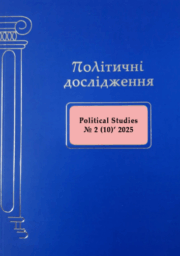
The journal “Political Studies” is a professional scientific edition on political sciences.
The founder of the journal is the Kuras Institute of Political and Ethnic Studies of the National Academy of Sciences of Ukraine.
The thematic direction of the publication is represented by the following headings:
- Theory and history of political science. Political philosophy.
- Political institutions and processes. Political sociology.
- Political culture and ideology. Political psychology.
- Problems of global political development. Basics of national security of the state.
- Ethno-political and ethno-state science.
Manuscripts of articles for the next issue of the journal will be accepted by the editors until October 14, 2022. Publication will be made until November 30.
Articles are published on a free of charge and royalty-free basis.
The journal is included in the list of academic publications of Ukraine in political sciences, specialty 052 – “Political Science”, category “B” (decree of the Ministry of Education and Science of Ukraine dated 04/07/2022 No. 320).
Information for authors. Requirements for manuscripts of articles
Grounds of the journal’s editorial policy
E-mail address of the editorial office: editor_ipiend@ukr.net
Chief Researcher of the Department of Theory and History of Political Science of our Institute, Doctor of Historical Sciences, Professor Yuriy Shapoval took part in work of the the scientific conference “Decommunization of Symbolic Space and Decolonization of Ukrainian Culture”, which took place on August 30, 2022 in the press center of the national informational agency “Ukrinform”. Yu. Shapoval’s online speech was entitled “Decommunization in Ukraine and the creative heritage of Oleksandr Hrytsenko”.

Yuriy Shapoval during a speech at a scientific conference
As it is known, with the support of our Institute, in 2019, the monograph of Oleksandr Hrytsenko (1957–2022), a scientist and writer, Candidate of Technical Sciences, “Decommunization in Ukraine as a state policy and as a socio-cultural phenomenon” was published. This is one of the most thorough studies of the process of decommunization and the politics of memory in Ukraine.
Dear colleagues!
Dear friends!
On the eve of Independence Day, we celebrate the Day of the National Flag of Ukraine!
With this symbol, the Ukrainian people confirmed their statehood, unity and independence, with it today our soldiers defend their native land from the invaders.

We cordially congratulate everyone on the Day of the National Flag and Independence Day of Ukraine!
We wish you peace, goodness and happiness!
May the yellow-blue flag of the will and unity of the Ukrainian people always fly proudly over Ukraine!
Glory to Ukraine!
Mykola Riabchuk, a leading researcher at the Department of Political Culture and Ideology of our Institute, on July 18 gave a speech on Russian war crimes in Ukraine to the audience of the International Security Studies Program at the University of Fribourg (Switzerland).
The announced topic – “Investigation of war crimes, protection of victims, assistance to refugees” – covered a wide range of issues related to the current Russian-Ukrainian war.

Mykola Riabchuk
The Russian war in Ukraine, the speaker emphasized, has a clearly genocidal goal – the destruction of not only the Ukrainian state, but also the nation, which, according to the Moscow leadership, has no legitimacy and must be assimilated or, in case of resistance, liquidated.

During the lecture
During the five-month military invasion, the Russians committed numerous war crimes and crimes against humanity in Ukraine, which are now being thoroughly documented by Ukrainian and international investigators. Proving the commission of genocide, however, is not easy, because the tribunal requires evidence not only of genocidal acts, but also of genocidal intent. Usually, criminals do not announce it directly, so we have to rely on indirect evidence – on specific statements of Russian leaders and their propagandists, on the appropriate context and interpretation of those statements.

With students of the International Program of Security Studies
The discussion about the war and the international reaction to it was continued after the break in the form of a round table with the participation of the Ambassador of Ukraine to Switzerland Artem Rybchenko and the Ambassador of Switzerland to Ukraine Christian Schoenenberger. The discussion was moderated by the Director of the Security Studies Program, Honorary Consul of Ukraine in Fribourg, Professor Andrej Lushnycky.
On the website of the Institute, in the “Our publications” section, there is an electronic version of the book “Unforgiven. Oleksandr Dovzhenko and the communist special services” written by the chief researcher of the Department of Theory and History of Political Science, Doctor of Historical Sciences, Professor Yuriy Shapoval.
This scientific work is the result of copious cooperation with our Polish colleagues – scientists of the Institute of Political Studies of the Polish Academy of Sciences. The director of the Institute of Political Studies of the Polish Academy of Sciences, Professor Grzegorz Motyka, initiated the publication of our employee’s research work.
Our colleague’s many years of painstaking research work on the book about Oleksandr Dovzhenko ended in June 2022 with its publication by the Polish publishing house “Volumina. Daniel Krzanowski” of a thorough study, through the prism of the peculiarities of the era and the events, inscribed in the historical and political context of the time, of the personal life and work of a brilliant man, who was Oleksandr Dovzhenko.
Recently, on July 28, 2022, a round table was held in Warsaw (Poland) – “Discussion around Yuri Shapoval’s book “Unforgiven. Oleksandr Dovzhenko and the communist special services”” with the participation of Polish and Ukrainian scientists – specialists in historical and political sciences.
In the author’s afterword, written already after February 24, 2022, Yuriy Shapoval notes: “I hope this publication will evoke not only sympathy for Oleksandr Dovzhenko. I would like that the least of all. I hope otherwise. Dovzhenko will appear as a living person. And there are no living persons without flaws and specific features. However, this alive Dovzhenko, even if you try to revive him with the help of Chekist secret documents, is much more valuable than Dovzhenko as a boring, bronzed film classic, which he was made to be for many decades”.
Oksana Zorych, senior researcher at the department of Theory and history of political science, candidate of political sciences, became a laureate of the “Atlas” academic mobility program of the “House of Humanities” Foundation (Paris, France) in the field of research “Propagation of violence. Russian invasion of Ukraine: strategies and tactics of information warfare”.

Oksana Zorych
The Foundation Maison des sciences de l’homme (FMSH) was founded in 1963 by Fernand Braudel in Paris. The Foundation supports research and dissemination of knowledge in the field of humanities and social sciences, as well as innovative research. For more than 50 years, FMSH has been building an important network of national and international partners in order to popularize research in the field of humanities and social sciences.
Among the main programs of the Foundation are the mobility program “Atlas”, “DEA”, “International research networks in HSS”, “Vigoni workshops”, “PREFALK Programme”.
The results of the research, which is carried out by a scientist under the FMSH academic mobility program, will be used in the work on the individual research topic “Integration and disintegration discourses in modern media” of the departmental research topic of the Department of Theory and History of Political Science of the Kuras Institute of Political and Ethnic Studies of the National Academy of Sciences of Ukraine: “The concept of the unity of Ukraine: origins, evolution, political relevance.”
On July 28, 2022, a round table “Soviet repression against the Ukrainian intelligentsia” was held in Warsaw (Poland). Discussion about the book by Yuriy Shapoval “Unforgiven. Oleksandr Dovzhenko and the communist special services””.
The event was organized by the laboratory named after Richard Pipes of the Institute of Political Studies of the Polish Academy of Sciences and took place using the ZOOM platform.
Among the participants of the round table were Polish and Ukrainian scientists – specialists in historical and political sciences.
Director of the Institute of Political Studies of the Polish Academy of Sciences, Doctor of Humanities, Professor Grzegorz Motyka addressed the participants of the round table with a welcome speech.
During the round table, the book “Unforgiven. Oleksandr Dovzhenko and the communist special services” is a joint publication of the Institute of Political Studies of the Polish Academy of Sciences and the Kuras Institute of Political and Ethnic Studies of the National Academy of Sciences of Ukraine. The author-compiler of this unique edition is Yuriy Shapoval – doctor of historical sciences, professor, chief researcher of the Department of Theory and History of Political Science of our Institute.

Yu. Shapoval. Unforgiven. Oleksandr Dovzhenko and the communist special services. Warsaw–Kyiv–Kharkiv, 2022.
While working on the book, the author-compiler used unique documents about Oleksandr Dovzhenko (1894–1956), materials from the form file, as well as other archival sources. Analysis of these files made it possible to see and hear a completely “different” Oleksandr Dovzhenko – a man who was forced to create the Soviet movie canon, but at the same time – a non-conformist capable of giving realistic and ruthless assessments of the ruling order.
The participants of the round table had an interesting and objective conversation about the repressions of the Soviet authorities against representatives of the Ukrainian intelligentsia.

During the work of the round table
Employees of our Institute took part in the work of the round table: Doctor of Political Sciences Oleg Kalakura, Doctor of Political Sciences Oleg Kondratenko, Doctor of Historical Sciences Oleksandr Mayboroda, Doctor of Political Sciences Yuriy Shaihorodskyi.
On the website of the Institute, in the “Our Publications” section, there is an electronic version of the scientific professional publication – the journal “Political Studies”, the founder of which is the Kuras Institute of Political and Ethnic Studies of the National Academy of Sciences of Ukraine.
Articles on problems of the theory and history of political science, research of political institutions and processes, political culture and ideology, problems of world political development, ethno-political science and ethno-state science are published in the next issue of the journal.
Acceptance of manuscripts of articles that will be published in the next (No. 2 (4)’ 2022) number of the magazine continues until October 14. Publication will be made until November 30, 2022.
At the Julius-Maximilian University of Würzburg (JMU), one of the largest universities in Germany, within the framework of the Volkswagen Foundation support program, the implementation of the research project “Ethno-political management in Ukraine and certain EU countries: a comparative analysis” has begun. The co-author and co-executor of the project is the leading researcher of our Institute, Candidate of Political Sciences Anastasiia Dehterenko. The scientific project will be implemented together with an employee of the Department of International Relations and European Studies, Carolyn Rueger from the Institute of Political Science and Sociology of JMU.

Anastasiia Dehterenko
The purpose of the project is to study the peculiarities of ethnopolitical management in Ukraine, to carry out a comparative analysis of ethnopolitics in the countries of the European Union, and to find ways to increase the effectiveness of the implementation of ethnonational policy in Ukraine.
On July 14, 2022, on the territory of the Babyn Yar National Historical and Memorial Reserve, the leading researcher of our Institute, Candidate of Historical Sciences, Anatoliy Podolskiy, held a meeting-excursion on the territory of the reserve for the Ambassador of the United States of America in Ukraine, Mrs. Bridget Brink.

Bridget Brink and Anatoly Podolsky during the meeting
The conversation touched on the events of the modern war, Russian aggression against Ukraine. After the full-scale invasion of Ukraine, the Russian invaders not only kill people and destroy the buildings and infrastructure of our cities and towns, but also seek to destroy our memory of the past, particularly about the victims of World War II. In March 2022, as a result of missile and bomb attacks by Russian troops, memorial complexes in Kyiv and Kharkiv were destroyed.
The US Ambassador in Ukraine Mrs. Bridget Brink noted during the meeting-excursion that her country has been helping Ukrainians to protect themselves from the atrocities of the Russians since the very beginning of the Russian invasion, which she compared to the crimes of the Nazis in Babyn Yar.

During an excursion in the territory of the “Babyn Yar” reserve
“My visit to Babyn Yar became a reminder of the atrocities committed by the Nazis against Jews and others, which Russian rockets made very real again, while striking and killing innocents,” said the Ambassador. She emphasized: “We must never forget this and help Ukraine to protect itself from these atrocities.”
Mykola Ryabchuk, a leading researcher at the Department of Political Culture and Ideology, held a series of seminars at the University of Regensburg (Germany). Scientific seminars were devoted to Ukrainian-Russian relations and the current Russian military aggression. The cycle was supplemented by a public lecture on the topic “Ukrainian civil society and the state: from confrontation to cooperation.”
In his lecture, Mykola Ryabchuk noted the important role of civil society in upholding democracy in Ukraine and countering the authoritarian tendencies of the first decades of independence.

Mykola Ryabchuk during a public lecture
The scientist emphasized that civil society and, in particular, volunteer groups and organizations played a particularly important role in 2014, when after the high treason of Viktor Yanukovych and many other high-ranking officials, state bodies and institutions in some regions ceased to function, and volunteers had to take over their responsibilities, including the defense of the country. This experience of unity turned out to be relevant in 2022, when under the influence of Russian aggression, the partnership of the state and society in Ukraine became not only desirable and possible, but also vitally necessary.
For two days (July 1-2, 2022), the international scientific conference “Still without peace” took place at the University of Warsaw. It was organized by the Center for East European Studies, which is headed by Professor Jan Malicki. Scientists from Poland, Great Britain, France, and Belarus took part in the conference. Among the participants of the conference were also scientists from Ukraine who are currently living abroad. Among them is the chief researcher of our Institute, doctor of historical sciences, professor Yuriy Shapoval.

Professor Jan Malicki opens the conference
The participants of the international conference discussed the current problems of countering Russian aggression, in particular, in the informational sphere.
Within the framework of the conference, a round table was held on the topic “Russian-Ukrainian war: informational resistance”. Professor Yuriy Shapoval took part in this work and gave a speech.
The participants of the international scientific meeting emphasized on the need to unite the efforts of European countries and strengthen cooperation in the humanitarian, economic, energetical and security spheres to counter Russian aggression.

From left to right: Professor Serhiy Troyan, Professor Antonina Kozyrska, Professor Yuriy Shapoval in front of the building of the Warsaw University Library, where the international conference took place
On the 13th of June, Dr. Mykola Riabchuk, a Senior Research Fellow of the Department of Political Culture and Ideology, took part in a panel discussion on the post-war perspectives of „Ukraine and Europe and the world”, organized by the Paris City Hall in cooperation with the French Institute of Advanced Studies. In his presentation, the Ukrainian scholar argued that Ukraine has been always the linchpin of European stability and security, but the persistent failure of Western powers to properly understand and appreciate this role has largely resulted in the exponential growth of Russian authoritarianism and militarism, up to the current tragic events. Nonetheless, both the EU and NATO have finally recognized their political blindness and increasingly engaged in a multilayer support for Ukraine that fights back the all-out military aggression of a rogue state. This newly discovered unity and solidarity of the democratic states provides a good opportunity for consolidation of democracy on the continent and beyond, for strengthening of international institutions, and for transforming Ukraine into a full-fledged member of the Euro-Atlantic community.
Information about the scientific event (in French)
On the website of the Institute, in the “Our publications” section, the text of A. Yasinska’s monograph “Behavior of voters did not decide on the electoral processes in Ukraine and European countries (2010-2019)” is posted.
The monograph examines the behavior of voters who did not decide electorally based on an analysis of the 2010–2019 presidential and parliamentary election campaigns in Ukraine, France and Poland. The main factors of influence on the formation of electoral preferences of citizens, on the reasons for the growth of electoral uncertainty and absenteeism have been determined. Recommendations to reduce the level of electoral uncertainty among the population of Ukraine are offered.
Scientific journal «POLITICAL STUDIES»
Новини
Оголошення

