
On March 30, 2023, the National Council of Television and Radio Broadcasting of Ukraine held the first of a series of meetings planned to discuss and define criteria for information that can be classified as intolerant and discriminatory based on national or religious affiliation. This meeting was dedicated to countering anti-Semitism in Ukrainian society. Scientists, journalists, and representatives of the country’s Jewish community were invited to the meeting.
Among the participants of the meeting were the head of the National Council Olga Herasimyuk, the responsible secretary of the National Council Olena Nitsko, the member of the National Council Maksym Onoprienko, the representative of the Secretariat of the Commissioner of the Verkhovna Rada of Ukraine for Human Rights Elvina Kurtalieva, the expert of the Association of Jewish Public Organizations Vyacheslav Likhachev, experts of the media regulator and representatives of Jewish public organizations and institutions, experts on anti-Semitism, and others.

During the discussion
Anatoliy Podolskiy, a leading researcher of the Department of Ethnopolitics of our Institute, Candidate of Historical Sciences, took part in the discussion on the problem of confronting anti-Semitism in Ukraine during the Russian military aggression.
During his speech, the scientist drew attention to the fact that “there is anti-Semitism in the country, and it’s nothing to worry about. It is about the fact that it is marginal and is not mainstream in Ukrainian society.”

Anatoliy Podolskiy
He reminded that Jews stood alongside Ukrainians in the protest movement during the Revolution of Dignity, and they are among the victims-heroes of the Maidan. Nowadays, many Jews are defending Ukraine at the front: “During the full-scale invasion and as early as 2014, there was a letter from the Jewish community, it is known, it is in open sources, where it is said that we share the fate of our own country, we are Ukrainian Jews… and there is no need to protect us”. Anatoly Podolskiy noted: “We consider Ukrainian Jews as a part of Ukrainian culture. The Jewish culture of Ukraine is Ukrainian culture.” This is exactly what the media should emphasize, such messages unite us.
Based on the results of the discussion on issues of anti-Semitism in the Ukrainian media, recommendations will be developed to which all participants will be able to provide their clarifications or suggestions.
More details about the meeting
On March 31 – April 2, 2023, the next annual conference of the British Association of Slavic and East European Studies (BASEES) was held at the University of Glasgow (Scotland). More than 400 researchers from 30 countries took part in the congress. At the panel discussion “War as a creator of nations?” Nation-building in Ukraine as a result of Russia’s war against Ukraine – discourses, identities, achievements” report on the topic: “Institutional changes of the political system of Ukraine under the influence of Russian military aggression” was delivered by the Head of the Department of Political Institutions and Processes of our Institute, Doctor of Political Sciences, Professor, Corresponding Member of the National Academy of Sciences of Ukraine Galyna Zelenko.

The participants of the panel discussion noted that wars, of course, destroy nations, but they can also make them stronger, becoming a kind of trigger for very rapid and qualitative changes. In the case of Ukraine, Russia’s war against Ukraine since 2014 is not the end, but the beginning of national construction. In Ukraine, the nation-building process is not based on ethnic, but on civic nationalism, the idea of building a modern democratic and multicultural society.
In essence, state formation in Ukraine is a process that began after the declaration of independence in 1991 and was reinforced by two Maidans in 2004 and 2013/14. But Russia’s war against Ukraine since 2014 can certainly be considered the main factor and catalyst of national building in Ukraine. This is part of a powerful discourse, which can also be observed from the data of sociological surveys, which confirm the growth of national pride and civic Ukrainian identity.
On the other hand, the war also became a catalyst for qualitative changes in the political regime in Ukraine, the modernization of political actors and, most importantly, the reduction of the influence of financial and industrial groups (oligarchs), the destruction of the political and economic monopoly in the country.
In combination with the rapid development of civil society, the change of political identities, the stabilization role of the EU also caused rapid institutional changes in the entire political system of Ukraine. It is also emphasized that the process of Europeanization is an articulated choice of the orientation of nation-building, which put an end to the geopolitical ambivalence of Ukraine.
In the last week of March, a Senior Research Fellow at the Department of Political Cultures and Ideology Mykola Riabchuk delivered a cycle of public lectures on the current developments in Ukraine at three Romanian and Moldovan universities – in Iași, Suceava and Chișinău, under the general title „Rallying Around the Flag: The War Challenges and Civic Mobilization in Ukraine”.
In his presentations, Dr. Riabchuk examined the factors that determined Ukrainian spectacular and, for many, unexpected resilience against Russian military assault, and argued that slow, convoluted and incoherent development of the country in the past decades has largely obscured its gradual maturing and consolidation.
The speaker employed a wide set of sociological data to prove an unusual level of civic consolidation, defined in scholarship as „rallying around flag” – i.e., neglecting and sacrificing particular interests for the sake of a common good in critical situations.

During the lecture
The main question, in his opinion, is how sustainable this civic consolidation may be after the war threat recedes, how much social capital Ukrainians are able to accumulate for the successful peaceful development in the future.
On March 24, Dr. Mykola Riabchuk, a Senior Research Fellow at the Department of Political Cultures and Ideology, delivered a keynote lecture (online) at the 4th Annual Taras Shevchenko Conference at Indiana University, Bloomington. His paper, entitled “Mapping a ‘Nowhere Nation’: Imperial Knowledge and Challenges of Decolonization”, drew on the concept of Imperial Knowledge as invoked by Ewa Thompson and defined as a system of narratives aimed at control and manipulation of subordinate nations.
That “knowledge”, conceived in the 18th century, has been developed, institutionalized and disseminated globally as presumably ‘scientific truth’. It was normalized and became therefore unquestionable; still worse, it completely excluded the alternative voices, in particular voices of subjugated nations, from the public debate as allegedly ‘deviant’ and ‘nationalistic’.

All this made the Imperial Knowledge a root cause of many eventual problems, including a centuries-long international misperception of Russia, ignorance of Ukraine, and disastrously wrong Western policies vis-à-vis both countries and the entire Eastern Europe. The ongoing Russo-Ukrainian war, framed as an attempt at a neo-imperial conquest, makes the detailed deconstruction of Imperial Knowledge and its various ideological-cum-political metastases highly urgent and topical – as an intellectual part of a much broader decolonization agenda.
On the website of the Institute, in the section “Our publications”, the materials of the round table “New generation of Ukrainian politicians in the conditions of war and post-war social transformations” are posted.
The round table was held on November 15, 2022. The scientific event was organized by the Kuras Institute of Political and Ethnic Studies of the National Academy of Sciences of Ukraine and the Institute of Social and Political Psychology of the National Academy of Sciences of Ukraine within the framework of the Program of Joint Activities of the National Academy of Sciences of Ukraine and the National Academy of Educational Sciences of Ukraine for 2020-2022.
The collection of materials of the round table contains abstracts of the speeches of the participants. The indicators of the turnover of political generations in Ukraine; political and psychological portraits of the new generation of Ukrainian politicians; synchronization of processes of turnover of political generations in Ukraine and the world are analyzed. The authors investigate the causal relationships between the rotation of political generations and changes in mass consciousness; necessary prerequisites for the formation of a new political elite within civil society. Particular attention is paid to the analysis of the Russian-Ukrainian war in the context of the generational conflict of national political elites, the creation of institutional and other safeguards for the restoration of oligarchy in Ukrainian politics in the post-war period.
It is addressed to researchers in the field of social and behavioral sciences, experts, political and public figures, students and post-graduate students of higher educational institutions, and everyone who is interested in generational issues in politics.
The collection is published in electronic format.
On February 14, 2023, a discussion was held at the Jewish Museum in Berlin on the issue of the impact of the Russian war against Ukraine on the politics of European historical memory and the instrumentalization of the past by Putin’s regime.
The participants of the panel discussion were: the German State Minister of Culture Claudia Roth, the Head of the EVZ Foundation (“Memory. Responsibility. Future” Dr. Andrea Despot, and the Director of the Arolsen archive Floriane Azolai. The Leading Researcher of the Department of ethnopolitics of the Kuras Institute of Political and Ethnic Studies of the National Academy of Sciences of Ukraine, Candidate of Historical Sciences Anatoliy Podolskiy took part in the discussion (online).
During the discussion, it was emphasized that since the end of February 2022, Russia has been waging a war of aggression against Ukraine. In the shadow of the acute humanitarian disaster in Ukraine, another threat arises: the fundamental instrumentalization of history. The questions that were the focus of attention of the discussants: what does the war in Ukraine mean for the German, Jewish and Ukrainian cultures of memory? What reflections – such as the avoidance of guilt and the relativization of the Holocaust and Nazi injustice – can be seen in the German public debate, and how can they be countered?

During the discussion
During his speech, Anatoliy Podolskiy drew attention to the fact that the memory of the past today, during the war, is an important factor of the identity of modern Ukrainian society. Commemorating the victims of the Holocaust during the full-scale Russian invasion is also our weapon in the war against the enemy. We are capable of honest historical reflections. Ukraine will never return to the empire and will never be a Russian colony. A. Podolskiy also noted that European countries, in particular Germany, should help Ukraine finally defeat Russian totalitarianism. The democratic world is used to concessions to dictators, the time has come to break this cycle of impunity.
More than a hundred participants took part in the discussion – German politicians, scientists, journalists, as well as Ukrainians who are now forced refugees from Russian military aggression. The audience expressed absolute support for the struggle of Ukrainians against the Russian invaders.
The panel discussion was organized by the Berlin Jewish Museum in cooperation with the Memory, Responsibility and Future Foundation Fond (EVZ).
Video recording of the discussion
Fragment of the A. Podolsky’s speech
On February 23, 2023, the international conference “Imperialism under the sign of the double-headed eagle and the red star. Victims of Russian Communism and Imperialism in the 20th Century” was held in the Sejm of the Republic of Poland. The event, timed to the anniversary of the beginning of Russia’s large-scale aggression against Ukraine, was organized at the initiative of Marshal (Speaker) of the Sejm Elzhbieta Witek and Director of the Institute of National Remembrance of Poland, Karol Nawrocki.
In the context of the anniversary of the Russian aggression against Ukraine, the conference aimed to show, using the examples of the historical experience of several countries, the validity of Józef Pilsudski’s thesis: “Regardless of what its government will be, Russia is a fierce imperialist. This is the main feature of its political character.”
First of all, it was about Ukraine, which defended its sovereignty in 1917–1921, and also about the struggle against Bolshevism of the Baltic peoples in 1918–1921 and about the resistance of the peoples of Transcaucasia to the Russian Bolsheviks and White Guards in 1917–1921. Special attention was paid to the Polish-Ukrainian union concluded in April 1920. It was the first attempt to create a bloc of allied states between the Baltic Sea and the Black Sea under the auspices of Poland, which made it possible to stop Russian expansionism. This topic was presented and discussed at the first section of the conference. The second section discussed the “Polish operation” of the NKVD in 1938, the Soviet repressions against Polish citizens in 1939–1944, as well as the repressive actions of the communist regime against the citizens of Eastern Europe in 1944–1989.
At the conference with a report on the topic “Ukraine: defense of sovereignty in 1917-1921“, the Chief Researcher of the Department of Theory and History of our Institute, Doctor of Historical Sciences, Professor Yuriy Shapoval spoke. Scientists from Latvia, Georgia, Poland, deputies of the Seimas, diplomats, and public representatives took part in the conference.

Conference participants
In the photo from left to right: Professor Eriks Jekabsons (Latvia), Doctor of History Dariush Rogut (Poland), Doctor of History Myroslav Shumylo (Poland), Doctor of History Jan Shumskyi (Poland), Professor Yuriy Shapoval, Ambassador of Ukraine to Poland Vasyl Zvarych, Professor Mikael Bakhtadze (Georgia).
In order to honor the courage and heroism of the citizens of Ukraine living in the temporarily occupied territory – in the Autonomous Republic of Crimea and the city of Sevastopol, in defense of the territorial integrity of Ukraine, on the occasion of the anniversary of the holding of a rally in support of the territorial integrity of Ukraine on February 26, 2014 in the city of Simferopol with the participation of Crimean Tatars, Ukrainians and representatives of other nationalities by Decree of the President of Ukraine V. Zelenskyi established the Day of Resistance to the Occupation of the Autonomous Republic of Crimea and the City of Sevastopol in Ukraine, which is celebrated every year on February 26.
On February 23, 2023, the National University of Bioresources and Nature Management of Ukraine hosted the International Scientific and Practical Conference “Transformation of the System of International Relations in the Conditions of the Russian-Ukrainian War” (to the Day of Resistance to the Occupation of the Autonomous Republic of Crimea and the City of Sevastopol). Among the co-organizers of the conference was the Kuras Institute of Political and Ethnic Studies of the National Academy of Sciences of Ukraine.
Program of the International Scientific and Practical Conference
Congratulating the participants of the conference on behalf of the co-organizers, Doctor of Historical Sciences, Professor, Corresponding member of the National Academy of Sciences of Ukraine, Deputy Director for scientific work of the Kuras Institute of Political and Ethnic Studies of the National Academy of Sciences of Ukraine Oleksandr Mayboroda noted that today there is a struggle for the survival not only of Ukraine, but also of the existing international system, it is a struggle for the political climate of the planet, a struggle against totalitarian and authoritarian regimes that are not capable of solving the urgent problems of today. The scientist emphasized the fact that civilization develops no longer according to a religious principle, but according to the principle of democracy or non-democracy, belonging or not belonging to democracy. This is the essence of today’s global debate.

Oleksandr Mayboroda is speaking
At the sectional meeting, under the leadership of Doctor of Historical Sciences, Professor of the Department of International Relations and Social Sciences of the National University of Life and Environmental Sciences of Ukraine, Olena Lyubovets, a Senior Researcher of the Department of Theory and History of Political Science of the Kuras Institute of Political and Ethnic Studies of the National Academy of Sciences of Ukraine Mykola Gorbatiuk delivered a report “The impact of the decentralization reform on the process of European integration of Ukraine”. In his speech, the scientist paid special attention to the topical issues of the impact of the decentralization reform on the process of European integration of Ukraine.

Mykola Gorbatiuk is speaking
More than 300 scientists from higher education institutions, academic research institutions, diplomats, state and public figures took part in the conference. Among the participants are representatives of 22 regions of Ukraine, 6 countries of the world (Poland, the United Kingdom of Great Britain and Northern Ireland, Moldova, Romania, India, Germany).
On February 22, 2023, a meeting of the scientific discussion club “Cultural-Historical Dialogues” on the topic “Confirmation of Ukrainian Identity” was held in the Kyiv House of Scientists of the National Academy of Sciences of Ukraine.
Doctor of Historical Sciences, Professor, Chief Researcher of the Department of Theory and History of Political Science of our Institute, Tetiana Bevz, gave a scientific report “Confirmation of Ukrainian identity in conditions of full-scale war: challenges and threats“ at the meeting.
The speaker emphasized the urgency of the issue of establishing the Ukrainian identity, especially now – in the conditions of a full-scale war of the Russian Federation against our state, when there was a real threat of losing the subjectivity of Ukraine. According to the scientist, the war became a kind of a test for the stability of society, the capacity of state and political institutions, and national cohesion.

Tetiana Bevz reports
The report focused on the analysis of identity markers (language, culture, religion, values, historical memory, politics, civilizational choice). It was also about the fact that the full-scale invasion of the Russian Federation into Ukraine created a new reality, strengthening the sense of political unity, confirming Ukraine’s subjectivity and national identity. Ukrainians have proven to themselves and others that they exist as a nation that has a civic and national identity and is capable of defending its independence, territorial integrity, and unity.
Russia’s war against Ukraine had a significant impact on the consciousness of Ukrainians. It transformed our system of values, changing the evaluations of the past, the attitude towards some iconic historical figures, as well as towards influential institutions that until recently had great trust and authority.

During the work of the scientific discussion club
More than 30 scientists – philosophers, psychologists, historians and political scientists – took part in the work of the discussion club. Scientific employees of our Institute – Doctor of Political Sciences, Professor Yurii Shaihorodskyi and Doctor of Political Sciences, Associate Professor Vyacheslav Yaremchuk – participated in the work of the scientific event.
On February 21, 2023, a round table was held at the Kyiv National Economic University named after Vadym Hetman on the topic: “Political technologies of propaganda and counter-propaganda in the Russian-Ukrainian war.” The scientific event took place on the eve of the anniversary of the full-scale military invasion of the Russian Federation into Ukraine.
Scientists of our Institute took part in the round table – Doctor of Historical Sciences, Professor, Chief Researcher of the Department of Theory and History of Political Science T. Bevz and Doctor of Political Sciences, Professor, Chief Researcher of the Department of Political Institutes and Processes M. Karmazina.
Reports were made at the round table meeting: “War for identity. The power of cultural resistance” (T. A. Bevz) and “”We”: an analysis of the national-patriotic discourse of President V. Zelenskiy during the full-scale Russian invasion of Ukraine (February 24, 2022 – the beginning of 2023)” (M. S. Karmazina).
On February 2, 2023, the Razumkov Center hosted the presentation of the research “Political and ideological orientations of Ukrainian citizens in the conditions of Russian aggression”, the preparation of which was attended by the Head of the Department of Political Institutions and Processes of our institute, Galyna Zelenko, and leading researcher Nataliia Kononenko.
In her speech, Galyna Zelenko emphasized that the disappearance of some lines of socio-political divisions (foreign policy orientations, language issue, civic self-identification) will not mean the absence of other divisions. Moreover, their depth will depend on how long the war will last and how it will end. The new ones that will arise will rather relate to valuable things – the concept of justice, involvement in state-building processes. Also due to the extreme complexity of the socio-economic situation, colossal losses that Ukraine has never faced before, demographic and economic problems, post-traumatic syndrome, problems of war veterans, etc. will lead to increased demand for simple solutions. This will mean a surge of populism with all the consequences – political scandals, instability, unsystematic political decisions. And here the problem arises as to how far existing political institutions – parties – considering how they are created, will be able to adequately articulate these problems or will it be an imitation. Stability (instability) in the state will be determined depending on this.

During the scientific event
After the war, the level of political absenteeism, passivity, and anomie will significantly decrease, and the demand for political participation will increase. But this is a double-edged sword. Why? Because the mechanisms of political participation in Ukraine remain quite ineffective. And here we return to the problem of the content of political parties as political institutions that perform the relevant functions. Therefore, the task of adopting a new law on political parties with the subsequent re-registration of political parties is already facing us. Thus, the process of political rehabilitation will be launched. The second, archive-important step is the return of those functions that were allocated to local self-government bodies before the war. Since there will be a desire of the current powerful people, who have concentrated power in their hands, which is quite logical for war, not to share their competences in peacetime. The third step, which should be taken now, is to ensure the system (institute) of political responsibility of deputies of representative bodies through the adoption of appropriate procedural legislation, streamlining of intra-parliamentary procedures, etc. This does not require changes to the constitution, so it can be adopted even under martial law. That is, the condition of more or less normal development is precisely the provision of systemic access, the inclusion of society, the provision of channels of participation and, ultimately, the consociational model of democracy.
On January 27, 2023, on the International Day of Remembrance of the Victims of the Holocaust, at the Kuras Institute of Political and Ethnic Studies of the National Academy of Sciences of Ukraine, the 16th round table “Ukrainian society and the memory of the Holocaust: the experience of the modern war against Ukraine” was held. The scientific round table was co-organized by the Ukrainian Center for the Study of the History of the Holocaust, the Goethe-Institut in Ukraine with the support of the “Learning to Remember” project of the Jewish community of Dusseldorf.
In 2005, the UN General Assembly adopted Resolution No. 60/7, declaring January 27 the International Day of Remembrance for the Victims of the Holocaust. The resolution emphasizes the importance of education and awareness-raising in order to learn the lessons of the Holocaust and prevent future manifestations of hatred, bigotry, racism and prejudice. At the state level, Ukraine joined the commemoration of the International Holocaust Remembrance Day in 2011. In accordance with the resolution of the Verkhovna Rada of Ukraine dated 07/05/2011 No. 3560-VI “On the 70th anniversary of the Babyny Yar tragedy”, Ukraine annually celebrates Holocaust Remembrance Day on January 27.

The participants of the round table observed a minute of silence in memory of the victims of the Holocaust and the victims of the modern war against Ukraine
Non-governmental scientific and educational institutions of Ukraine joined the celebration of this day immediately after the adoption of the UN Resolution.
This year’s round table “Ukrainian society and memory of the Holocaust” took place in the conditions of a full-scale war, unleashed against our state by the Russian aggressor. That is why the accents of all reports and discussions were dictated by the age and objective circumstances. The focus, as always, was on modern research and educational methods in this area, the issue of commemorating the memory of the victims of the Holocaust, combating discrimination, anti-Semitism, Gypsies phobia, and any manifestations of genocide. Leading scientists, educators, public figures and officials representing different regions of the country: Kharkiv, Odesa, Rivne, Zhytomyr, Cherkasy, Poltava, the capital of Ukraine, were invited to participate in the work of the round table.

Oleksandr Mayboroda is speaking
The round table was opened by the Deputy Director for scientific work of our Institute, Doctor of Historical Sciences, Professor, Corresponding Member of the National Academy of Sciences of Ukraine Oleksandr Mayboroda. In his speech, he emphasized that the Kuras Institute of Political and Ethnic Studies of the National Academy of Sciences of Ukraine has always supported studies on Jewish history and culture, in particular research on the history of the Holocaust, preservation of the memory of the victims of the Holocaust in modern Ukraine, ethno-political aspects of this issue. We have special challenges in this area now, during the Russian attack on our country, emphasized Professor O. Mayboroda.
One of the speakers of the round table was the Leading Researcher of the Department of Political Culture and Ideology of the Institute, Doctor of Historical Sciences, Professor Yuriy Nikolaiets. He gave a speech “Historical memory of the Second World War: manipulation in the conditions of Russian aggression.” The focus of this speech was the analysis of modern falsifications of the history of the Second World War by the aggressor country. The distorted history of that war is one of the cornerstones of the enemy’s anti-Ukrainian propaganda, which was actively exploited by him throughout the war.

Yuriy Nikolaiets is speaking
One of the central reports of the round table was the speech of Oksana Dovgopolova, Doctor of Philosophy, Professor of the Department of Philosophy of the Odesa I. I. Mechnykov National University located in Odesa, curator of the memory culture platform “Past / Future / Art”. The speaker presented the topic “Mutual reflections of “final decisions”: memory of the Holocaust in the light of the Russian-Ukrainian war.” It was about current challenges for Ukrainian academic humanities and historical education regarding responsible and professional comparisons of the crimes of National Socialism, Communism and modern Russian ideology and practice.

During the work of the round table
The round table was moderated by a leading researcher of the Department of Ethnopolitics of the Kuras Institute of Political and Ethnic Studies of the National Academy of Sciences of Ukraine, Candidate of Historical Sciences Anatoliy Podolskiy. During the closing of the round table, the moderator emphasized that the memory of the past, the responsibility to remember it now – during the war – is also a weapon. The ability, under the current conditions, when the Russian aggressor destroys our lives every day, to remember the victims of the Second World War, especially the victims of the Holocaust, is a testament to the strength of our spirit. We live on our land, honoring the past and choosing right now our right to live in a free country, where human life, freedom, human rights, and dignity are indisputable values.
All presentations of the round table “Ukrainian society and memory of the Holocaust: the experience of the modern war against Ukraine” have video recordings (each report is recorded separately) and will soon be available for viewing on the YouTube platform.
On January 24, 2023, an All-Ukrainian round table was held at the Research Institute of Ukraine Studies of the Ministry of Education and Science of Ukraine dedicated to the Day of the Unity of Ukraine, the 104th anniversary of the proclamation of the Unification Act of the Ukrainian People’s Republic and the West Ukrainian People’s Republic (January 22, 1919) and the 105th anniversary of the publication of the IV Universal of the Central Council and the declaration of independence of Ukraine (January 22, 1918).
The main researcher of the Department of Theory and History of Political Science of our Institute, Doctor of Historical Sciences, Professor T. A. Bevz, took part in the work of the All-Ukrainian Round Table, and delivered a report “Updating the topic of unification in political discourse.” The speaker emphasized the relevance of the subject of the Unity in the conditions of a full-scale war of the Russian Federation against Ukraine. At the beginning of her report, Tetyana Bevz thanked the defenders of Ukraine and the captain of the Armed Forces of Ukraine V. Ya. Mykhailenko, who was personally present at the event, for their heroic fight against the Russian aggressors. The speaker also emphasized that the unity is the basis of the resistance of Ukrainians to the Russian occupiers, the unity is the singleness on which the Ukrainian state rests, and unity is “the foundation of our successes, the guarantee of a strong independent state and the restoration of its territorial integrity. This is a fundamental value for us.”

Tetyana Bevz
In the speaker’s opinion, the study of the phenomenon of Unity needs a new understanding in the context of modern challenges and threats. The subject of the study should be not only memories of the turbulent events of that time, scientific works, but also modern social and political events, conceptualization of the very idea of Unity.
Today, the Unity of Ukraine means the de-occupation of all its temporarily occupied territories, the restoration of singleness with Donetsk region, Luhansk region and Crimea. And it is no coincidence that the slogan of this year’s Unity Day is: “Ukraine is united.” Together to victory!”, “We are returning ours. Unity is the goal of Victory.”
The speaker expressed her confidence that the idea of Unity is determined primarily by the unity of values, ideals and interests of the citizens of Ukraine, the main goal of which is currently victory over the enemy.
After the work of the round table, its participants watched the performance of the Mariupol Theater of the author’s play, dedicated to the current events of the Russian-Ukrainian war, the fate of the citizens of Ukraine (children, youth, adults and elderly people) who got into the terrifying grinds of war. The performance of the actors, who became refugees in their own country, made a deep impression on the audience.
The text of O. Kondratenko’s monograph “Ukraine in world democracy ratings” is posted on the Institute’s website in the “Our Publications” section.
The monograph highlights the issue of political governance in Ukraine according to world ratings of democracy. Scientific studies and analytical reports of such international non-governmental organizations as “Freedom House”, “The Economist Intelligence Unit”, “Reporter without Borders” and others are taken into account. Based on the analysis of these materials, the dynamics of the index and rating of Ukraine’s democracy against the background of the state of global freedom during 1996–2021 – the period of active monitoring of Ukrainian political processes – were determined. The monograph is intended for social scientists, politicians, experts and all those interested in the issues of democratization of governmental processes in Ukraine.
On the eve of the Day of Unity of Ukraine, on January 19, 2023, at the Kuras Institute of Political and Ethnic Studies of the National Academy of Sciences of Ukraine, the All-Ukrainian Scientific Conference “The Unity of Ukraine: History and Modernity” was held. The conference was co-organized by V.I. Vernadsky Taurida National University.
More than 50 scientists from different regions of Ukraine took part in the work of the All-Ukrainian scientific event. Students of V. I. Vernadsky Taurida National University took part in the work of the conference.
The Director of the Kuras Institute of Political and Ethnic Studies of the National Academy of Sciences of Ukraine, Doctor of Historical Sciences, Professor, Corresponding Member of the National Academy of Sciences of Ukraine, Vice-President of the National Academy of Sciences of Ukraine Oleg Oleksiyovych Rafalskiy. He congratulated the participants of the conference on behalf of the Presidium of the National Academy of Sciences of Ukraine and emphasized the urgency of the problem to which the conference is devoted, not only from a scientific point of view, but also from a political point of view.
The theme of the unity of Ukraine, noted O. O. Rafalskiy, resonates especially in the current times, when our people are again forced to defend themselves and their state, as it was more than a hundred years ago. The Unification Act, adopted at the meeting on Sofia Square on January 22, 1919, is a significant milestone in our history. This fateful event was forever etched in the memory of the people of Ukraine. Evaluating the events of that time, it is necessary to emphasize their historical determinism, based on the primordial dream of Ukrainians for an independent and united state. In the end, O. O. Rafalskiy emphasized, it was born of the revolutionary struggle of manifestations of the will of Ukrainians for ethnic and territorial consolidation, evidence of a powerful urge to form a political nation.

Oleg Rafalskiy
As it is known, the conciliar aspirations of the Ukrainians at that time were not realized due to a number of subjective and objective factors. However, the non-implementation of the Unification Act cannot override its historical and ideological-political significance. After all, it was an example of a conscious unification movement, a civilized gathering of ethnic territories in a single sovereign state. This example of unity left a deep mark in the fate and historical memory of the Ukrainian people, and in the following decades it remained a powerful integrational factor and a high ideological imperative of all political forces and camps without exception.
At the end of his speech, O. O. Rafalskiy noted that the organization of scientific and scientific-practical events dedicated to the problems of the Ukrainian revolution, Ukrainian statehood and Ukrainian unity is an established tradition. Each such event, as well as the current conference, marks a certain milestone in the research development of an extremely important topic, leaving behind new ideas, report materials, collections of articles, special issues of specialized publications. O. Rafalskiy wished a creative mood to the participants of the scientific conference and ended his speech by mentioning the famous saying of the ancient Latins: “Ubi сoncordia, ibi victoria!” (Where there is harmony, there is victory!).
In his greeting to the participants of the scientific event, the director of the Educational and Scientific Humanitarian Institute of the V. I. Vernadsky Taurida National University, Doctor of Philosophy, Professor Ihor Kudrya emphasized the political relevance of the topic of the All-Ukrainian scientific conference. He noted that the Day of Unity, as a national holiday, is perceived in a special way now, when the unity of the people of Ukraine is a necessary prerequisite for victory in the resistance to Russia’s military aggression against our country.
Kudrya emphasized the role of historical memory in the formation of the worldview of modern student youth, noted the thoughtfulness of the conference program and the comprehensiveness of the topics of the speeches proposed in it. At the end of his address to the participants of the conference, I. Kudrya wished success in its work and expressed confidence in its effectiveness.
The Chief Researcher of the Department of Theory and History of Political Science of the Kuras Institute of Political and Ethnic Studies of the National Academy of Sciences of Ukraine, Doctor of Historical Sciences, Professor Tetyana Bevz spoke with the report “The Phenomenon of the Unity of Ukraine in Political Discourse“.

Tetyana Bevz
The speaker, in particular, noted that the idea of the unity of all Ukrainian territories has always been relevant, since Unity is one of the basic concepts of Ukrainian statehood. The topic of Unity remains among the top priorities on the agenda of national tasks. The integrity and unity of Ukraine are fundamental values of Ukrainian statehood. Outlining the political relevance of Sobornost, the President of Ukraine V. Zelenskiy emphasized that “Proclamation of Unification Act is an important page in the annals of state formation, and now, after more than a century, we understand that the unity of Ukraine is not only about history, it is about our present and future “.

During the work of the scientific conference
And indeed, the speaker pointed out, Unity is not only a memory of the past, but also the present – united joint work and interaction, unity in resisting Russian military aggression.
Bevz emphasized that in the current conditions of Russia’s full-scale military invasion of Ukraine, the political essence of the phenomenon of unity, national and political unity, and cohesion in defense of the country’s territorial integrity needs a new understanding and interpretation. In the conditions of war, it is important to understand the value of the unified Ukrainian state, its unity. Preserving the territorial integrity of Ukraine, strengthening the unity of its regions, the diversity and distinction of which have developed as a result of historical circumstances, will continue to be a relevant and urgent task. T. Bevz stressed that the study of the phenomenon of unity requires modern scientific theories that offer a different perspective not only on history, political science, but also on politics.
In the speeches of the participants of the conference, a number of scientific problems in historical and modern dimensions were highlighted. Doctor of Political Sciences, Associate Professor V. Yaremchuk – leading researcher of the Department of Theory and History of Political Science of the Kuras Institute of Political and Ethnic Studies of the National Academy of Sciences of Ukraine devoted his speech to the development of the idea of the unity of Ukraine during the First World War. The problems of the Eastern Galician issue in the international workshop (1920s) – Сandidate of Historical Sciences, Associate Professor, Head of the Department of Philosophy and History of the V. I. Vernadsky National University Z. Zahojay.
The interest of the participants of the conference was aroused by the speeches of the Professor of the Department of International Relations and Social Sciences of the National University of Life and Environmental Sciences, Doctor of Historical Sciences, O. Lyubovets “The first attempt to annex Crimea in the 1990s as a manifestation of the imperial ambitions of the Russian Federation” and Candidate of Historical Sciences, Associate Professor of the Department of Philosophy and History of the V. I. Vernadsky Taurida National University E. Goryunova – “Crimea as an inseparable part of the united Ukraine“.
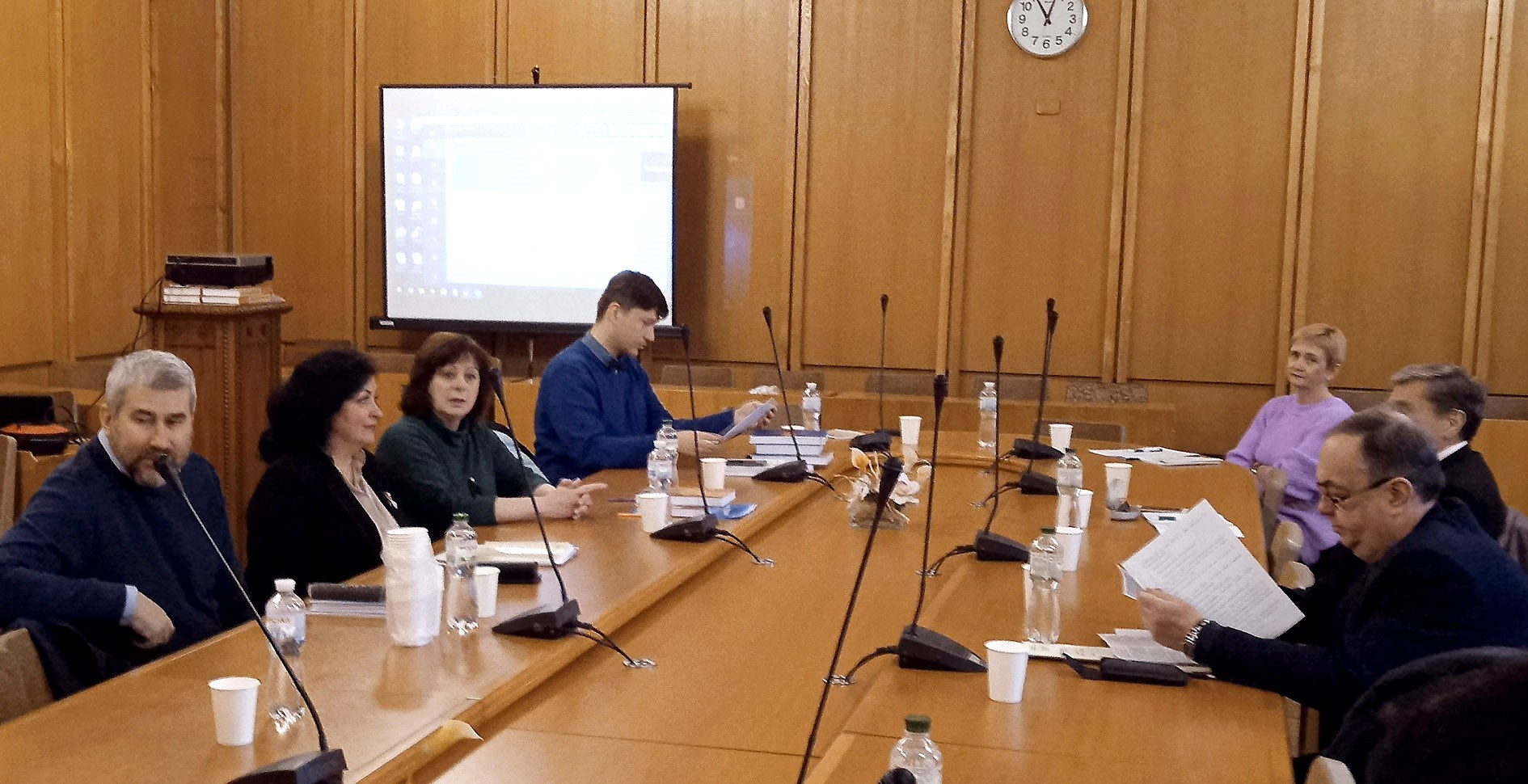
During the work of the scientific conference
Most of the speeches of the participants of the scientific conference were devoted to contemporary events and the role of ideas of union in the processes of social consolidation: “The union of Ukraine in the light of the civilizational analysis of history” – Doctor of Historical Sciences V. Kosmina, “The Jewish community and the unity of Ukraine: the challenges of today. Ukrainian Jews in the struggle against Russian aggression” – a leading researcher of the Department of Ethnopolitics of the Kuras Institute of Political and Ethnic Studies of the National Academy of Sciences of Ukraine, Candidate of Historical Sciences A. Podolskiy, “Decentralization in Ukraine: Tests by War” – Candidate of Historical Sciences, Senior Researcher of the Department of Theory and History of Political Science of the Kuras Institute of Political and Ethnic Studies of the National Academy of Sciences of Ukraine, M. Gorbatyuk, and others. O. Yaremchuk, Doctor of Psychological Sciences, Leading Researcher of the Institute of Social and Political Psychology of the National Academy of Sciences of Ukraine, devoted his speech to the political and psychological problems of the consolidation of Ukrainian society at the current stage of state formation.
In the online format, the Head of the Department of Political Science of the Ivan Franko National University of Lviv, Doctor of Political Sciences, Professor A. Romanyuk (“Transformations of Ukraine’s political parties on the eve of the war: what’s next?“), Leading Researcher of the Department of Theory and History of Political Science of the Kuras Institute of Political and Ethnic Studies of the National Academy of Sciences of Ukraine, Doctor of Political Sciences V. Grynevych (“The Unity of Ukrainian Lands in Stalin’s Style (1939-1945)“), Senior Researcher of the Department of Theory and History of Political Science of the Kuras Institute of Political and Ethnic Studies of the National Academy of Sciences of Ukraine, Candidate of Political Sciences O. Zorych (“The concept of unity as a factor of social transformations“) and others. The speeches of the Deputy Director for scientific work of the Institute of Social and Political Psychology of the National Academy of Sciences of Ukraine, Doctor of Psychological Sciences, Corresponding Member of the National Academy of Sciences of Ukraine L. Naidyonova and Professor of the State University of Infrastructure and Technologies, Doctor of Psychological Sciences M. Naidyonov devoted their speeches to issues of socio-psychological components of modern socio-political processes.
The scientific conference was moderated by the Deputy Director for Scientific Work of the Kuras Institute of Political and Ethnic Studies of the National Academy of Sciences of Ukraine, Doctor of Political Sciences, Professor Yu. Shaihorodskyi.
The summaries of the participants’ speeches are planned to be published in the collection of materials of the All-Ukrainian scientific conference “The Unity of Ukraine: History and Modernity”.
The Chief Researcher at the Department of Political Culture and Ideology of our Institute, Doctor of Political Sciences, Volodymyr Kulyk, ordered from KIIS a survey on language and identity with the help of a grant from the Canadian Institute of Ukrainian Studies.
According to Volodymyr Kulyk, the most important change compared to the 2017 survey is a sharp increase in the share of respondents who (say that) speak mainly Ukrainian in everyday life, and a corresponding decrease in the share of Russian language speakers. In December 2022, 41% of respondents said that they communicate only in Ukrainian, another 17% – “in most situations” in Ukrainian, on the other hand, 6% speak only Russian, and mainly Russian – 9% (another 24% said that they use both languages “equally”).
Compared to 2017, the share of full and predominant Ukrainian speakers increased by 8%, and the share of Russian speakers decreased by as much as 11%. The regional distribution is even more impressive: even in the East and South, according to the answers, Ukrainian speakers are now no less than Russian speakers (29% versus 27%).
As for identity, the results of the survey show that compared to 2017 (then, of course, respondents were asked who they “consider themselves to be by nationality”), the share of Ukrainian nationality increased by 7%, while the share of Russian nationality decreased by 5%, and the share of dual nationality decreased by 2%. Now, even in the South and East, as many as 90% associate themselves with Ukrainian nationality, while five years ago it was only 64%. Judging by these data, Ukraine has, in fact, ceased to be a multi-ethnic state, because untitled nationalities make up only a few percent of the population. Accordingly, ethnopolitics will not play a significant role in the national political process, although it will remain a factor in some regions and in Ukraine’s relations with international organizations that care about minority rights.
The survey was conducted from December 4 to 27, 2022, and 2,005 respondents who lived in Ukraine at that time (within the boundaries controlled by the Ukrainian authorities until February 24, 2022) were interviewed by telephone interviews using a computer. The maximum error of the survey results is 2.4%.
Information about our colleague’s research is posted on the website of the National Academy of Sciences of Ukraine.
More about the results of the study
On January 12-13, 2023, the International Scientific Conference “Democracy in the Process of Changes” was held at Maria Sklodowska-Curie University (Poland). In their speeches, the participants of the conference emphasized that the Russian military aggression became a catalyst for radical changes not only in Ukraine and in the countries that support it in the fight against the enemy, but also in the Russian Federation itself.
At the panel discussion of the conference “Democracy vs. dictatorship in the context of Russia’s war against Ukraine”, the Head of the department of Political institutions and processes of our Institute, Corresponding Member of the National Academy of Sciences of Ukraine, Professor Galyna Zelenko, presented her report on the topic “Russian military aggression as a catalyst for socio-political transformations in Ukraine”.

International scientific conference “Democracy in the process of changes”
For a long time, the speaker noted, socio-political processes in Ukraine developed extremely contradictory. A high level of paternalism, political absenteeism, a rather low level of political culture, and the inability to use the so-called “tools of democracy” were present and hindered the development of democracy. The consequence of these and other phenomena was the radicalization of the political scene, a low level of trust and, accordingly, membership in political parties, public organizations, public anomie and distrust of state authorities, sometimes polar opposite foreign policy orientations, etc.
However, during the years of the Russian-Ukrainian war, which began in 2014, significant changes occurred in the political identity of Ukrainians. So far, socio-political divisions caused by the dilemma of national, linguistic or religious (church) self-identification, and the choice of foreign policy priorities have significantly weakened. These changes enabled, along with the existing clan-oligarchic system, the country’s dynamic movement in the direction of Euro-Atlantic structures.

During the work of the international conference
The speaker noted that now there is every reason to talk about the completion of the process of forming a political nation in Ukraine, about significant gains in the development of social capital, which is based on institutional trust, caused in particular by such a phenomenon as volunteerism, etc. That is, G. Zelenko emphasized, there have been significant qualitative shifts in the socio-cultural sphere, thanks to which a peculiar window of opportunities is being formed for qualitative changes in the political regime in Ukraine. At the same time, according to the speaker, war is primarily a terrible human and colossal economic loss, which forms potential lines of socio-political divisions and which should already be the subject of accurate study.
Doctor of Political Sciences, Senior Researcher of the Department of Global Political Development Problems of the Kuras Institute of Political and Ethnic Studies of the National Academy of Sciences of Ukraine, Sergiy Rymarenko, who conducts research at the University of Sydney under the SAR program, gave a speech “Ethnic relations and democratization” at the scientific seminar “Justice, Peace and Conflict” of the School of Social and Political Sciences of the University of Sydney.

The speaker touched on several topics: “Can new European models of liberal pluralism contribute to the democratization and stabilization of Ukraine?”, “Democratic transitions and ethnicity”, “Theoretical foundations of Western models of minority rights. Fundamental principles and practices”.
Researchers from Australia, the USA, Chile, Germany and other countries took part in the work of the scientific seminar.
Kuras Institute of Political and Ethnic Studies of the National Academy of Sciences of Ukraine became a member of the European Consortium for Political Research (ECPR). ECPR is a Charitable Non-Governmental Organization (CIO) registered and based in the UK.
The European Consortium for Political Research (ECPR) was founded in 1970 by a group of twelve European universities with the aim of overcoming national barriers and creating a strong international community of scholars in Europe. The consortium is the leading scientific society of political scientists in Europe.
Currently, the Consortium has more than 300 institutional members, uniting tens of thousands of scientists and representing almost 50 countries of the world.
ECPR unites political scientists in a global network for the development of researches in the field of political science and the promotion of international scientific cooperation by:
- conducting methodological and professional training to promote the career growth of graduate students and researchers;
- providing forums for the development of researches and the formation of cooperation networks;
- issuing grants and ensuring the possibility of funding for scientists;
- managing a prestigious publishing program that shares the latest researches with the widest possible audience.
The organization is headed by Jean Blondel and Stein Rokkan.
ECPR official website: https://ecpr.eu/
By the Order of the Ministry of Education and Science of Ukraine dated December 23, 2022 No. 1166 at the Kuras Institute of Political and Ethnic Studies of the National Academy of Sciences of Ukraine formed a specialized academic council for awarding the scientific degree of Doctor of Sciences D 26.181.01.
Specialization of the specialized scientific council of the Institute:
- 23.00.01 – Theory and history of political science.
- 23.00.02 – Political institutions and processes.
- 23.00.05 – Ethnopolitics and ethno-state studies.
Scientific journal «POLITICAL STUDIES»
Новини
Оголошення

